TRANSMISSION // 2611.34015v1
AI Stories Look More Similar Under Shared Prompts—but the Baseline Matters
Source published
A study finds that stories from five language models are more alike in coded features when they answer the same prompt than when compared across similar prompts. The difference is relative to an observational baseline, and its size depends on how prompts and story features are measured.
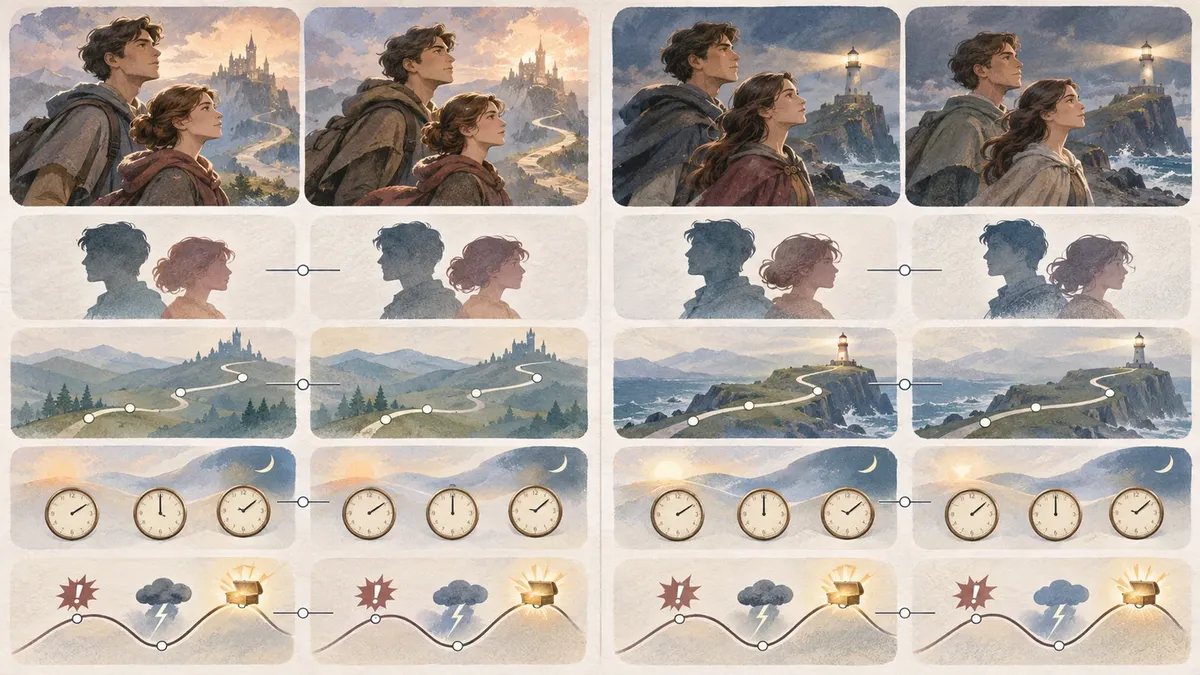
When different language models answer the same story prompt, their outputs may resemble one another partly because the prompt gives them common ground. A study compares that similarity with stories generated from similar—but not identical—prompts. It finds a measurable difference, while emphasizing that this comparison does not isolate a causal effect of prompts.
Imagine, hypothetically, a prompt asking for a story about a traveler stranded far from home. It would already suggest some characters and events. If several language models produced similar stories, that resemblance could reflect the shared instruction, the models’ outputs, or both. Mehdy Sedaghat Payam’s study examines this problem using stories from the StoryScope corpus. It does not estimate what the same models would write without prompts; instead, it compares two prompt conditions.
The analysis covers 51,240 stories generated by five models—GPT-5.4, Claude Sonnet 4.6, DeepSeek V3.2, Kimi K2.5 and Gemini 3 Flash—for 10,248 common prompts. The researcher did not generate new stories. Instead, the study compares existing stories using 213 coded narrative features in seven dimensions, including characters and relationships, plot and events, perspective, revelation and chronology.
Comparing same-prompt and matched-prompt stories
For each prompt, the study measures how different two models’ stories are across the coded features. It compares that distance with distances between stories from the same pair of models when one responds to the original prompt and the other responds to a different, semantically similar prompt. In the primary analysis, the alternative prompts are the three closest distinct prompts according to a text-embedding model.
The feature set mixes binary, categorical, numeric, ordered and multi-select values. The study uses a procedure similar to Gower’s distance, with study-specific rules for the different data types. When a feature value is missing for either story, that feature is left out of the distance calculation rather than filled in.
The resulting Residual Convergence Index (RCI) describes how much lower the same-prompt distance is than the matched-prompt distance. An RCI of 0.40 means the first distance is 40% lower than the second. “Residual” here means a contrast relative to the selected matched-prompt controls—not a prompt-independent tendency or a causal estimate of prompt influence.
The study also tests a semantic mask as a sensitivity analysis. It excludes the top 1% of prompt-feature pairs by embedding similarity, using a specified cutoff, from the relevant distance calculations. This is an imperfect way to probe prompt-feature overlap, not a definitive detector of which narrative features a prompt requires. In an audit of 420 prompt-feature pairs, the mask achieved an F1 score of .813 against labels supplied by the author. Near its decision threshold, accuracy was .621, and 53 of 76 disagreements occurred in that borderline group. Because the audit sample was deliberately stratified, it does not estimate the mask’s accuracy across the full corpus.
A measurable contrast, with limits
Across the seven dimensions, the average RCI was .409 without masking and .406 with the main mask. All seven dimension-level estimates remained positive after masking. In this dataset and under this comparison method, stories by different models responding to the same prompt were more alike in the measured features than stories compared across similar-but-distinct prompts. Excluding the most prompt-feature-similar comparisons changed the overall estimate little.
The contrast also remained positive when the researchers used a different method to select matched prompts or varied the mask threshold. These checks reuse the same underlying feature extraction and observational design; they are not independent demonstrations that the result generalizes. In a stricter comparison using only prompts with a very close distinct neighbor, the mean RCI was .250 for 690 prompts. That subset differs from the full sample, so the change cannot be attributed to prompt similarity alone.
A small recoding analysis using author-reviewed values for 14 features also found a positive overall RCI, but a smaller one. In a same-sample comparison involving 40 prompts, the mean prompt-level RCI was .380 using StoryScope’s feature values and .187 using the author-reviewed values. These estimates come from a limited recoding exercise, not the full corpus. Results across individual narrative dimensions were less consistent, and the difference does not establish which coding better represents the stories.
The matched-prompt baseline is observational: prompts that are semantically similar are not necessarily equivalent in the narrative requirements they impose. Exploratory author audits of prompt alignment were small and did not establish a separate alignment effect beyond embedding similarity. A positive RCI therefore says that distances differed under these selected comparisons; it does not show that shared prompts caused the difference or that the models would converge in their absence.
The study examines five fixed model sources and does not compare them with human-written stories produced under the same prompts. Some generation settings are unavailable, and the analysis relies on StoryScope’s feature definitions. The author was the sole annotator, used preliminary AI-assisted labels, and reports that original coding records were not fully preserved. Code and supplementary materials are reported as available. The paper is an arXiv preprint; the supplied source does not establish its review status. Its findings are best understood as evidence about one corpus, one set of models and particular measurement choices—not a general measure of AI-story similarity.
- large language models
- AI-generated stories
- narrative similarity
- prompt conditioning
- StoryScope
- measurement validity
Reviewed cross-references
These connections were reviewed by a model, not independently fact-checked by a human. Similarity does not imply agreement; consult the original papers and the evidence below.
When AI gets a label wrong, the rulebook may need an audit
Supporting evidence: Both studies show that conclusions about AI outputs depend partly on how they are measured: in StoryScope, author-reviewed feature values produced a lower average prompt-level RCI than the original values (.187 versus .380), while the codebook audit found that targeted rule revisions reduced diagnosed annotation errors on held-out data. These are complementary examples, not a direct comparison: one measures narrative similarity in stories from five models, the other evaluates codebook-based annotation in two social-science domains.
Model review: · openai-codex/gpt-6-luna
Evidence and provenance
Selected excerpts, not complete papers. PDF extraction can omit figures or damage equations, tables and reading order; sources may be preprints.
2611.34015v1 — Original paper
Excerpt reference:
static/papers/2611.34015v1.md:1195-1214
Basis: Paper text
Source SHA-256:5dca48c2267db9b6cb14fbbd787e3c07124dc8411b5e7ff8bfc75fc2e952b51d2611.08846v1 — Original paper
Excerpt reference:
static/papers/2611.08846v1.md:13-78
Basis: Paper text
Source SHA-256:ff8b5c1576d4f2fb06f35f1bf7819eb18f913d726e19cb4f8f4b01c1f3545b63
Related reading
Automatically matched by shared topic keywords. These links do not imply that the sources agree or establish a consensus.
When AI gets a label wrong, the rulebook may need an audit
Source published
Shared keywords: large language models, measurement validity
Why AI Agents Still Stumble on Complex Tasks
Source published
Shared keywords: large language models
How Moral Concepts Are Organized Inside Language Models
Source published
Shared keywords: large language models
Are large language models street-smart?
Source published
Shared keywords: large language models
Why AI Can Get Civil Time Wrong
Source published
Shared keywords: large language models