TRANSMISSION // 2611.34004v1
When a classical shortcut crosses a quantum boundary
Source published
The discrete truncated Wigner approximation can locate signs of ordering in some Ising-model simulations, but its correlations do not follow the quantum transition’s universal scaling.
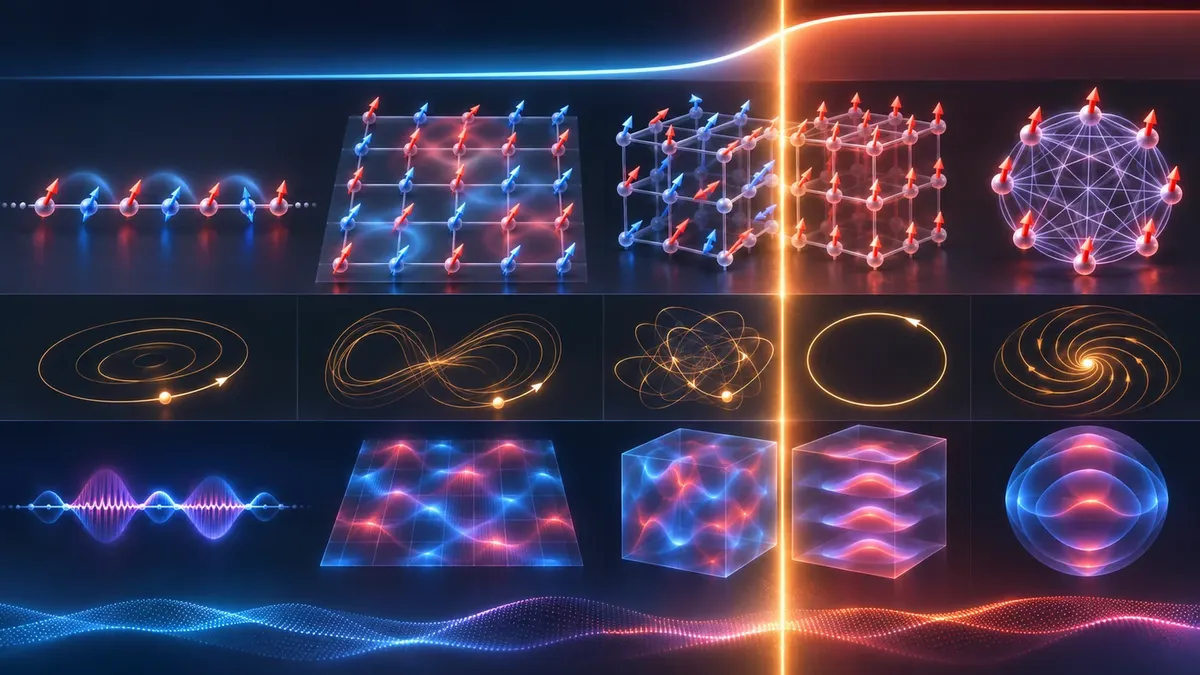
A fast way to simulate many interacting spins can be useful even when it is not fully quantum. But what happens when that shortcut models a system crossing a quantum phase transition? A preprint tests the discrete truncated Wigner approximation across several versions of the transverse-field Ising model—and finds that its reliability depends strongly on how the spins are connected.
A shortcut put to a demanding test
Quantum computers and simulators can prepare large collections of interacting spins and drive them through phase transitions. Predicting their behavior on ordinary computers is difficult, especially in two or three dimensions. One practical approximation, the discrete truncated Wigner approximation (DTWA), represents quantum spins with classical vectors. Randomly chosen starting vectors encode some quantum fluctuations, after which the vectors follow classical equations of motion.
That approach can make large simulations more manageable. But a transition is a demanding test: correlations should grow in a characteristic way as a system is driven through its critical point. Can DTWA reproduce that growth, or does its classical description change the answer?
Tuan-Vu Truong and Hoang-Long Nguyen examine this question in a preprint using the transverse-field Ising model. They compare slow linear ramps and faster ramps in a one-dimensional chain, square and cubic lattices, and an all-to-all-connected system. Their checks include exact quantum calculations for the chain and all-to-all case, quantum Monte Carlo (QMC) estimates of lattice critical points, and near-exact results for two-dimensional dynamics. They track spin correlations, an order parameter, and correlation length—the distance over which spins tend to align.
A different picture in each geometry
On the one-dimensional chain, DTWA fails to reproduce the quantum growth of correlations during slow ramps. Its correlation length levels off after only a few lattice spacings, while the exact result continues to grow with slower ramps. For sufficiently slow ramps, DTWA also gives a nearest-neighbor correlation larger than one. That exceeds the quantum-mechanical bound for this observable, making it a clear warning that the approximation is no longer trustworthy. The warning is not a general accuracy test: staying below the bound would not, by itself, prove the result is correct.
The authors connect the chain’s behavior to classical thermalization. In their interpretation, random initial conditions act like a source of heat, and the classical spins relax toward a thermal state with a finite effective temperature. Slower ramps do not reduce that fitted temperature to zero. A one-dimensional system with short-range interactions cannot order at any finite temperature, consistent with the limited correlations DTWA produces. This explanation is supported by comparisons with classical thermal states, but the effective temperature is fitted rather than derived from first principles.
In two and three dimensions, DTWA does build order. On the square lattice, its ordering behavior begins around the QMC critical point, but the results do not establish long-range order for the system sizes and ramp times studied. On the cubic lattice, order rises sharply just after the QMC critical point and becomes strong for slower ramps. In both cases, correlation growth does not follow the Kibble–Zurek scaling expected for the quantum transition. The square-lattice correlations grow more slowly than expected at the end of slow ramps; the cubic-lattice correlations grow faster in the reported comparisons. The authors distinguish detecting the onset of order from reproducing the transition’s universal dynamics.
The all-to-all model is the strongest case for DTWA. Every spin interacts with every other spin, and the approximation closely follows the exact growth of the order parameter throughout the ramp. This is consistent with the expectation that TWA approaches exactness in the mean-field limit: corrections are of order 1/N, so finite systems are not necessarily exact.
What the result does—and does not—say
The study suggests a practical caution: in the square- and cubic-lattice settings examined, DTWA may help indicate roughly where ordering begins, but it should not be relied on for precise critical locations or quantum critical exponents. A classical-looking result can still be informative, but it is not automatically a faithful account of quantum dynamics.
The authors note open questions. The effective temperature is fitted to match a nearest-neighbor correlation, and the study does not track it throughout the ramp. Its relationship to the transition seen in DTWA remains unresolved. The authors also lack a quantitative theory for the observed correlation-growth rates, and the role of classical chaos has not been demonstrated directly. Moreover, dimension and number of neighbors change together in the lattice comparisons, so those results alone cannot isolate which feature explains the trend.
This account is based on the authors’ arXiv preprint, version 1, not an independently established consensus. The work does not show that DTWA is unreliable for every spin system or every use. Its narrower message is that success in one geometry—or for one observable—does not guarantee that a semiclassical method captures universal quantum dynamics.
- discrete truncated Wigner approximation
- quantum phase transition
- transverse-field Ising model
- Kibble–Zurek scaling
- spin dynamics
- semiclassical simulation
Reviewed cross-references
These connections were reviewed by a model, not independently fact-checked by a human. Similarity does not imply agreement; consult the original papers and the evidence below.
Can NMR Track Quantum Information Spreading Through Proteins?
Shared method: Both papers use the discrete truncated Wigner approximation (DTWA): the origin paper evaluates it for transverse-field Ising ramps, while White et al. benchmark it among methods for protein-NMR OTOCs. The systems, observables and study questions differ, so this shared method does not establish comparable accuracy or support transferring either paper’s conclusions to the other setting.
Model review: · openai-codex/gpt-6-luna
Evidence and provenance
Selected excerpts, not complete papers. PDF extraction can omit figures or damage equations, tables and reading order; sources may be preprints.
2611.34004v1 — Original paper
Excerpt reference:
static/papers/2611.34004v1.md:615-724
Basis: Paper text
Source SHA-256:9c7c46f408c7cec41f01540f47ed997f2e9e30c7a4c81ef0956618c8ed280ef72611.23213v1 — Original paper
Excerpt reference:
static/papers/2611.23213v1.md:212-281
Basis: Paper text
Source SHA-256:95b632c12d9f6aedf1f0bf00974cb2db28db6d540c85d371212da3331c44675b
Related reading
Automatically matched by shared topic keywords. These links do not imply that the sources agree or establish a consensus.
A hybrid method brings huge spin baths within reach
Source published
Shared keywords: semiclassical simulation
When Weaker Quantum Fluctuations Make a Gap Grow
Source published
Shared keywords: quantum phase transition
Why Quantum Gibbs Samplers Can Be Slow
Source published
Shared keywords: transverse field ising model
Can NMR Track Quantum Information Spreading Through Proteins?
Source published
Shared keywords: spin dynamics
A four-qubit counterexample challenges a quantum-circuit depth conjecture
Source published
Shared keywords: transverse field ising model