TRANSMISSION // 2611.33993v1
How a robot can decide when not to correct itself
Source published
Aegis-VLA forecasts moving objects, proposes bounded action changes and uses a learned gate to control them. It improved task success in simulation; real-robot tests remain future work.
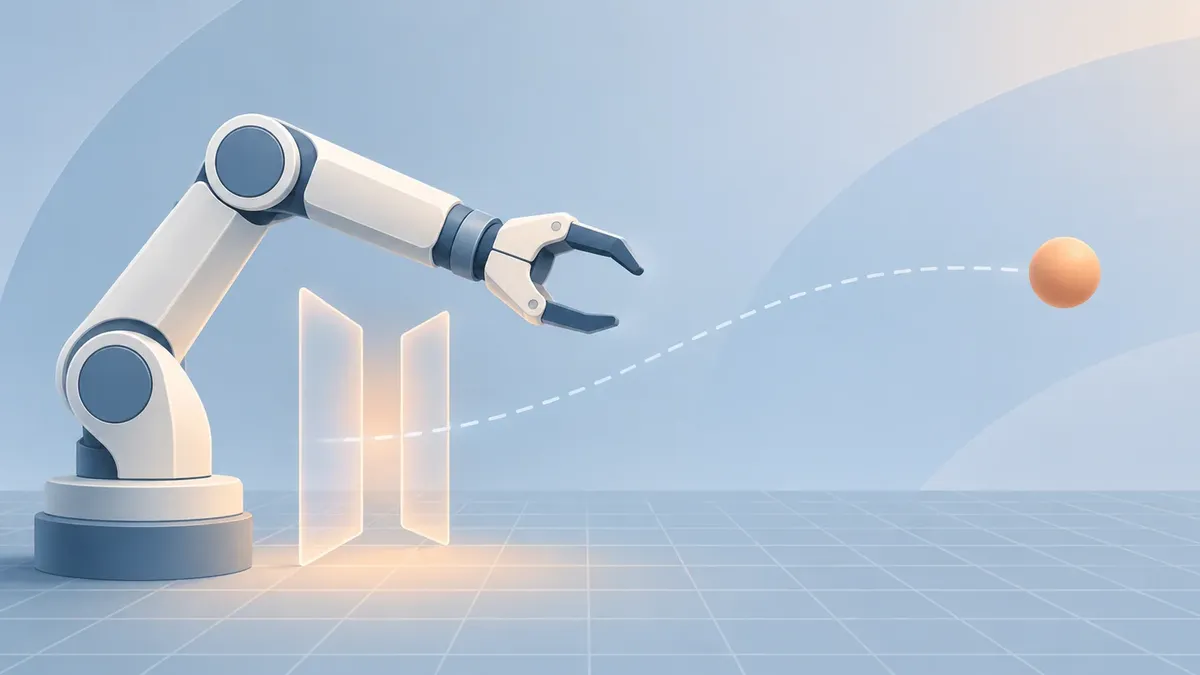
A moving target may shift before a robot’s action takes effect. But a correction is not always helpful: the original plan may already account for the motion. Aegis-VLA, tested in simulation, pairs proposed action changes with checks that determine whether to admit and how strongly to apply them.
A robot reaching for a moving object must account for where it may be when the action takes effect. But a forecast alone cannot tell whether changing the robot’s plan will help: an extra adjustment could undermine a plan that already accounts for the target’s motion. Aegis-VLA is designed to propose corrections and regulate their use.
The researchers describe Aegis-VLA as a vision-language-action (VLA) framework. It adds forecasting, refinement and gating modules to a policy that produces actions from images, instructions and robot state.
Forecasting, then deciding
The system processes recent images from an external camera and a wrist camera, together with proprioceptive history: measurements of the robot’s own state, including end-effector poses. Its trajectory world model combines basic motion extrapolation with learned adjustments to forecast the object’s future position and estimate positional uncertainty.
A separate module compares two forecasts of the end effector—the robot arm’s working tip. One uses observation history; the other also takes the policy’s proposed arm actions into account. Differences between those forecasts help generate bounded corrections to the arm’s action sequence. The system retains the policy’s original gripper commands.
A reliability gate controls what happens next. During training, its learned selector is supervised using whether a proposed action reduces error against a demonstrated action relative to the base action, subject to specified improvement and forecast-accuracy criteria. This is not feedback from task success. At inference, history-validity checks and the selector determine admission; predictive uncertainty can veto or attenuate a correction, while predicted object–end-effector proximity can suppress its strength. Rejected corrections leave the corresponding base actions unchanged. The selector score is not a calibrated probability of task success.
The action-generating backbone remains frozen; only the added modules are trained, with about 2.45 million trainable parameters. A frozen backbone does not guarantee unchanged behavior, because the added modules can alter executed actions.
Results in simulation
The researchers evaluated Aegis-VLA on the Dynamic Object Manipulation benchmark using a simulated Franka Panda arm in Isaac Sim. The reported evaluation covered 1,800 trials across 90 configurations. Aegis-VLA completed 56.72% of tasks, compared with 45.44% for a reproduced DynamicVLA baseline—a difference of 11.28 percentage points. It scored higher in eight of nine evaluation dimensions and matched the baseline on long-horizon sequencing.
The paper also reports a shorter mean end-effector path: 1.87 metres, compared with 2.41 metres. Mean nominal episode duration was 8.43 seconds for both methods at the reported precision. These averages include failed trials, so they do not establish that successful episodes alone were more efficient.
In a separate offline inference benchmark, measured on one RTX 4090 at batch size one, mean time per 20-action chunk rose from 227.06 to 239.31 milliseconds, an overhead of 5.40%. The timing used prepared, GPU-resident inputs and excluded input preparation, data transfers, communication and execution. It is not a measure of total real-world response time.
Ablations provide useful but limited evidence about the design. A plain residual adapter—without trajectory predictors, discrepancy inputs or gating—scored 22.00%, below the baseline. A discrepancy-guided refiner without a gate scored 48.11%; adding object forecasting brought that independently trained ungated variant to 50.56%. An adapted gate configuration scored 51.50%, and the full system scored 56.72%. In a separate inference test using the full model’s residuals, bypassing learned admission reduced success. These are reported single-run settings; the authors say smaller ablation differences warrant repeated runs. The comparisons therefore do not establish statistical significance or show that every admitted correction helps.
What remains unknown
The evaluation is simulation-based. Testing on physical robots and under shifts in target motion, visibility and execution dynamics is future work identified by the authors. They also note that matching a demonstration’s action is not the same as succeeding at a task: a different action may work, while a closer match may not improve contact timing or later steps. The unchanged long-horizon sequencing score may reflect the system’s short-horizon focus, the paper suggests.
This article is based on an arXiv preprint. The supplied source does not establish its peer-review status, so the results should be understood in the context of the evidence reported: performance on a simulated benchmark, with single-run ablation settings and physical-robot testing still to come. The findings do not establish reliability in everyday robotic environments.
- robotics
- robot manipulation
- vision-language-action models
- moving objects
- world models
- simulation
Reviewed cross-references
These connections were reviewed by a model, not independently fact-checked by a human. Similarity does not imply agreement; consult the original papers and the evidence below.
How a robot hand uses touch when the lighting changes
Shared method: Both frameworks use predictive evidence to regulate whether or how strongly proposed action refinements are applied: Aegis-VLA gates bounded arm corrections using motion uncertainty and anticipated proximity, while TipDex-VTLA gates bounded feature corrections using visual action reliability and tactile forecast discrepancies. This is a methodological parallel, not evidence of equivalent performance; the systems use different signals and address different manipulation settings.
Model review: · openai-codex/gpt-6-luna
Evidence and provenance
Selected excerpts, not complete papers. PDF extraction can omit figures or damage equations, tables and reading order; sources may be preprints.
2611.33993v1 — Original paper
Excerpt reference:
static/papers/2611.33993v1.md:79-140
Basis: Paper text
Source SHA-256:b560933d42df14e386ee741e032426b7d9800326b7d91320ce5677d9bb3dba6e2611.25683v2 — Original paper
Excerpt reference:
static/papers/2611.25683v2.md:112-174
Basis: Paper text
Source SHA-256:9dd80231e3beca73fe2c8da86ddb69780276a361330cc5915b73eef1e6bcb9e8
Related reading
Automatically matched by shared topic keywords. These links do not imply that the sources agree or establish a consensus.
How a robot can learn from its own attempts
Source published
Shared keywords: robot manipulation, vision language action models
When a robot misses a grasp, force feedback can cue a retry
Source published
Shared keywords: robot manipulation, vision language action models
How robots can keep the visual details that matter
Source published
Shared keywords: robot manipulation, vision language action models
Teaching Robot AI to Focus on Motion, Not Scenery
Source published
Shared keywords: robot manipulation, vision language action models
A robot backdoor built from just 1% poisoned demonstrations
Source published
Shared keywords: robot manipulation, vision language action models