TRANSMISSION // 2611.33989v1
How Low-Beta Space Shocks Reshape Electrons
Source published
Two-dimensional simulations at the physical proton-to-electron mass ratio trace how a particular low-beta shock may produce electron beams upstream and flattened velocity distributions downstream.
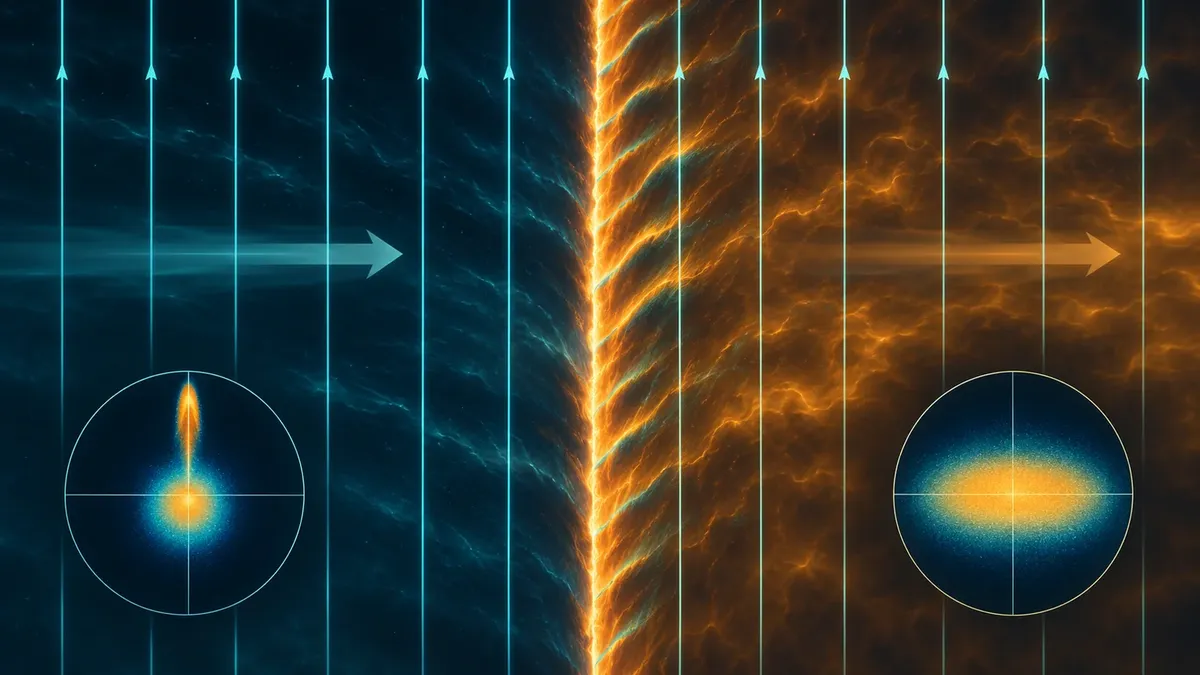
When plasma crosses a shock, electric and magnetic fields can reorganize how its electrons move. A simulation study investigates two patterns seen around quasi-perpendicular shocks—and proposes different processes that could produce them.
In a collisionless plasma, particles rarely collide directly; instead, electric and magnetic fields govern much of their interaction. At a shock, those fields can accelerate electrons and reshape their velocity distributions. But how field-aligned electron beams form ahead of some shocks, and why flatter distributions appear behind them, has remained unsettled.
A new study investigates these patterns in simulations of a low-beta, quasi-perpendicular shock. “Low beta” means that the plasma’s thermal pressure is small compared with its magnetic pressure. “Quasi-perpendicular” describes the angle between the incoming magnetic field and the shock normal: the field is nearly at right angles to the normal, and thus nearly parallel to the shock front. The modeled conditions are relevant to some heliospheric shocks, including those associated with coronal mass ejections close to the Sun.
The researchers used two-dimensional, fully kinetic particle-in-cell simulations. This computational method represents plasma with particles and calculates how they respond to electromagnetic fields. The simulations used the physical proton-to-electron mass ratio, 1836 to 1. One longer, lower-resolution run followed the shock’s evolution; a shorter, higher-resolution run examined electron-scale details. Both used the same upstream conditions, including a magnetic-field angle of 85 degrees to the shock normal and a total plasma beta of 0.02.
Whistler waves and an upstream beam
In the detailed simulation, electromagnetic turbulence in the shock transition region had properties consistent with whistler-mode waves. The researchers attribute these waves to the modified two-stream instability, or MTSI, driven by reflected ions moving relative to electrons. The wave properties, propagation direction and estimated frequencies support this interpretation; they do not constitute an experimental measurement of the instability’s cause.
The simulated electron distribution was nearly Maxwellian—a familiar thermal pattern—in a sampled region farther upstream. Closer to the shock, a field-aligned beam appeared. By tracing representative electrons, the researchers found trajectories consistent with shock-drift acceleration (SDA): electrons interact with the shock’s changing magnetic field and can be reflected back upstream. In the traced example, the electron’s speed along the magnetic field increased as it moved away from the shock.
The authors note that earlier simulations using a reduced ion-to-electron mass ratio emphasized different instabilities and beam-formation mechanisms. At the physical mass ratio, they find conditions favoring electromagnetic whistler turbulence and interpret the upstream beam as mainly produced by SDA. However, their simulations were not a matched set of runs differing only in mass ratio. The study therefore does not isolate the mass ratio’s effect through a direct controlled comparison.
A flatter distribution downstream
Farther through the simulated shock, the electron velocity distribution broadened and developed a relatively flat core along the magnetic field. The researchers propose that nonuniform acceleration by the parallel electric field helps create this pattern. Different electrons encounter field regions with different strengths and polarities, and remain in them for different lengths of time. A particle may speed up in one region and slow down in another. The resulting variation in velocity changes can spread electrons across parallel velocities and flatten the distribution.
The evidence includes traced particle paths and a statistical analysis of selected tracer electrons. The relationship between accumulated exposure to the magnitude of the parallel electric field and the size of an electron’s net parallel-velocity change was weakly positive. The quantities measure different things: exposure adds field magnitudes regardless of polarity, while the net change can reflect cancellation between fields pointing in opposite directions. The authors interpret the trajectories and distribution changes together as support for their explanation, not as evidence that field exposure alone determines an electron’s outcome.
Scope and limitations
These findings concern a specific simulated regime, not every space shock. The shock’s modeled beta, speed and magnetic-field angle constrain how broadly the results apply. The simulation’s limited transverse size restricts the structures it can represent, and its two-dimensional geometry excludes some possible wave behavior. The longer run covered less than one upstream ion gyroperiod, so evolution across multiple such periods remains untested. The authors identify larger three-dimensional simulations and controlled scans of parameters as important next steps.
The supplied manuscript states that the article has been accepted for publication in The Astrophysical Journal. That status is reported in the manuscript but is not independently verified here. The results are best understood as a proposed explanation for electron distributions in the simulated conditions, rather than a universal account of electron acceleration at shocks.
- collisionless shocks
- plasma simulations
- electron acceleration
- whistler waves
- particle-in-cell
- space physics
Related reading
Automatically matched by shared topic keywords. These links do not imply that the sources agree or establish a consensus.
How shock-driven plasma jets may spark magnetic reconnection
Source published
Shared keywords: collisionless shocks
How Magnetic Reconnection May Heat Ions Behind Shock Waves
Source published
Shared keywords: collisionless shocks
How magnetized shocks could shape fast radio bursts
Source published
Shared keywords: plasma simulations
How energetic particles behave ahead of space shocks
Source published
Shared keywords: space physics
Late solar radio bursts point to particle acceleration after a flare’s peak
Source published
Shared keywords: electron acceleration