TRANSMISSION // 2611.33987v1
A proposed route to preparing quantum many-body scars
Source published
A theoretical algorithm uses Dicke states to prepare exact and asymptotic scar states in three spin-1 models.
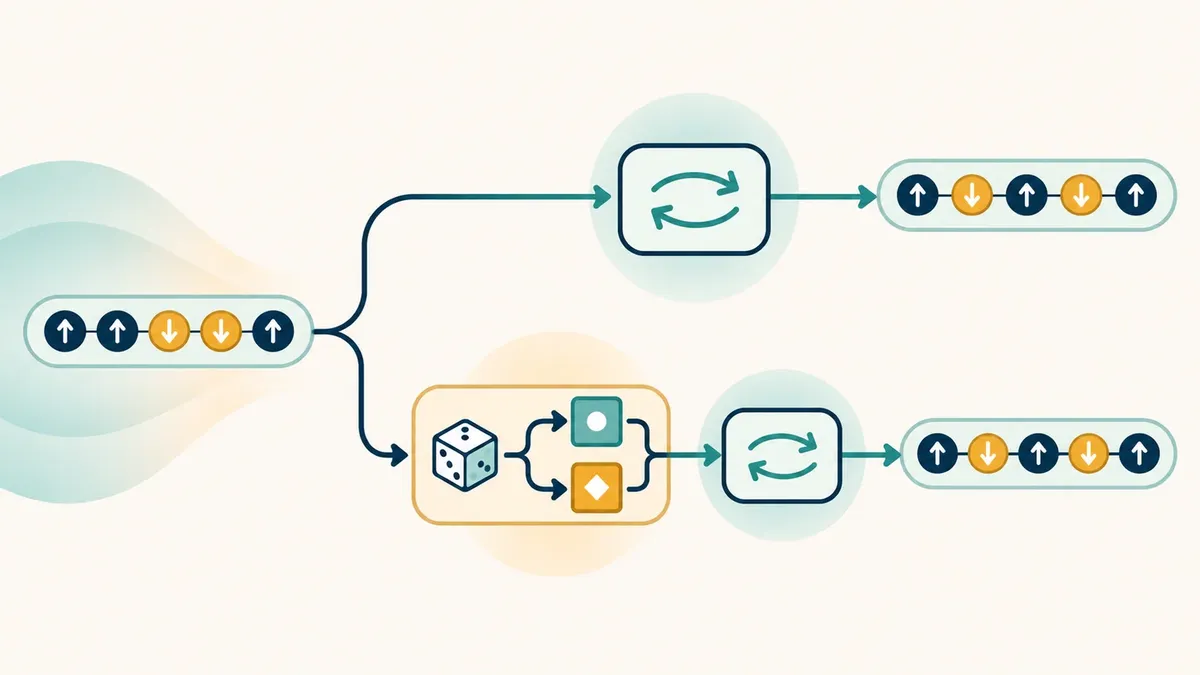
How can researchers prepare particular quantum many-body scar states for study? A preprint proposes a shared algorithmic framework for exact and asymptotic targets in three spin-1 models, using Dicke states as starting points.
Preparing a chosen quantum state is an important step in studying its behavior on a quantum simulator. Yuki Asari, Masaya Kunimi and Tetsuro Nikuni propose an algorithm for preparing exact and asymptotic quantum many-body scar (QMBS) states in three models: the spin-1 XY model, a domain-wall-conserving model and an Onsager scar model.
The abstract focuses on the preparation problem: how to construct these target states in a quantum-computing framework. It does not, by itself, establish broader claims about scar states’ place in the energy spectrum or their dynamics, so those questions are outside the evidence available here.
A shared starting point, two procedures
The framework uses model-dependent isometries—mathematical maps between state spaces. According to the abstract, these maps connect exact scar states to Dicke states, and connect target asymptotic scar states to gapless magnon excitations of a spin-1/2 ferromagnetic Heisenberg chain.
Both procedures start from Dicke states, but then differ. For exact QMBS states, the proposed procedure is direct: prepare a Dicke state, then apply the inverse of the relevant isometry to obtain the target state in the physical chain.
For asymptotic QMBS states, the algorithm adds a stage before applying the inverse isometry. It uses block encoding to prepare the corresponding magnon excitation from a Dicke state to a prescribed fidelity. Block encoding is a technique for representing an operator within a larger unitary operation. The inverse isometry then maps the prepared state to the target chain.
A bound on probabilistic preparation
The block-encoding step is probabilistic. The authors report that, at fixed target fidelity, its success probability has a positive lower bound independent of system size and scar index. They infer that a constant number of amplitude-amplification rounds suffices. Amplitude amplification is a quantum procedure that can increase the success chance of a probabilistic step.
This is a theoretical claim about a specific part of the proposed algorithm. It does not establish that the whole procedure is straightforward to run on current hardware. The abstract provides no numerical circuit costs, hardware requirements or implementation-error analysis, so practical resource demands cannot be assessed from the supplied evidence.
The authors say the algorithm could enable systematic studies of nonergodic dynamics on programmable quantum simulators. Its stated scope is the three models named above and their associated exact and asymptotic scar states; the abstract does not claim a method for all scar states.
What remains uncertain
This account is based on the abstract rather than a full-text assessment. The abstract does not give the detailed derivations, circuit constructions or assumptions behind the isometries, and it does not mention numerical or experimental demonstrations. That does not establish what the full paper may report. The source is an arXiv preprint, and the supplied material does not establish peer-review status; its claims should be treated as a research proposal, not as a validated hardware result.
- quantum many-body scars
- Dicke states
- quantum state preparation
- block encoding
- magnons
- quantum simulators
Related reading
Automatically matched by shared topic keywords. These links do not imply that the sources agree or establish a consensus.
Dicke states from every qubit, with no extras
Source published
Shared keywords: dicke states, quantum state preparation
An exact theory explains the speed limits of measurement-driven quantum preparation
Source published
Shared keywords: dicke states, quantum state preparation
When quantum collisions can prepare entangled states
Source published
Shared keywords: dicke states, quantum state preparation
When machine learning meets quantum-state preparation
Source published
Shared keywords: dicke states
How operator size can create quantum scar states
Source published
Shared keywords: quantum many body scars