TRANSMISSION // 2611.33985v1
A sparse 3D model aims to build more reliable molecules
Source published
MolGPAO combines octree-based molecule generation with coordinate refinement and internal candidate ranking. Its authors report improvements on three computational benchmarks; practical usefulness remains untested.
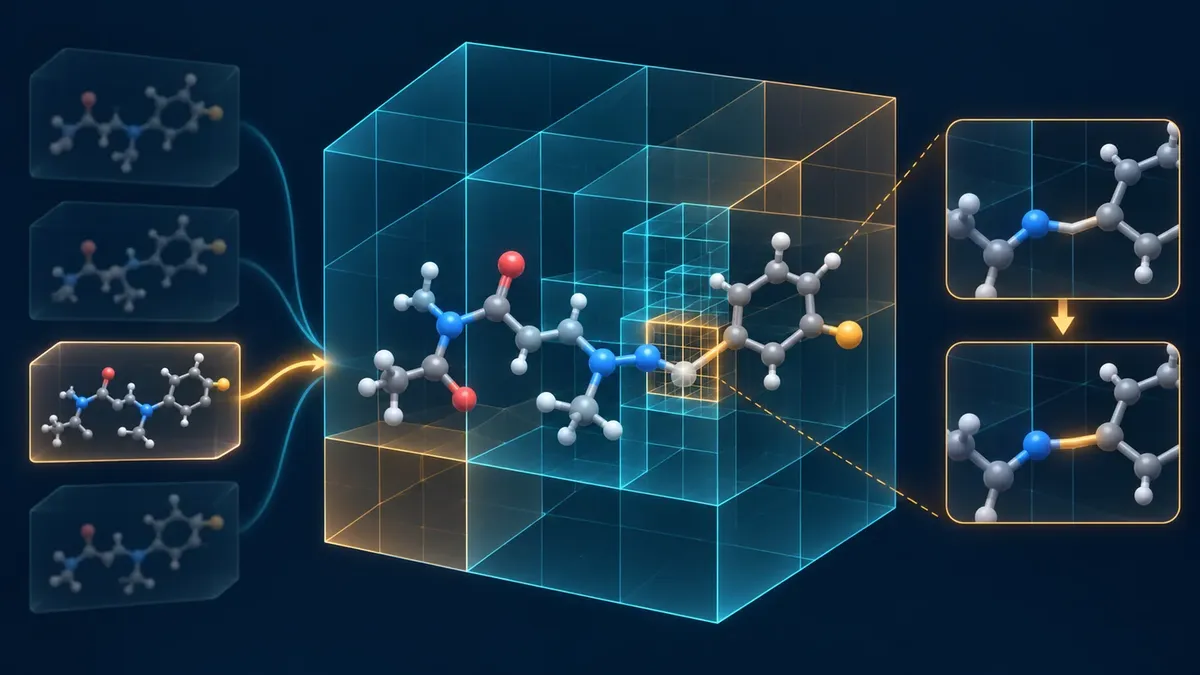
Generating a molecule in three dimensions means getting more than its atoms right: their positions and bonds must form a plausible structure. A new arXiv preprint introduces MolGPAO, a model designed to generate large molecules efficiently while addressing geometric glitches and ranking candidates. Its reported results come from computational tests, not evidence that the molecules work as drugs or materials.
A molecule is not just a list of atoms. Its three-dimensional shape and the way atoms connect help determine its properties, so a useful computer-generated structure must be chemically plausible as well as geometrically sensible. But modeling every possible pair of atoms can become costly as molecules grow. Could a model that builds molecules through a sparse, hierarchical 3D representation be made both faster and more reliable?
A preprint by Shangqian Chen and colleagues at DP Technology presents MolGPAO, an autoregressive model that constructs molecules using an octree. An octree repeatedly divides three-dimensional space into smaller regions, representing occupied regions rather than filling a dense grid. The authors describe this approach as having a computational scaling advantage over methods that explicitly process all atom pairs. In practice, however, earlier octree generation could produce awkward bonds where atoms fell on opposite sides of a division boundary, and could struggle with chemical validity and property targeting.
Building, repairing and ranking candidates
MolGPAO combines several components to address those problems. It conditions generation on a target atom budget without assigning rigid atom quotas to individual regions. It also explores multiple partial structures in stages: an internal critic first ranks coarse spatial layouts, then ranks completed structures after a geometry-refinement step. The system ultimately returns one molecule per prompt, rather than relying on an external model to choose among final candidates.
The refinement component is an equivariant graph model: its predictions are designed to behave consistently when a molecule is rotated or shifted in space. It adjusts atom coordinates to reduce errors associated with octree boundaries, and the model also includes steps intended to reconcile valence—the usual bonding capacity of an atom. The authors say the approach uses no external property-prediction surrogate, reinforcement learning, or machine-learning interatomic-potential relaxation during inference. It does still use internal learned critics and a geometry refiner; “self-contained” does not mean free of learned evaluation.
The authors tested the system on three datasets. On GEOM-Drugs, they generated 10,000 molecules and measured chemical validity and connectivity, among other structural properties. On QM9, they tested generation conditioned on six quantum-chemical properties using a train–test split described as disjoint. On OE62, they targeted a molecular orbital property and evaluated a subset of generated candidates with live quantum-chemistry calculations using PBE0/def2-TZVP.
What the authors report
On GEOM-Drugs, the authors report that the fraction of generated molecules that were both valid and connected rose from 12.7% for the vanilla octree baseline to 86.2% for MolGPAO with its more extensive internal candidate search. They also report 99.83% atom-level stability for that configuration. These are distinct measures: a high atom-level score does not mean every complete molecule is valid and connected.
For molecules with 100 atoms, the paper reports that single-pass MolGPAO ran 7.3 times faster than the tested 100-step FlowMol setup and had a higher valid-and-connected yield: 22.8% versus 14.0%. With a more extensive internal search, MolGPAO achieved a 27.6% yield and was 1.65 times faster than FlowMol. These results apply to the authors’ hardware, settings and benchmark—not necessarily to other implementations or workloads.
On QM9, the authors report that one MolGPAO model, trained for substantially less GPU time than the six-model PropMolFlow comparison, had lower test errors for two properties: HOMO energy and dipole moment. On OE62, MolGPAO’s reported live quantum-chemistry hit rate was 33.3%, compared with 16.7% for PropMolFlow, across 42 prompts. This test provides a computational check using quantum-chemistry calculations, but its scope is limited to those prompts and conditions.
What remains uncertain
These findings are reported in an arXiv preprint; the supplied source does not establish its peer-review status. The comparisons depend on benchmark choices, evaluation procedures, computing hardware and search effort. The paper’s own results show that more internal candidate exploration changes both speed and yield. The live OE62 evaluation involved 42 prompts, so it is a limited test rather than a broad assessment across possible molecules or settings.
Computational validity or a target-property hit does not establish experimental stability, synthesizability, biological activity or usefulness in a real drug or materials application. The work reports a computational design and results on selected tests; independent reproduction and experimental validation would be needed to establish how broadly the results hold and whether the generated molecules are useful in practice.
- molecular generation
- 3D molecules
- octree
- computational chemistry
- machine learning
- arXiv preprint
Related reading
Automatically matched by shared topic keywords. These links do not imply that the sources agree or establish a consensus.
Teaching graph generators which hidden dimensions matter
Source published
Shared keywords: machine learning, molecular generation
Can AI design molecules for a targeted smell-receptor pattern?
Source published
Shared keywords: molecular generation
Keeping Generated Graphs Within Mathematical Bounds
Source published
Shared keywords: molecular generation
Chem World tests whether chemistry-aware AI can predict properties across molecules and mixtures
Source published
Shared keywords: machine learning
What would quantum chemistry advantage actually cost?
Source published
Shared keywords: computational chemistry