TRANSMISSION // 2611.33979v1
A coherent-circuit model of dipole branching
Source published
A preprint encodes regulated Mueller dipole branching in a coherent circuit and reports separate simulations of multiplicity fluctuations and a comparison with DIS measurements.
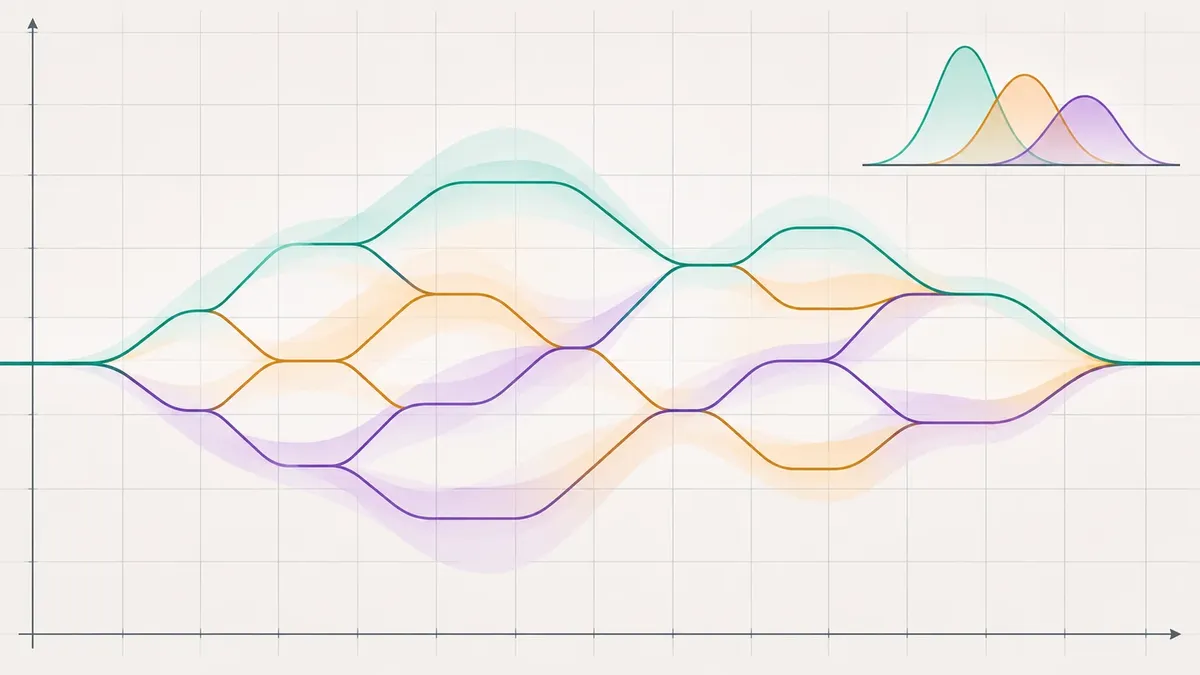
How can a stochastic branching process be represented in a quantum circuit, and what do simulations suggest about its multiplicity fluctuations? A new arXiv preprint constructs a coherent circuit for a finite, regulated version of Mueller dipole branching at small *x*. It also reports separate simulations of the cascade and a comparison with charged-particle measurements in deep inelastic scattering (DIS).
Mueller dipole branching at small x is a stochastic process in which dipoles split at rates that depend on their transverse geometry. Because it is stochastic, repeated cascades can have different outcomes. The authors ask how to encode a regulated version of this process in a coherent quantum circuit and report numerical studies of fluctuations and DIS phenomenology.
The work is an arXiv preprint. The evidence available for this article is its abstract, rather than the full paper, so the methods and assumptions cannot be examined in detail here.
Building a circuit for branching
A classical stochastic model assigns probabilities to possible outcomes. A quantum circuit represents possibilities through amplitudes in a superposition. The authors construct a circuit for a finite-state, regulated version of Mueller dipole branching. They prepare transition amplitudes from local splitting rates, rather than loading a distribution that has already been evolved.
The construction uses Poisson-clock uniformization to control the number of updates. It also uses orthogonal event-history registers to retain splitting paths, including paths that lead to the same final configuration.
To check the construction, the authors compare multiplicity probabilities from the circuit’s statevector with classical calculations. They report agreement to numerical precision with the truncated-clock Markov result, and agreement with a full continuous-time Markov-chain benchmark within approximately 7 × 10⁻⁴. These tests concern the regulated finite-state model. The abstract does not report execution on quantum hardware or a quantum computational advantage.
Fluctuations in a separate simulation
The authors also independently simulate the Mueller cascade using continuous transverse coordinates. This analysis is separate from the finite-state circuit calculation. At the largest rapidity studied, the normalized fourth factorial moment is 1.81; the abstract gives 2.84 for an equal-mean Yule process as a comparison. This reports a difference in that fluctuation measure for the stated comparison, not a general result for all branching models or conditions.
The study also determines multiplicity entropies and correlations between dipole-size sectors. The abstract does not give their detailed results, so their behavior cannot be summarized more specifically from the available evidence.
Comparing with DIS measurements
For a phenomenological comparison, the authors apply a fixed negative-binomial dipole-to-charged-particle response. They report that it reproduces the rising trend of H1 charged-particle multiplicity entropy toward smaller x. The same response does not fully describe the measured multiplicity distributions. Thus, the reported agreement concerns an entropy trend, not a complete account of the observed distributions. The abstract does not establish whether this response is unique or sufficient for a broader description.
What the results do—and do not—show
The abstract supports a specific methodological finding: a regulated finite-state version of dipole branching can be encoded coherently, and its multiplicity probabilities closely match the stated classical benchmarks. It also reports results from an independent continuous-coordinate simulation and a limited comparison with DIS data. The available evidence does not explain how sensitive the results are to regulation choices or other modeling assumptions.
These conclusions should be treated as preliminary. The source is an arXiv preprint, and the abstract alone does not allow a detailed assessment of the circuit construction, numerical procedures, or phenomenological assumptions. The results describe a proposed encoding and numerical investigations; they do not establish hardware performance or a practical advantage over classical simulation.
- Mueller dipole branching
- quantum circuits
- small x physics
- multiplicity fluctuations
- deep inelastic scattering
- arXiv preprint
Related reading
Automatically matched by shared topic keywords. These links do not imply that the sources agree or establish a consensus.
Why finite quantum circuits cannot reproduce the quantum switch
Source published
Shared keywords: quantum circuits
Preparing low-temperature states with shallow quantum circuits
Source published
Shared keywords: quantum circuits
Teaching a quantum-circuit optimizer which frequencies to use
Source published
Shared keywords: quantum circuits
When causal order varies without outside influence
Source published
Shared keywords: quantum circuits
RubriQ teaches AI to favor cheaper correct quantum circuits
Source published
Shared keywords: quantum circuits