TRANSMISSION // 2611.33964v1
How Embodied-VGGT keeps long 3D reconstructions aligned
Source published
A reconstruction method uses ground geometry and repeated views to reduce drift while preserving locally consistent structure in long driving sequences.
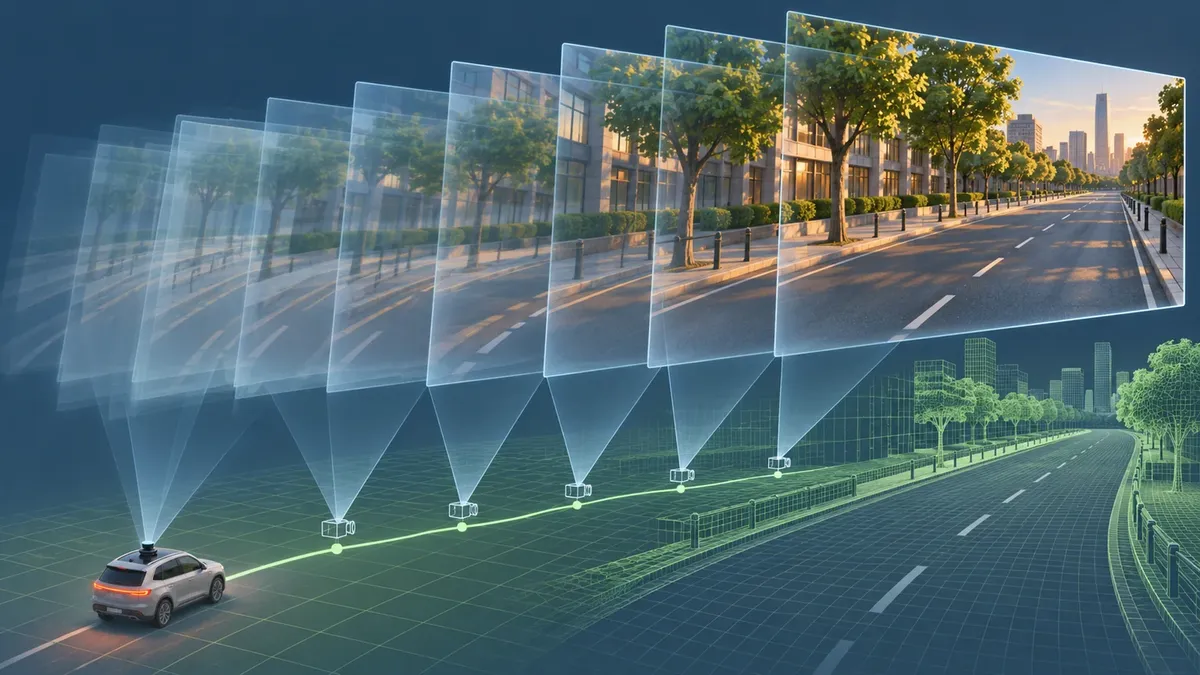
Building a 3D map from a long drive is a balancing act: local views may fit together well, yet small alignment errors can accumulate over distance. Embodied-VGGT uses recurring ground and scene observations to help connect those views and limit changes to relationships that appear reliable.
Why long sequences are difficult
A camera on a moving vehicle sees the same places from different positions and sometimes revisits them. A reconstruction system must combine those views into one map. But each short segment may have its own scale and coordinate frame, and errors in stitching segments together can accumulate into drift. Global adjustments can reduce that drift, but may also distort geometry that was already consistent locally.
In this preprint, Yiheng Han and colleagues propose Embodied-VGGT, a method for reconstructing 3D scenes and camera trajectories from long image sequences. Its central idea is to use regularities of vehicle-based capture—not just visual matching. For example, the camera’s relationship to the ground is relatively stable, and overlapping sequence windows provide repeated observations of the same frames.
Three pieces that work together
The method processes a sequence in overlapping chunks, building on Scal3R’s shared context memory. Memory-Augmented Grounded Chunks (MAGC) uses predicted ground geometry to regularize updates to that memory and estimate relative scale between chunks. The scale is relative, not an independently measured absolute distance: the method does not require the camera’s installation height to be known.
Superpoint Alignment (SA) estimates how chunks should be translated relative to one another. Instead of letting densely sampled areas dominate the calculation, it groups image correspondences into spatial regions and balances evidence from ground and non-ground areas when enough reliable observations are available.
Finally, Cross-Loop Optimization (CL) looks for agreement in geometry and camera motion across overlapping windows. It groups selected chunks and applies a shared scale-rotation-translation correction to each group. That lets the overall trajectory adjust while keeping the group’s internal relative transformations intact. The authors describe this as selectively preserving local relationships, rather than freezing every local estimate regardless of its reliability.
What the tests found
The authors evaluated the approach on five public driving benchmarks: KITTI Odometry, Virtual KITTI 1 and 2, nuScenes mini, and Waymo Open Dataset. The main paper reports detailed results for KITTI, Virtual KITTI 1, and nuScenes mini; Waymo and Virtual KITTI 2 results are in the supplement.
On KITTI Odometry, Embodied-VGGT’s mean absolute trajectory error (ATE) was 7.30 metres, compared with 13.72 metres for Scal3R under the paper’s evaluation protocol. ATE measures the distance between estimated and reference camera positions after aligning the trajectories. The method also achieved a mean Chamfer distance of 2.67 metres for its reconstructed point cloud, versus 3.48 metres for Scal3R. Chamfer distance summarizes how far points in each cloud are from their nearest counterparts in the other cloud.
The results were not uniformly better on every measure: KITTI’s mean relative rotation error was 1.81 degrees per 100 metres, compared with 1.65 for Scal3R. On that benchmark, the authors report the clearest gains in trajectory position and relative translation. They also report improvements in mean ATE on the other evaluated benchmarks, though individual results vary. For example, on Waymo, Embodied-VGGT’s mean ATE was 1.63 metres against 2.58 metres for the authors’ reproduced Scal3R baseline; they note that this reproduced baseline differs from the original study’s reported result.
The method’s additional processing came with a cost. On KITTI, reported mean runtime rose from 673.6 seconds for Scal3R to 749.0 seconds for Embodied-VGGT. Ablation tests—where parts of the system are switched off—suggest that ground conditioning and the alignment and optimization modules contribute to the reported performance, though the gains depend on how the components are combined.
What remains uncertain
These are benchmark results, not evidence that the system will perform equally well in every environment. The approach depends on useful ground-plane predictions and repeated, overlapping observations; the paper’s sensitivity tests show that errors in ground references can affect trajectory accuracy. The reported experiments concern driving datasets, so they do not establish performance for arbitrary robots, indoor scenes, or different capture setups.
The article is based on an arXiv preprint, which may not have undergone peer review. The authors say they released code, supporting further checking and reproduction, but that does not independently verify the reported results. Comparisons also depend on the paper’s chosen data, baselines, and evaluation procedures. The findings are promising evidence for using platform and environment geometry to manage reconstruction drift—not a guarantee of accurate maps in all conditions.
- 3D reconstruction
- computer vision
- robotics
- autonomous driving
- visual geometry
- camera trajectory
- arXiv preprint
Related reading
Automatically matched by shared topic keywords. These links do not imply that the sources agree or establish a consensus.
How a Few Radar Returns Can Help Cameras Locate Cars
Source published
Shared keywords: autonomous driving, computer vision
A 360-degree image can map a room—but not every surface
Source published
Shared keywords: 3d reconstruction, computer vision
A pixel-level test for when generated videos bend reality
Source published
Shared keywords: 3d reconstruction, computer vision
How an AI agent builds a 3D object from video
Source published
Shared keywords: 3d reconstruction, computer vision
Instant NuRec: A One-Pass Route to 3D Driving Scenes
Source published
Shared keywords: autonomous driving, computer vision