TRANSMISSION // 2611.33953v1
A neural network follows photon orbits one slice at a time
Source published
PINN-Slicer breaks a difficult long-range calculation of photon paths near a black hole into short steps. In the tested Schwarzschild case, its results closely matched a finite-difference reference across many starting conditions.
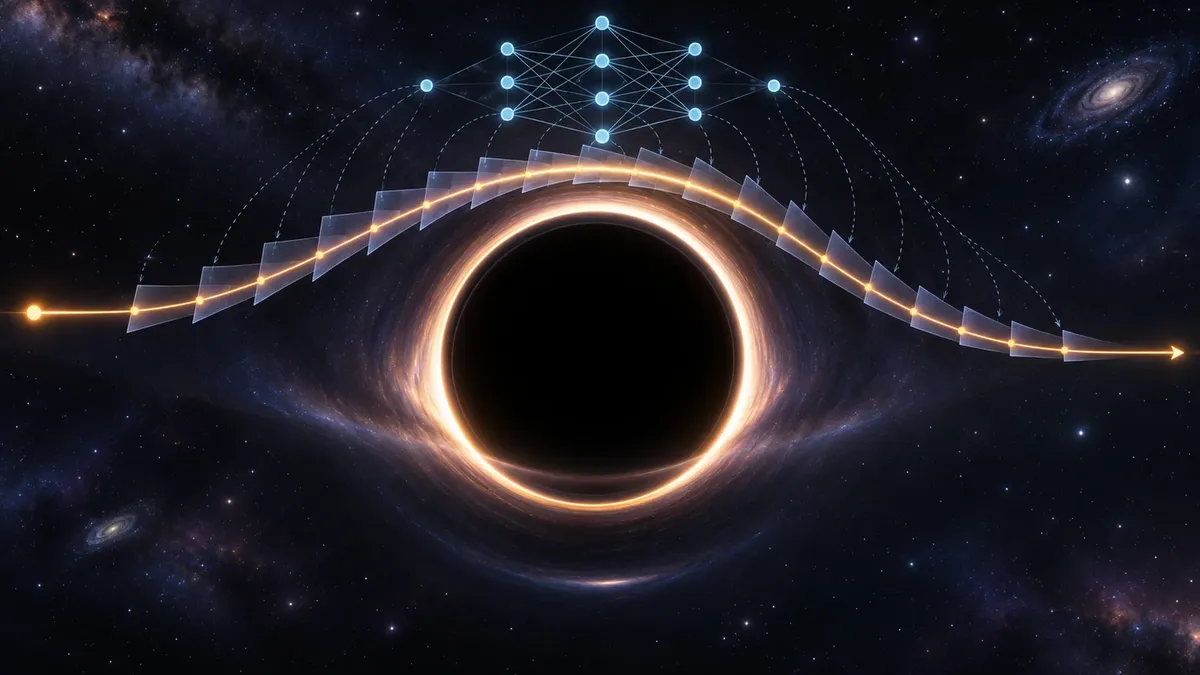
Physics-informed neural networks can struggle when asked to follow a system over a long domain. A new method, PINN-Slicer, trains one network on a short segment and reuses it step by step to calculate photon orbits around a Schwarzschild black hole.
Why divide a calculation into slices?
A photon’s path near a black hole can be hard to calculate accurately over a long stretch. Its trajectory may escape, spiral inward, or circle the black hole in an unstable orbit; small changes to the starting conditions can affect what happens. Physics-informed neural networks (PINNs) offer a way to approximate solutions to differential equations using the equations themselves, rather than relying on measured examples. But, as the authors note, PINNs can fail even on relatively simple problems, and a network that works over a short interval may not remain reliable over a longer one.
Claire David, Tlotlo Oepeng and Harrison B. Prosper introduce PINN-Slicer to address that challenge. Their study asks whether a PINN can accurately model photon orbits when the relevant domain is not known in advance, while also handling different initial conditions with a single trained model.
One trained network, reused step by step
The team studies the equation for photon trajectories around a non-rotating Schwarzschild black hole. They express the trajectory using the inverse radial coordinate, measured in units of the Schwarzschild radius, and use the azimuthal angle as the independent variable. Depending on a photon’s starting position and direction, the solution may end at the black hole, extend outward, or continue around it.
PINN-Slicer relies on a property of the equation: it is autonomous, meaning that shifting the starting value of the angle does not change the form of the equation. The researchers train a single neural network on a thin interval, or slice, of that angle. They then apply it repeatedly. At the end of each slice, the predicted position and rate of change become the starting conditions for the next one.
The method also builds the starting conditions directly into the network’s solution formula. This avoids enforcing them through a separate penalty in the training loss. The authors sample starting conditions using Sobol sampling, a quasi-random approach intended to cover the chosen range more evenly than purely random sampling. They compare the network’s results with a custom finite-difference solver, a conventional numerical method for approximating differential equations.
How well did it work?
A network applied directly across a large interval failed, including within its training domain. With slicing, the authors report much closer agreement with the finite-difference reference. For their preferred slice width of 0.1 radians, the largest point-by-point root-mean-square error across four illustrated orbits was about 0.00049 for the inverse radial coordinate. In a grid test, all 1,642 comparable orbits had an error below 0.001. These results cover starting conditions within the study’s tested training range; they do not establish accuracy for arbitrary conditions.
The paper also tests other slice widths. The grid results show a trade-off: larger slices generally allow more error to accumulate during repeated application. For widths up to 0.4 radians, all comparable orbits in the test grid remained below the stated 0.001 error threshold. At larger widths, some did not. Without slicing, only 3.3% of comparable orbits met that threshold. The researchers also report that PINN-Slicer reproduced the particularly sensitive “boomerang” orbits shown in their examples.
What the results do—and don’t—show
The work is a computational demonstration, not a new observation of black holes or photons. Its accuracy is assessed against a finite-difference reference for one specific equation: photon orbits in the Schwarzschild setting. The authors suggest that the approach may extend to other second-order autonomous equations, but say further applications are still being tested. It should not be taken as proof that the method works equally well for every such equation or for rotating black holes.
Repeated stepping can also propagate errors, and the paper’s own slice-width comparisons show that performance depends on the chosen interval. The authors say they did not systematically optimize the network’s hyperparameters. The comparison grid excludes cases where the photon is absorbed so quickly that there are too few shared points for a meaningful error calculation; the reported grid statistics therefore apply to comparable orbits, not every possible starting condition.
The paper was accepted at the 2026 Workshop on Machine Learning and the Physical Sciences, according to its text. It is a preprint-style workshop paper, not evidence of broad independent validation. Its code is listed as publicly available by the authors, which may help others check and extend the results. For now, PINN-Slicer is best understood as a promising strategy for one carefully defined orbit problem, with its broader usefulness still an open question.
- PINN-Slicer
- physics-informed neural networks
- photon orbits
- black holes
- numerical methods
Related reading
Automatically matched by shared topic keywords. These links do not imply that the sources agree or establish a consensus.
A hidden magnetic field may steady pulsar current sheets
Source published
Shared keywords: physics informed neural networks
Stretching coordinates helps neural networks learn sharp solution changes
Source published
Shared keywords: physics informed neural networks
PINNeval asks physics-informed AI benchmarks to test the whole training pipeline
Source published
Shared keywords: physics informed neural networks
Why Fewer Quantum Parameters Can Still Run Slower
Source published
Shared keywords: physics informed neural networks
Can a language model build a neural network from physical laws?
Source published
Shared keywords: physics informed neural networks