TRANSMISSION // 2611.33945v1
Venus’s clouds may contain iron sulfate
Source published
A reanalysis of Pioneer Venus data points to ferric sulfates in cloud aerosols, but their original form and the source of their iron remain uncertain.
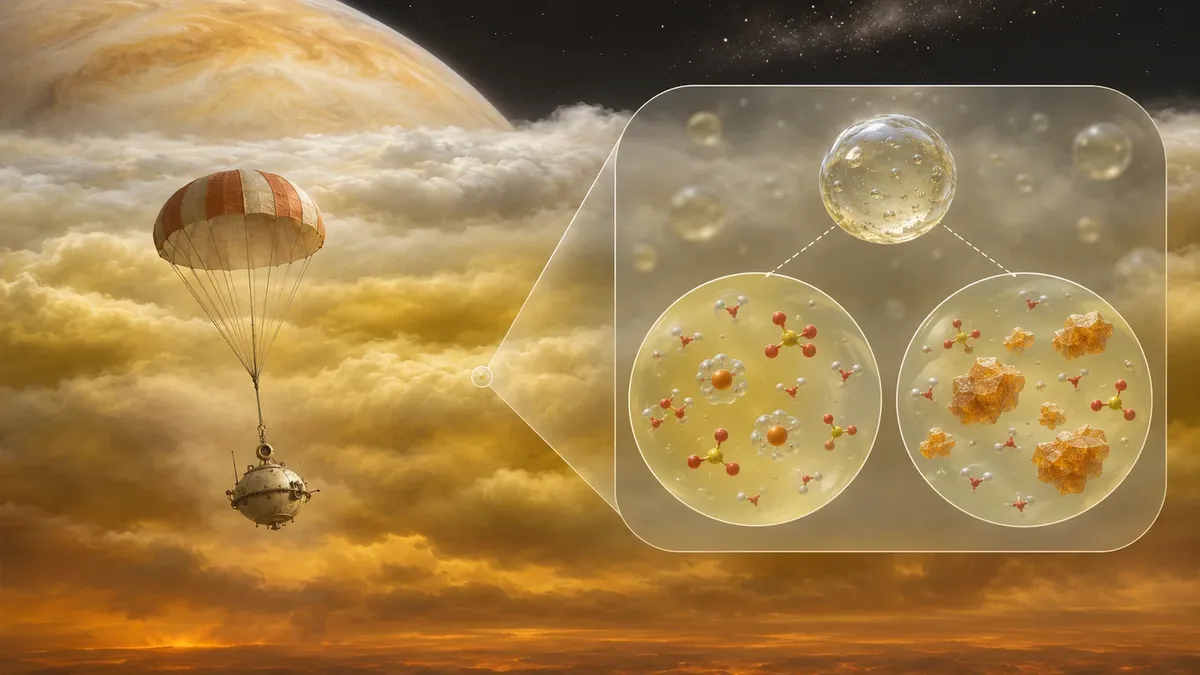
What are Venus’s clouds made of—and could iron-bearing salts be an important ingredient? Researchers revisited measurements from a probe that accidentally collected cloud material. Its signals are consistent with ferric sulfates, but do not directly reveal the minerals’ form in the clouds.
Venus’s bright clouds are often interpreted as being dominated by sulfuric acid. Other measurements have hinted at iron, leaving open what iron-bearing material is present and how it arrived there. A new analysis of data from NASA’s Pioneer Venus Large Probe argues that aerosols in part of the cloud deck contained ferric sulfates—iron compounds containing sulfate—and suggests cosmic dust as a possible source of the iron.
The evidence comes from an unusual sampling process. During its 1978 descent, the probe’s Large Probe Neutral Mass Spectrometer (LNMS) apparently collected aerosols through its inlets at roughly 48–51 kilometres altitude. As the probe descended into hotter air, the captured material heated up and released gases and other compounds into the instrument. The researchers treat the resulting measurements as a kind of thermal analysis: they track substances appearing in the mass spectrometer as the inlet temperature increased.
To identify iron-bearing material, the team searched the LNMS data for signals at mass positions associated with iron and iron oxides. The instrument measured only selected mass positions, and some recorded signals could also have come from other substances. The researchers fitted peaks to the available measurements, estimated and accounted for overlapping chlorine and xenon signals, and used known iron isotope proportions to help interpret the results. They compared the altitude and temperature patterns of iron-related signals with those of sulfur dioxide, sulfur trioxide, sulfuric acid and water. Thermochemical calculations provided an additional check on whether proposed compounds and breakdown products were plausible under Venus conditions.
The iron signals and gases released at lower altitudes were consistent, the authors argue, with captured ferric sulfates breaking down as they heated. Their estimated iron-to-sulfate mole ratio was 2.0 ± 1.1. Within that uncertainty, the ratio is compatible with hydronium jarosite, a particular iron sulfate mineral. The authors suggest jarosite may have formed inside the instrument inlet after capture, as the aerosols lost water and sulfuric acid. That is not the same as showing that jarosite crystals were present in the clouds.
The paper estimates that the captured aerosol material included about 30 ± 17 percent hydronium jarosite, 50 ± 10 percent water and 20 ± 5 percent sulfuric acid by mass. These estimates describe the thermally unstable and volatile components the analysis could characterize; other, unmeasured constituents may also be present. The estimated bulk iron abundance is reported as 0.8 ± 0.4 milligrams per cubic metre in the abstract, but as 0.8 ± 0.5 milligrams per cubic metre in the paper’s table and discussion. The source does not explain this difference, so the value should be treated as an approximate estimate with substantial uncertainty—not a direct weighing of cloud material.
Several limits leave the interpretation open. Some relevant peaks were measured on their slopes rather than at their exact masses, and some signals could not be assigned unambiguously. Iron estimates also depend on assumptions about how iron oxides ionize and fragment inside the instrument. Most importantly, the aerosols were transformed during capture and heating. The study cannot determine whether ferric sulfate in the original clouds was dissolved in droplets, present as particles, or existed in another form. Jarosite is an interpretation of the inlet’s decomposition products, not a direct observation of the original aerosol mineral.
The team also considered where the iron came from. Their calculations suggest that iron-bearing gases from the surface would supply only trace amounts under the conditions they modeled; delivery by dust particles from the surface remains unresolved. Cosmic dust is a proposed alternative. The paper’s abstract estimates that cosmic dust could supply a comparable amount of cloud iron over 2.4 ± 1.5 million years, while its discussion gives 2.6 ± 1.7 million years. The paper does not explain this discrepancy. Both are model-based timescale estimates, not direct measurements of the iron’s source or history.
The work revisits measurements from a single historical probe and combines them with chemical calculations. It is presented as an arXiv preprint, which may not have completed peer review. The results therefore offer evidence consistent with ferric sulfates, not a final determination of Venus’s cloud composition. Future in-situ sampling that can better preserve and identify cloud material could help test the interpretation; that is a prospective research approach, not a result of this study.
- Venus
- planetary clouds
- aerosols
- ferric sulfate
- Pioneer Venus
- mass spectrometry
- cosmic dust
Related reading
Automatically matched by shared topic keywords. These links do not imply that the sources agree or establish a consensus.
Dust-like surfaces sharply reduce UV-driven ice loss in laboratory tests
Source published
Shared keywords: cosmic dust
A fairer test for peptide-spectrum prediction AI
Source published
Shared keywords: mass spectrometry
Dusty Starbursts in the Early Universe
Source published
Shared keywords: cosmic dust
CosmicGrain follows dust histories through a simulated galaxy
Source published
Shared keywords: cosmic dust
Can Top-Heavy Stars Explain JWST’s Bright Early Galaxies?
Source published
Shared keywords: cosmic dust