TRANSMISSION // 2611.33941v1
A galaxy-cluster collision with a possible third player
Source published
New observations show that cluster RMJ1219 is merging, but its stretched dark-matter distribution leaves open whether two or three subclusters are involved.
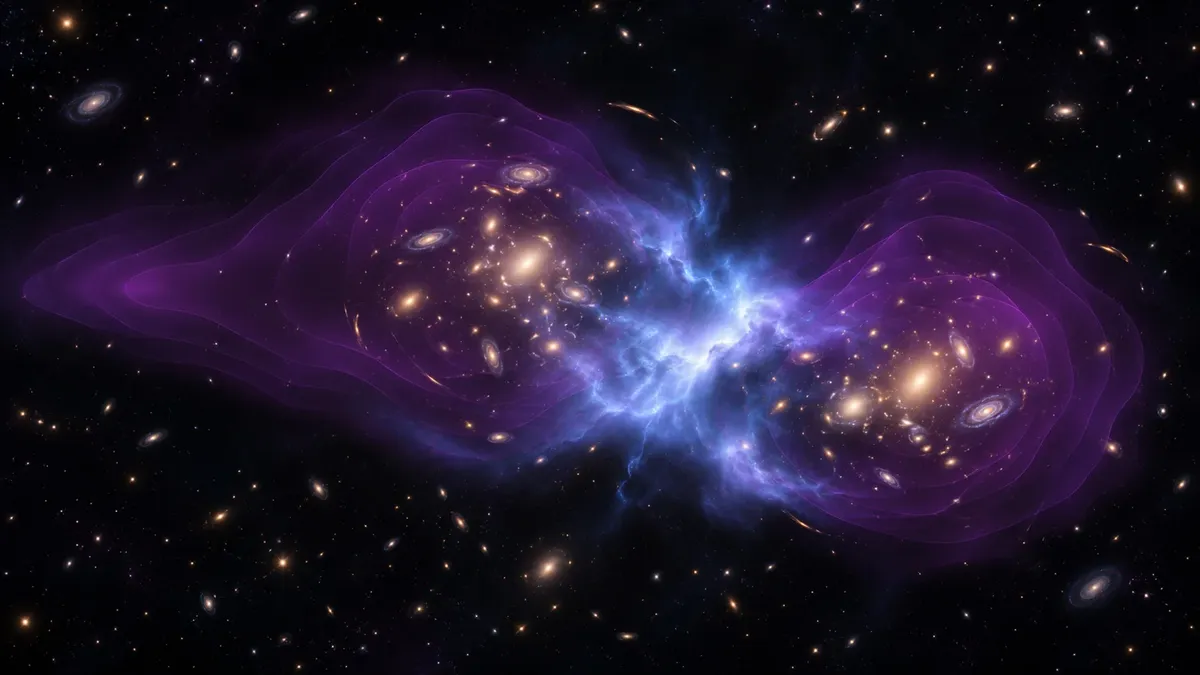
A galaxy cluster can look like a straightforward collision between two systems—until its dark matter refuses to fit the picture. Observations of RMJ1219 confirm a merger, but do not settle whether a third, smaller halo is involved.
Galaxy clusters grow as smaller groups and clusters collide and combine. In these encounters, galaxies and dark matter respond mainly to gravity, while the hot gas between galaxies can be slowed and displaced. Comparing the locations of these components can reveal clues about a merger’s history. But what if the dark matter distribution does not fit a simple two-cluster collision?
A team led by Rodrigo Stancioli examined RM J121917.6+505432.8, or RMJ1219, which was flagged as a possible merger because its galaxy distribution appeared to have two concentrations. The study asks whether the system is a merger between two subclusters or whether a third, less obvious dark matter halo could also be involved.
Three kinds of evidence
The researchers combined observations that trace different parts of the cluster. Images from the Hubble Space Telescope’s Advanced Camera for Surveys were used for weak gravitational lensing: the subtle distortions of background galaxies reveal how mass is distributed along the line of sight, including mass that does not shine. XMM-Newton observations traced X-rays from the cluster’s hot gas. Keck/DEIMOS spectroscopy measured galaxy redshifts, helping distinguish cluster members and estimate their motions. The analysis also considered existing low-frequency radio observations from LOFAR.
The Hubble images show two distinct peaks in the reconstructed mass map, associated with the cluster’s eastern and western brightest galaxies. The eastern mass concentration is more massive in the two-halo fits, but it is also stretched along the line joining the two concentrations. That shape could mean the eastern halo is intrinsically elongated, or it could be the blended signal of an additional, unresolved halo. A cluster member galaxy near the middle of the system makes the latter possibility worth testing, but does not establish it.
The X-ray picture provides evidence that the cluster has passed through a close encounter. The gas is much fainter around the western subcluster than around the eastern one, and the overall gas distribution is less stretched than the mass map. The authors interpret the morphology as consistent with a post-pericenter merger: the subclusters have passed their closest approach. The contrast could reflect the effects of the collision on the gas, but it does not by itself tell whether there are two halos or three.
A model can fit better without being the answer
To test the shape of the mass distribution, the team fitted the weak-lensing data with four arrangements of Navarro–Frenk–White halo profiles, a standard mathematical description of dark matter halos. The models included two spherical halos, three spherical halos, an elliptical eastern halo plus a spherical western one, and a single elliptical halo.
The three-halo model produced the best numerical fit. Yet its proposed central halo is poorly constrained: its best-fit mass is consistent with zero within one standard deviation, and the lensing data do not clearly justify the extra model complexity. In the authors’ model comparison, the Akaike information criterion did not show a clear preference among the multiple-halo fits, while the Bayesian information criterion favored models with fewer parameters. The authors nonetheless argue that a simple two-spherical-halo picture does not capture the system’s elongated structure. Distinguishing a third halo from an elliptical halo will require better data and further modeling.
Spectroscopy adds another clue, but also an important caveat. The team obtained 120 secure new galaxy redshifts and combined them with archival measurements. Their spatially weighted analysis estimated a line-of-sight velocity difference of about 480 km/s between the eastern and western subclusters, with broad uncertainties. A relatively small line-of-sight component is consistent with much of the collision occurring across the plane of the sky. However, the two brightest galaxies’ redshifts imply a larger difference, and a separate mixture-model approach gave a substantially different result that the authors considered inconsistent with other evidence. They note that limited spectroscopy near the cluster core and the difficulty of assigning galaxies to subclusters may affect the estimates.
The study therefore establishes RMJ1219 as a merging cluster, but not as a confirmed three-way merger. Its central lesson is about the limits of inference: several observational clues point to a complex collision, while the mass data cannot yet distinguish halo shape from an extra halo with confidence. The putative radio relic is also unconfirmed; observations at additional radio frequencies, including spectral-index and polarization information, are needed to determine its nature.
This account is based on the authors’ November 2026 arXiv preprint, not an independently verified consensus. Preprints may not have completed peer review, and the available evidence here does not establish the final publication status. The paper itself emphasizes limits from weak-lensing precision and the spectroscopic sample; deeper, higher-resolution imaging and additional observations could change how the system is interpreted.
- galaxy clusters
- cluster mergers
- dark matter
- weak gravitational lensing
- intracluster gas
- X-ray astronomy
- RMJ1219
Related reading
Automatically matched by shared topic keywords. These links do not imply that the sources agree or establish a consensus.
A two-factor model helps reconcile cluster X-ray relations
Source published
Shared keywords: galaxy clusters, intracluster gas, x ray astronomy
Radio Sources May Hide Some Galaxy Clusters
Source published
Shared keywords: galaxy clusters, weak gravitational lensing, x ray astronomy
A fuller picture of galaxy cluster mass
Source published
Shared keywords: dark matter, galaxy clusters, weak gravitational lensing
A neural network maps dark matter to hot cosmic gas
Source published
Shared keywords: dark matter, galaxy clusters, x ray astronomy
Galaxy Clusters Don’t Scale as Simply as Gravity Predicts
Source published
Shared keywords: galaxy clusters, x ray astronomy