TRANSMISSION // 2611.33936v1
How phonons could disrupt a diamond quantum memory
Source published
A simulation studies how lattice vibrations affect transferring quantum information between an NV center’s electron and nuclear spins. Its results are illustrative, not experimental.
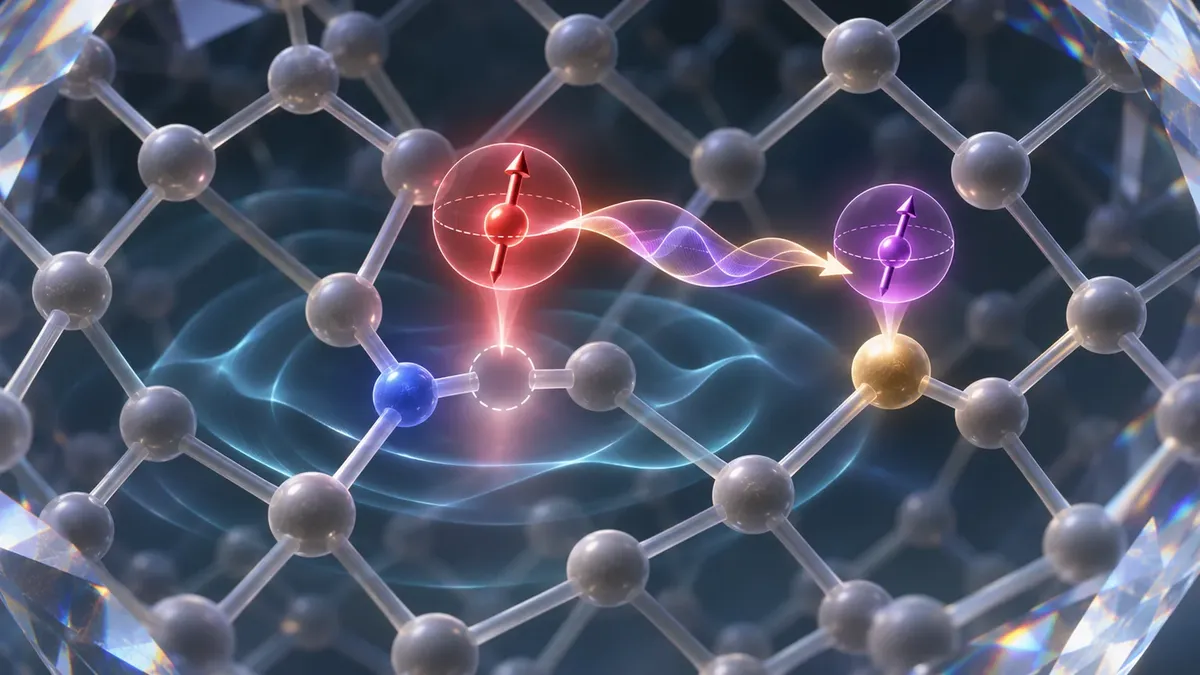
A nitrogen-vacancy center in diamond could use an electron spin for control and a nearby nuclear spin for storage. A new simulation explores how phonons—quantized lattice vibrations—might interfere with transferring and retrieving a quantum state, and why its numerical results need cautious interpretation.
A quantum memory must do more than hold information: it must accept a quantum state, preserve it, and return it intact. Nitrogen-vacancy (NV) centers in diamond offer a possible route. Their electron spins can be controlled and read optically, while nearby nuclear spins can serve as storage qubits. But lattice vibrations may disturb the electron spin during the operations that move information into and out of storage.
A study by Manjith Baby Sarojam Chellam examines that problem in a computer model. It asks how a write–store–read sequence performs when the NV center’s electron spin is coupled to a nuclear spin and to a vibrational mode. The work is a theoretical simulation, not a report of a new laboratory demonstration.
A modeled handoff between two spins
The model represents an NV electron spin as a controllable interface qubit and a nearby spin-½ nucleus—modeled as a carbon-13 spin—as the memory qubit. The two spins interact through the hyperfine interaction, their magnetic coupling. To represent the transfer operation, the simulation uses an effective, microwave- and radio-frequency-assisted SWAP-like interaction: it moves the quantum state from the electron to the nucleus, then reverses the process to retrieve it.
The model also includes one effective phonon mode, coupled to the electron spin, as well as relaxation and dephasing processes. These are ways that a quantum system can lose energy or lose the stable phase relationships needed to preserve a quantum state. The researchers simulated the resulting open-system dynamics with QuTiP, using a Lindblad master equation, a secular approximation, and a drive tuned to the hyperfine-shifted transition in a rotating frame. In plain terms, the calculation tracks both the system’s controlled evolution and specified sources of noise.
What the simulations show
In an idealized case without spin–phonon coupling or electron decoherence, the modeled protocol recovers the input state with fidelity above 0.9999. Fidelity measures how closely the retrieved state matches the intended state; a value near one indicates a close match. This ideal result checks the behavior of the modeled transfer protocol, rather than demonstrating performance in a device.
With the study’s default decoherence rates, stronger modeled spin–phonon coupling lowers the worst-case retrieval fidelity: it falls from 0.9994 at zero coupling to 0.9884 at 0.06 MHz. The simulations also show oscillations in fidelity at the phonon-mode period. In this single-mode picture, the write step can entangle the electron spin with a displacement of the vibrational mode. Depending on the mode’s phase by the time of reading, the read step can partly undo that displacement—or leave more of its effect behind.
A separate temperature sweep uses a phenomenological rate model, meaning that temperature changes assumed relaxation and dephasing rates rather than being derived from a detailed microscopic phonon bath. In that calculation, fidelity declines from 0.9997 at 1 kelvin to 0.9938 at 300 kelvin. The paper also reports that storage-time losses follow the nuclear-spin decoherence rates chosen for the model. Under the selected parameters, the authors identify electron-mediated write and read operations as a more prominent source of error than storage over the plotted intervals. That is a result of this setup, not a general ranking for all NV memories.
Why the numbers are not predictions yet
The authors describe the framework as conceptual and say its absolute fidelity values depend on the chosen parameters. The electron–phonon interaction is simplified to an effective coupling, and the vibrational environment is represented by a single mode. The paper notes that a continuum of phonon modes would wash out the simulated revivals. Its temperature-dependent rates are phenomenological and would need calibration against measurements for quantitative predictions. The calculations also use a selected initial superposition and specific approximations, so they do not establish performance across every state, device, or operating condition.
The practical value of the work is therefore as a modeling framework and a guide to questions for future experiments: how strong is the relevant coupling, how do measured relaxation rates vary with temperature, and does a more realistic phonon spectrum change the predicted behavior? The paper says the QuTiP code and figure-generating scripts are openly available, offering a route for others to inspect or extend the simulations.
This article is based on the version 1 preprint listed on arXiv. A preprint is a public research manuscript that may not have completed peer review; the source information provided here does not establish peer-review status. The findings should be read as model-based results, not experimental confirmation that a physical NV-center memory will reach the reported fidelities.
- nitrogen-vacancy centers
- quantum memory
- phonons
- nuclear spin
- electron spin
- QuTiP simulation
- quantum decoherence
Related reading
Automatically matched by shared topic keywords. These links do not imply that the sources agree or establish a consensus.
Nuclear spins controlled without RF in silicon carbide
Source published
Shared keywords: nuclear spin
A Single Phonon as a Quantum-Battery Gate
Source published
Shared keywords: nitrogen vacancy centers
A diamond sensor probes nitrogen-15 in nitrate solution
Source published
Shared keywords: nitrogen vacancy centers
A hybrid method brings huge spin baths within reach
Source published
Shared keywords: quantum decoherence
How moving nitrogen spins reshape diamond’s quantum echo
Source published
Shared keywords: nitrogen vacancy centers