TRANSMISSION // 2611.33934v1
Can a Drone Track a Target Without Turning?
Source published
A simulation preprint explores panoramic drone tracking without active heading adjustment. Its model improves reported scores, while an offline-to-closed-loop reliability gap remains.
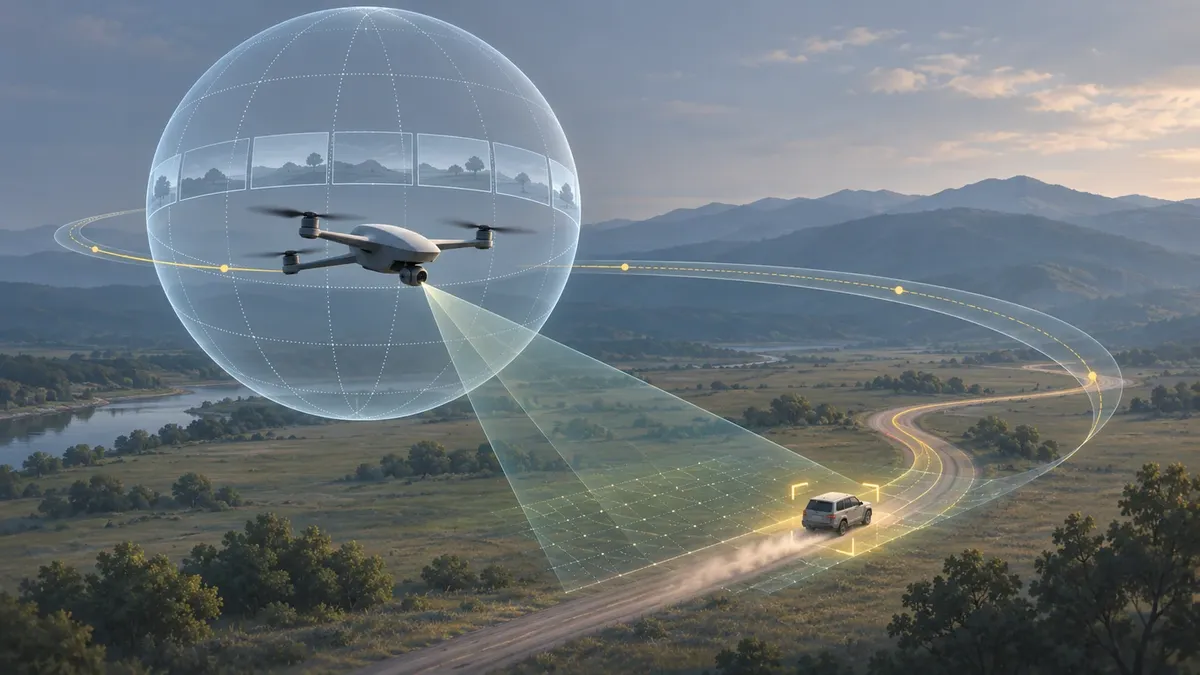
A forward-facing drone camera can lose sight of a moving target unless the drone changes heading. Could panoramic sensing help a drone track a designated target without actively turning to keep it in view? A preprint investigates that question using a simulation benchmark and a vision-language-action model.
The tracking problem
Tracking means more than recognizing an object in one image. A drone must keep identifying a designated target as it moves and use that information to guide its own motion. With a forward-facing camera, the target may leave the field of view, tying tracking to heading control.
In Towards 360° Embodied UAV Tracking Without Turning, the authors explore a different setup: full-spherical, or panoramic, perception paired with tracking that does not actively adjust the drone’s heading to look toward the target. They ask whether a system can use this broad view to identify a chosen target, reason about its motion, and control the drone in three dimensions.
A benchmark and a proposed model
The researchers introduce 360UAV-ETrack, a simulation benchmark with 2,652 sequences, more than 1.73 million synchronized observations, eight tracking tasks, and 150 held-out closed-loop scenarios. In closed-loop testing, actions and subsequent observations are linked: the system is evaluated as it acts and continues tracking, rather than only on isolated predictions.
They also propose 360UAV-TVLA, a panoramic vision-language-action framework. It combines persistent visual referring (PVR), compressed temporal memory (CTM), and geometry-aligned trajectory supervision (GTS). As described in the abstract, these components are intended to support instance identification, motion reasoning, and three-dimensional control.
The abstract reports experiments with two VLA backbones, π₀ and π₀.₅, and comparisons with standard fine-tuning. It gives results for a metric called normalized average tracking frames. For π₀, the reported value rises from 22.56% with standard fine-tuning to 35.28% with the proposed framework. For π₀.₅, it rises from 25.68% to 33.64%. The abstract names the metric but does not define how it is calculated, so these percentages should be read as reported rather than translated into a more specific interpretation.
The offline-to-action gap
The authors also report a substantial gap between offline imitation accuracy and closed-loop tracking reliability. This distinction matters because performance measured offline does not, by itself, establish that a system will track reliably while acting over time. The abstract flags this gap as a challenge for the benchmark and for future research, but does not give enough detail to characterize its size or causes.
Panoramic perception changes the tracking setup, but it does not remove the need to identify the intended target, reason about movement, and produce useful control actions. The reported gains show improvement over standard fine-tuning in the authors’ experiments. The abstract does not establish which model component accounts for the gains, or how results vary across the eight tasks and other conditions.
What remains uncertain
This account is based on the preprint abstract, not a full-text assessment. The available evidence does not provide details needed to evaluate the simulation assumptions, the exact test protocols, variation across runs, or performance task by task. Nor does it establish how the approach would transfer to physical drones, real panoramic cameras, or conditions beyond the simulated scenarios.
The work presents both a testbed and a proposed tracking framework. Its results are evidence of progress within the reported setup, not proof of real-world readiness. The authors’ reported gap between offline imitation and closed-loop reliability underscores that distinction. As an arXiv preprint, the work may not yet have undergone peer review; its claims should be treated accordingly.
- drone tracking
- panoramic vision
- embodied AI
- vision-language-action
- simulation benchmark
- robotics
Reviewed cross-references
These connections were reviewed by a model, not independently fact-checked by a human. Similarity does not imply agreement; consult the original papers and the evidence below.
Why 360° Drone Tracking Challenges AI
Supporting evidence: Both papers identify geometric difficulties with equirectangular panoramic observations: the origin paper says ERP distortions and projection discontinuities complicate translating spatial relationships into control, while PanoUAV-Track reports tracking degradation associated with latitude distortion and seam discontinuities. This supports the bounded point that ERP geometry can challenge UAV perception; the origin evaluates closed-loop target following in simulation, whereas PanoUAV-Track evaluates visual tracking across real and simulated clips, so their outcomes are not directly comparable.
Model review: · openai-codex/gpt-6-luna
Evidence and provenance
Selected excerpts, not complete papers. PDF extraction can omit figures or damage equations, tables and reading order; sources may be preprints.
2611.33934v1 — Original paper
Excerpt reference:
static/papers/2611.33934v1.md:157-223
Basis: Paper text
Source SHA-256:8e53011c8a0c4cb634dfcb71adaedf683250b95f9a03a59c97b8da559de83f722611.27383v1 — Original paper
Excerpt reference:
static/papers/2611.27383v1.md:90-145
Basis: Paper text
Source SHA-256:2700b947f6a5597e2cd0bfe66475dd2e7d7041c62b39e4dccc6926a452df031a
Related reading
Automatically matched by shared topic keywords. These links do not imply that the sources agree or establish a consensus.
AI coding agents build a robotics simulation benchmark
Source published
Shared keywords: embodied ai
When Reflections Challenge Robot Policies
Source published
Shared keywords: embodied ai
When should a robot look ahead before moving?
Source published
Shared keywords: embodied ai
Robots Learn From Teachers, Then From Failure
Source published
Shared keywords: embodied ai
Robot Memory Fails When the World Keeps Moving
Source published
Shared keywords: embodied ai