TRANSMISSION // 2611.33925v1
Robots learn from the grasp that goes wrong
Source published
Robot world models can struggle to predict what happens after a botched grasp. WorldReforge trains them on simulated failures and physical-motion clues, improving several prediction tests—but real-world control remains untested.
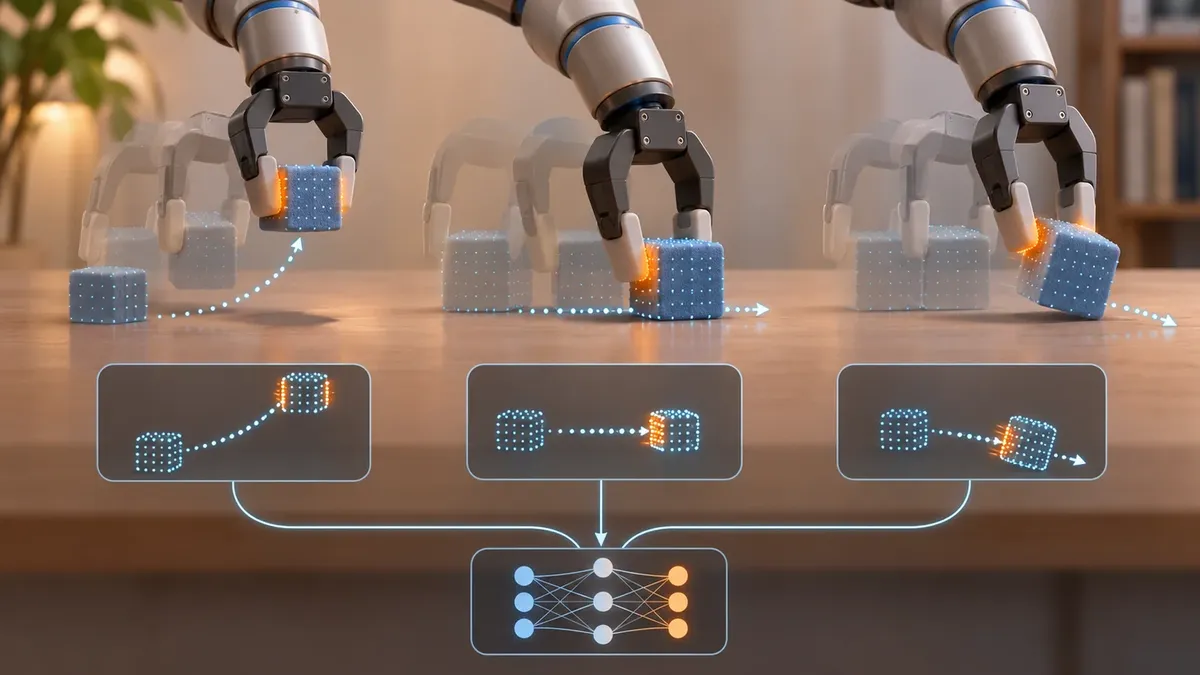
A robot’s model of the world needs to predict more than what happens when everything goes right. A new preprint introduces simulated failed grasps and two training signals designed to help those models follow object motion and contact. Its results are promising, but they do not yet show that robots make better decisions in real-world tasks.
A robot reaches for a cup, closes its gripper a little too soon, and nudges the cup sideways instead of lifting it. Predicting that outcome is important: a robot’s “world model” can help it compare possible actions before trying them. But if the model has mostly seen successful demonstrations, it may struggle to imagine what a failed grasp does to an object.
A new preprint asks whether deliberately generating failures in simulation can make these models better at predicting physical interactions. The researchers introduce WorldReforge, a training approach that combines simulated examples of manipulation going wrong with additional supervision about where contact occurs and how object surfaces move.
Making failures useful training examples
The team created Reforge, a dataset of 62,125 simulated trajectories involving 96 object assets, alongside 300 real-world failure trajectories involving 10 objects. In simulation, they started with successful reference grasps and varied the robot’s gripper position, orientation, and closure timing. The resulting interactions included pushes, tilts, slips, and failed pickups.
Unlike ordinary video examples, the simulated trajectories came with physical ground truth: information about object pose, contact, and points on object surfaces. This lets the researchers connect a change in the robot’s execution to what happened next. The real-world recordings were used for evaluation, not for post-training the models.
WorldReforge adds two training signals to a model’s existing video-prediction objective. Interaction Alignment gives extra weight to the object and nearby contact regions, which occupy only a small part of an image and might otherwise be overlooked by a loss that treats the whole frame alike. Surface Correspondence trains features inside the model to follow the same physical points on an object across video frames. Neither method adds inference-time parameters, according to the paper.
The researchers tested five pretrained models from three families, then compared versions trained on Reforge with versions using WorldReforge’s additional signals. They assessed predicted object and gripper motion against reference trajectories, as well as video reconstruction quality. They also tested whether models captured the difference between two outcomes that began from the same image but followed different actions.
Better motion predictions, with qualifications
On the simulated evaluation, the pretrained models struggled to track objects after failed contact. Their object-motion errors were at most 10.4% lower than those of a simple baseline that kept tracked points fixed in their initial positions; two models did worse than that baseline.
For Cosmos3 Nano, adding WorldReforge’s training signals reduced object trajectory error by 28.2% relative to the pretrained model overall and by 35.0% on objects not seen during post-training. In a test of pairs of different actions, the model’s error in predicting how their outcomes diverged was 43.3% lower than the pretrained model’s. These are results on the paper’s chosen benchmarks and metrics—not evidence that a robot completed more tasks or recovered from failures more successfully.
The authors also report improved video reconstruction on DROID, a robot dataset, and on their own real failure videos, even though post-training used simulated interactions. This suggests some transfer to real-world video prediction. It is not the same as showing that the model’s predictions are accurate enough to safely guide a robot’s actions in unfamiliar physical settings.
The paper’s controlled data studies point to a useful distinction: failed contact helps teach how objects respond to bumps and slips, while successful holding helps teach how a grasped object stays in place. Those examples appear complementary rather than interchangeable. WorldReforge’s physical-supervision signals also improved motion metrics over training on Reforge alone, though the size of the gain varied across models and tests.
What the study does—and doesn’t—show
The experiments test predictions, not a complete robot planning or control system. Better predictions could help a planner compare actions, but the study does not establish that using WorldReforge makes a robot more successful, safer, or more reliable in real-world manipulation. The authors identify longer-horizon tasks and closed-loop control—where a robot repeatedly acts on new observations—as future work.
There are also limits to what can be concluded from the reported evaluations. The training failures were generated in simulation, and the real-world evaluation covers a particular dataset and a relatively small set of recorded interactions. Results across selected models and benchmarks cannot establish that the approach generalizes to all robots, objects, or kinds of contact. Moreover, video quality and tracked motion are proxies for physical understanding; good scores on these measures do not prove that every important contact force or consequence is represented correctly.
The study is an arXiv preprint, which has not necessarily been peer reviewed. Its findings offer a concrete case for broadening robot training beyond polished demonstrations—but real-world robot trials will be needed to learn whether better imagined failures lead to better decisions.
- robotics
- world models
- robot learning
- simulated failures
- robot manipulation
- WorldReforge
Related reading
Automatically matched by shared topic keywords. These links do not imply that the sources agree or establish a consensus.
Teaching Robots Through Verified Synthetic Touch
Source published
Shared keywords: robot learning, robot manipulation, world models
A robot's-eye view, generated from outside video
Source published
Shared keywords: robot learning, robot manipulation, world models
Can a general AI model control a robot arm?
Source published
Shared keywords: robot learning, robot manipulation
WorldPhy Tests Robot World Models’ Physics
Source published
Shared keywords: robot manipulation, world models
Teaching Robot AI to Focus on Motion, Not Scenery
Source published
Shared keywords: robot learning, robot manipulation