TRANSMISSION // 2611.33906v1
A Fluence-Mapping Problem Complicates FRB Origins
Source published
A CHIME/FRB analysis finds that inferred delays between fast radio bursts and star formation depend on how burst brightness is handled.
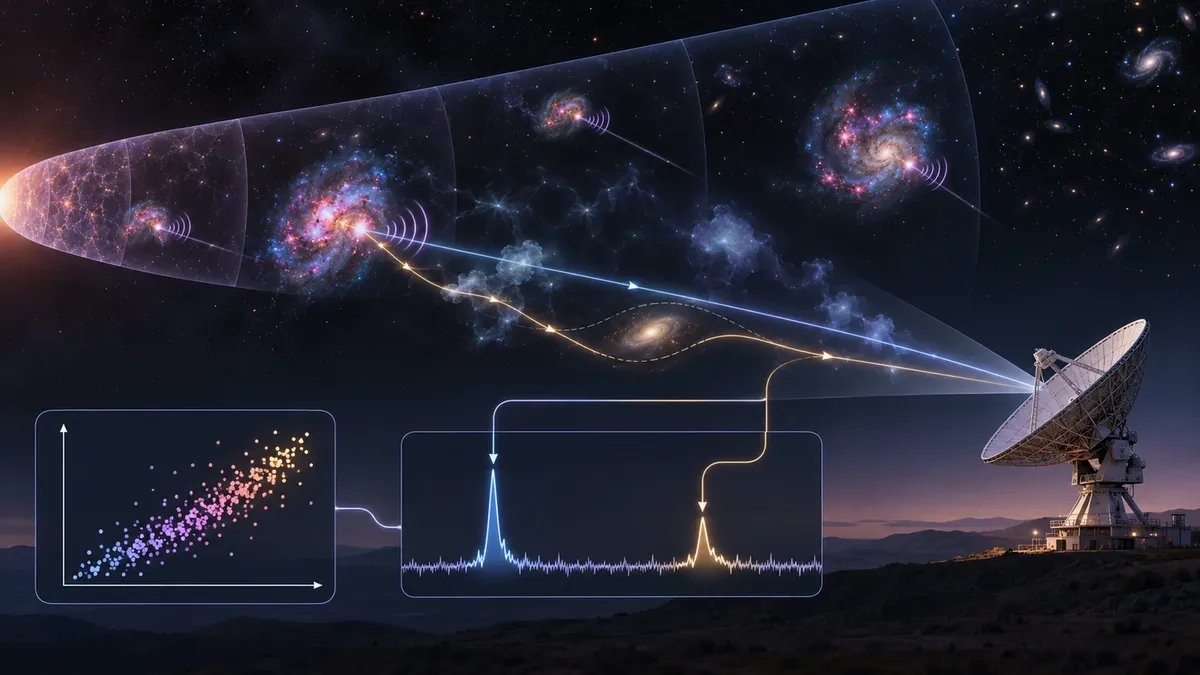
Do fast radio bursts follow soon after stars form, or can their sources take billions of years to emerge? A study using CHIME/FRB data finds that the answer changes with how burst brightness is incorporated—and highlights a mapping issue that needs further investigation.
Fast radio bursts (FRBs) are brief, bright flashes of radio waves from beyond the Milky Way. Their sources remain unidentified. One clue to their origins is how the rate of bursts changes over cosmic time. If that rate follows the history of star formation, some FRBs may come from young stellar populations. If it peaks later, some sources may form through processes with longer delays, such as compact-object mergers.
A preprint by X. D. Jia and colleagues examines this question using CHIME/FRB catalogs. Its central finding is that the inferred delay between star formation and FRB events depends on how the analysis handles fluence—the radio energy received per unit area during a burst.
Modeling the detected bursts
The researchers used forward modeling: they estimated how a proposed underlying FRB population would appear after passing through CHIME’s detection process. To represent the instrument’s selection effects, they used synthetic signals injected into the detection pipeline.
The main analysis compared observed and predicted counts across a two-dimensional grid of dispersion measure (DM) and signal-to-noise ratio (S/N). DM reflects the free electrons along a burst’s path, which delay its radio signal in a frequency-dependent way. It can help constrain distance, but electrons in the intergalactic medium and the burst’s host galaxy also contribute. S/N describes how clearly a burst stands out from noise and is related to its apparent strength.
The team focused on bursts classified as apparently one-off, applying cuts intended to reduce the influence of uncertain detections, Galactic contributions and strongly scattered signals. After these cuts, 1,955 events from the second CHIME catalog remained. The researchers also analyzed the first catalog in parts of the study.
Two approaches, different answers
When the model considered both DM and S/N, the fitted FRB rate followed the cosmic star-formation history with little delay. For both catalogs, the inferred delay was consistent with zero within two standard deviations. This does not establish that all FRB sources are young; it means the combined analysis did not find a statistically clear delay under its model and assumptions.
The result changed when the researchers used DM alone and marginalized over fluence. In that analysis, both catalogs favored a delay of roughly 3–4 billion years. The contrast illustrates why different modeling choices can produce different conclusions about the population’s cosmic history.
The authors point to the conversion between fluence and S/N as a possible source of the discrepancy. CHIME’s reported fluences can be lower limits rather than true values, partly because uncertainty about a burst’s location within the telescope beam affects the estimate. The study therefore uses a mapping between fluence and S/N rather than relying directly on reported fluences. But the two quantities are positively correlated without having a strictly linear relationship. As a result, counts grouped into fluence bins may not correspond neatly to counts grouped into S/N bins. The authors suggest that residual bias in this mapping could suppress an inferred delay in the analysis using both S/N and DM.
They also tested alternative descriptions of intergalactic DM and possible redshift evolution in the host-galaxy contribution. The paper reports that these choices did not remove the broad contrast between the joint DM-and-S/N and DM-only analyses, though assumptions can affect the estimated delay.
What remains uncertain
This is a model-based inference, not a direct measurement of individual bursts’ ages or origins. It depends on assumptions about the FRB energy distribution, host-galaxy DM, cosmic evolution and CHIME’s selection effects. The authors note that their model does not include possible evolution in burst energy with redshift. They also identify possible influences on the fluence-to-S/N mapping beyond pulse width and scattering.
The results therefore do not settle whether FRBs as a population mostly trace young or delayed progenitors. They show that the inferred history is sensitive to how burst brightness is interpreted, while leaving a delayed component plausible. More localized FRBs and better-calibrated measurements could help test the mapping and distinguish population behavior from observational bias.
The source is a November 2026 arXiv preprint. The supplied material does not establish whether it has undergone peer review, so the findings should be read as provisional and assessed alongside the paper’s methods and assumptions.
- fast radio bursts
- CHIME/FRB
- star formation history
- fluence
- signal-to-noise ratio
- dispersion measure
- astrophysics
Reviewed cross-references
These connections were reviewed by a model, not independently fact-checked by a human. Similarity does not imply agreement; consult the original papers and the evidence below.
What CHIME’s second catalog reveals about FRBs
Shared method: Both studies model CHIME/FRB populations while accounting for instrumental selection effects and use signal-to-noise and dispersion-measure information. Their rate-evolution results are not directly comparable: the origin study reports little delay when both DM and fluence are considered, whereas the Catalog 2 study says evolution relative to star formation remains statistically unconstrained.
Model review: · openai-codex/gpt-6-luna
Evidence and provenance
Selected excerpts, not complete papers. PDF extraction can omit figures or damage equations, tables and reading order; sources may be preprints.
2611.33906v1 — Original paper
Excerpt reference:
static/papers/2611.33906v1.md:104-171
Basis: Paper text
Source SHA-256:7c054bf9310f80313eee785c85b133559ad31c42b8c9e8e060bd8cad5e7e6ccb2611.33906v1 — Original paper
Excerpt reference:
static/papers/2611.33906v1.md:417-479
Basis: Paper text
Source SHA-256:7c054bf9310f80313eee785c85b133559ad31c42b8c9e8e060bd8cad5e7e6ccb2611.28334v1 — Original paper
Excerpt reference:
static/papers/2611.28334v1.md:192-264
Basis: Paper text
Source SHA-256:57ed5d1815c085c76390bbb4b8500c3d3d5c72740cd1062b4bb513ea73e20b0f2611.28334v1 — Original paper
Excerpt reference:
static/papers/2611.28334v1.md:354-478
Basis: Paper text
Source SHA-256:57ed5d1815c085c76390bbb4b8500c3d3d5c72740cd1062b4bb513ea73e20b0f2611.28334v1 — Original paper
Excerpt reference:
static/papers/2611.28334v1.md:45-75
Basis: Paper text
Source SHA-256:57ed5d1815c085c76390bbb4b8500c3d3d5c72740cd1062b4bb513ea73e20b0f
Related reading
Automatically matched by shared topic keywords. These links do not imply that the sources agree or establish a consensus.
What CHIME’s second catalog reveals about FRBs
Source published
Shared keywords: chime frb, dispersion measure, fast radio bursts
Radio bursts offer tentative clues to gas around nearby galaxies
Source published
Shared keywords: dispersion measure, fast radio bursts
Fast Radio Bursts Map the Clumping of Cosmic Electrons
Source published
Shared keywords: dispersion measure, fast radio bursts
Why repeating fast radio bursts may change their dispersion over time
Source published
Shared keywords: dispersion measure, fast radio bursts
A Cross-Signal Search for the Universe’s Missing Baryons
Source published
Shared keywords: fast radio bursts