TRANSMISSION // 2611.33899v1
Reading Turbulence in the Directions of Radio Waves
Source published
A theoretical study shows how polarization directions may reveal turbulence when radio emission and Faraday rotation share the same volume—and why the answer depends on the model and scale.
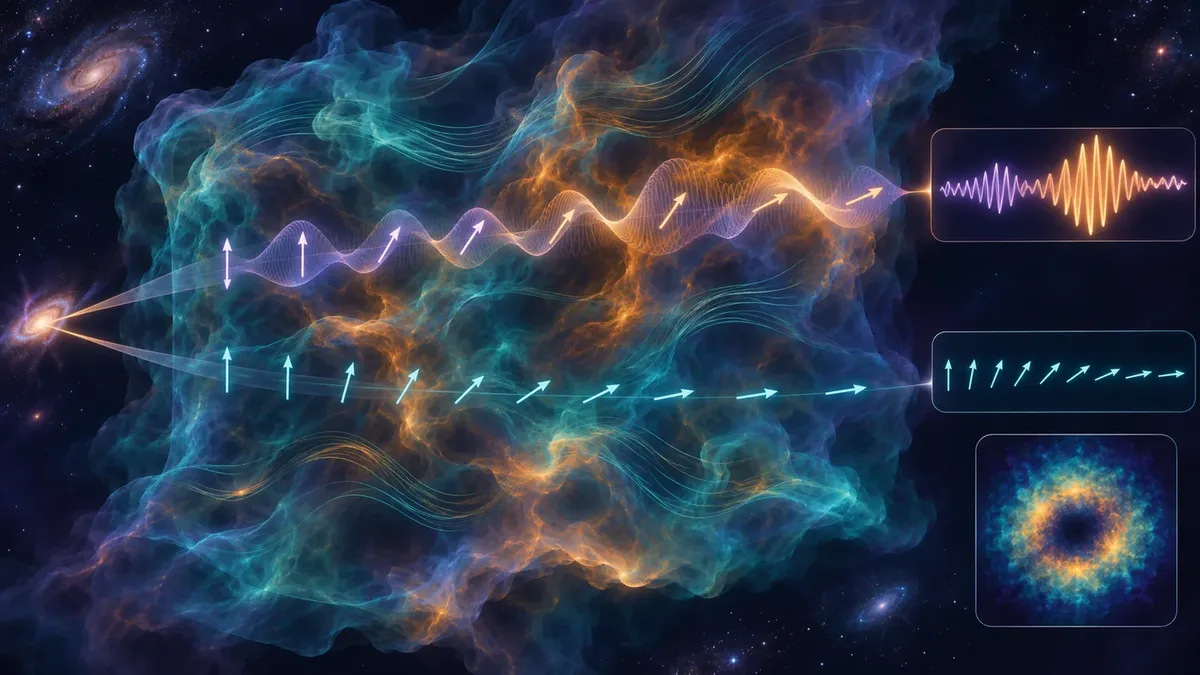
Radio waves from space carry clues about magnetic fields and turbulent plasma. A new theoretical preprint asks whether the changing directions of polarized radio waves can help disentangle emission from Faraday rotation when both happen along the same line of sight.
The problem: separating light from its journey
Synchrotron radiation, produced by charged particles moving through magnetic fields, is often polarized: its electric field has a preferred direction. As the wave travels through magnetized plasma, Faraday rotation turns that direction. In a turbulent region, both processes can occur throughout the same volume, so the observed signal combines emission from many depths, each rotated by a different amount.
The challenge is that ordinary polarization statistics are weighted by polarized brightness. Bright regions can therefore dominate a measurement, even if the question is about how directions vary across the sky. The authors study a complementary quantity: the spatial correlation of polarization directions after normalizing away the signal’s amplitude. Direction is unchanged if the polarization strength rises or falls, though the normalization has its own practical sensitivity to weak signals.
A conditional calculation
The paper develops a mathematical framework for this mixed emitting-and-rotating geometry. It represents the observed polarization as a depth integral: each contribution from the emitting medium accumulates a Faraday-induced rotation before reaching the observer. The authors then compare the normalized directions at pairs of sky positions and derive their correlation and spatial spectrum.
A central result applies when the intrinsic polarized emissivity is an independent, zero-mean circular complex Gaussian field. For this specified model, the authors derive an exact relation: first calculate the direction correlation while holding the Faraday-depth histories along the two sightlines fixed, then average over those histories. This order matters because normalizing a polarization vector is nonlinear. In general, averaging the ordinary polarization correlation first and then converting it into a direction statistic does not give the right answer.
The paper also examines limiting cases: weak internal rotation in a coherent, uniform emitter; strong random Faraday rotation in a deep volume; and strong, regular mean rotation. These are theoretical derivations and model-based predictions, not a report of new telescope observations.
What the analysis finds
In the strong-random-rotation case, the turbulent plasma sets an effective coherence depth: contributions from parts of the source whose rotation phases have become sufficiently different no longer add coherently in the ordinary polarization. The authors derive how this depth changes with transverse separation. When the Faraday-density spectrum is steep, the predicted behavior contains an additional interval of spatial scales. These intervals can, under suitable conditions, produce corresponding branches and breaks in the polarization-direction spectrum.
But the depth scalings do not automatically translate into measurable spectral slopes. That inference also requires low enough directional coherence, slowly varying intrinsic-emission correlations over the relevant range, and enough separation between the characteristic scales. If these conditions fail, finite-range correlations and boundaries matter, and a simple power law may not describe the result.
For weak rotation in a coherent uniform emitter, the direction statistic responds to Faraday fluctuations. The authors derive a wavelength-dependent contribution and show that correlations between intrinsic direction changes and Faraday rotation can enter as well. Thus, the signal is not always a clean measure of Faraday fluctuations alone.
The study also connects the direction spectrum to the normalized tangential polarization gradient, a measure of local direction changes. Their vector-gradient spectra are related exactly by a factor proportional to spatial wavenumber squared. The gradient emphasizes small-scale variation, but is more affected by beam smoothing, noise and the handling of weak polarization. The spectrum of the direction itself can help identify broad scale ranges without taking a spatial derivative.
Promise, caveats and preprint status
The proposed diagnostics could complement existing analyses of polarization, wavelength dependence and synchrotron intensity. Used together, they may help researchers investigate the statistics of the emitting and rotating material and whether those components occupy the same region. The paper stresses that no single statistic settles that question: several measurements and their wavelength behavior need to be interpreted together. Even patterns consistent with a separate foreground screen do not prove that the emitting and rotating regions are physically distinct.
The exact relation is conditional on its Gaussian-emissivity assumptions. Real synchrotron emissivity may be non-Gaussian, correlated with the rotating plasma, or have a nonzero mean; the paper says these cases require an appropriate conditional calculation. The analytic scaling laws are limiting results, not universal predictions. Observations would also need adequate resolution and polarized signal-to-noise, with beam and noise effects accounted for before normalization.
This is a theoretical preprint, not evidence that the proposed method has already succeeded on astronomical data. Its results provide a framework and testable predictions; their practical reach depends on realistic source modeling and observational validation.
- synchrotron polarization
- Faraday rotation
- astrophysical turbulence
- magnetic fields
- radio astronomy
- polarization statistics
Related reading
Automatically matched by shared topic keywords. These links do not imply that the sources agree or establish a consensus.
Blazar polarization hints at magnetic changes that build on one another
Source published
Shared keywords: magnetic fields
Which exoplanets could the SKA hear? A radio forecast with important caveats
Source published
Shared keywords: radio astronomy
Radio galaxies masquerade as tiny gravitational lenses
Source published
Shared keywords: radio astronomy
A Decade of Antarctic Radio Data Tightens the Search for Extreme Neutrinos
Source published
Shared keywords: radio astronomy
How cluster gas may carry the Flying Fox radio source
Source published
Shared keywords: radio astronomy