TRANSMISSION // 2611.33893v1
When AI Coding Agents Should Delegate
Source published
Parallel subagents can modestly improve coding-agent results, but the benefit depends on the task and may come at substantially higher cost.
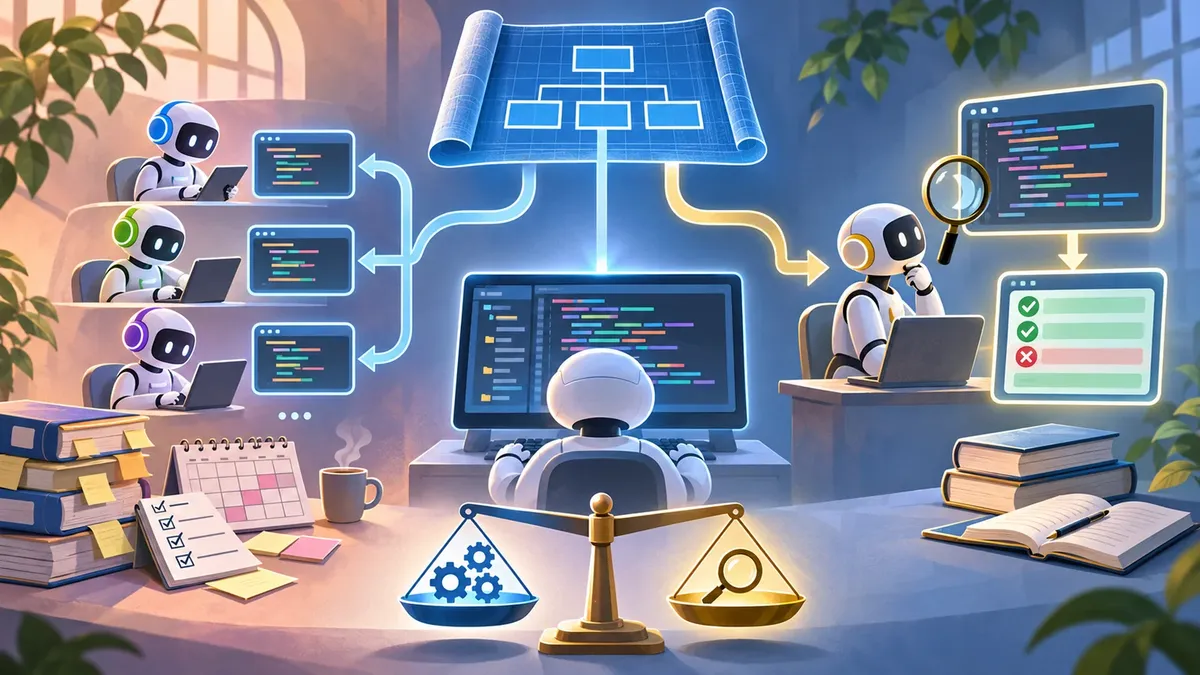
When a coding agent hands parts of a software-building task to parallel helpers, does the finished program get better? A preprint finds conditional benefits: gains are larger on hard tasks, while separate experiments suggest that checking a reference program can help a single agent too.
When does delegation pay off?
AI coding agents can tackle long tasks such as building a software repository from a written specification. Some systems let a main agent delegate work to parallel subagents. This can multiply the computational cost, so Zhiheng Lyu, Chengyu Yin and Lingming Zhang ask whether the extra work produces a better program—and when.
Their answer is qualified. Parallel helpers can improve results, particularly on harder tasks, but the average gains reported for randomly selected tasks are small. The abstract also describes ways a single agent can be prompted or run differently; these are separate findings, not evidence that delegation itself causes those behaviors.
How the researchers compared agents
The team compared a single agent with a main agent delegating to subagents on repository-construction tasks from NL2Repo and ProgramBench. ProgramBench also provides an executable reference program. They compared results at equal time and equal cost, ran experiments that changed how agents worked, and examined agent behavior in detail.
One outcome was the percentage of hidden tests passed: tests used to assess whether the generated program works beyond what may be apparent during development. The abstract reports that, on randomly drawn tasks, parallel subagents raised hidden-test pass rates by about 1 to 5 percentage points, at up to 3.8 times the cost of a single agent. The reported gain was larger on hard tasks, but the abstract gives no specific figure for that subgroup.
Checking, fresh sessions and code structure
The researchers report an intervention involving self-checking. With GPT-5.6 Sol, a single agent given a one-sentence instruction to probe the reference program first recovered most of the delegation gain, at a fraction of the cost. This shows that the instruction helped in that experiment; it does not show that delegation itself encourages agents to check their work. The authors also report that the delegation gain shrank from GPT-5.6 Sol to GPT-6.1 Sol as single agents checked their own work more.
A separate finding concerns long runs. In extended experiments, a single agent that periodically began a new session with an empty conversation made faster early progress in every comparison than one that resumed its conversation. The abstract reports faster early progress, not that fresh sessions matched delegation’s gains or improved final results.
The researchers also found that multi-agent runs produced more modular code—more files and shorter functions—and that this structure was closer to the upstream source. This is an observed difference in code structure; the abstract does not establish that it caused better test performance or that it is preferable for every project.
The authors report similar patterns in a smaller replication using Opus 5.5 with Claude Code. That offers a further check, but the abstract does not provide enough detail to judge how broadly the result generalizes.
What to take from the findings
The authors’ conclusion is conditional: subagents may help when a single agent stops checking too early, when a long session continues editing with little improvement, or when modular code benefits the task. Otherwise, they may mainly add cost. The fresh-session result and the reference-probing instruction are potential alternatives in specific experiments, not proof that a single agent can always reproduce delegation’s benefits.
These results concern particular repository-construction benchmarks, models and setups. Hidden-test performance measures task completion, but does not by itself assess software security, maintainability or overall quality. The supplied evidence is the paper’s abstract rather than its full text, so detailed methods, task counts and uncertainty estimates cannot be assessed here. The work is identified as an arXiv preprint; its peer-review status is not established by the available source. The findings should be treated as preliminary evidence, not a general rule that more agents make better software.
- AI coding agents
- parallel subagents
- software engineering
- repository construction
- artificial intelligence
Related reading
Automatically matched by shared topic keywords. These links do not imply that the sources agree or establish a consensus.
For Code-Finding Agents, Exploration Beat Extra Structure
Source published
Shared keywords: ai coding agents, software engineering
Why AI coding agents need more than a rulebook
Source published
Shared keywords: ai coding agents
When AI coding agents get a map to the rules
Source published
Shared keywords: ai coding agents, software engineering
How Faults Could Spread Across AI-Written Code Changes
Source published
Shared keywords: ai coding agents, software engineering
Teaching Coding Agents the Hidden Structure of On-Device AI
Source published
Shared keywords: software engineering