TRANSMISSION // 2611.33888v1
How Local Dephasing Can Make Quantum Histories Behave Classically
Source published
A mathematical study links local memory loss to weaker interference between quantum histories, while emphasizing the assumptions and limits of that connection.
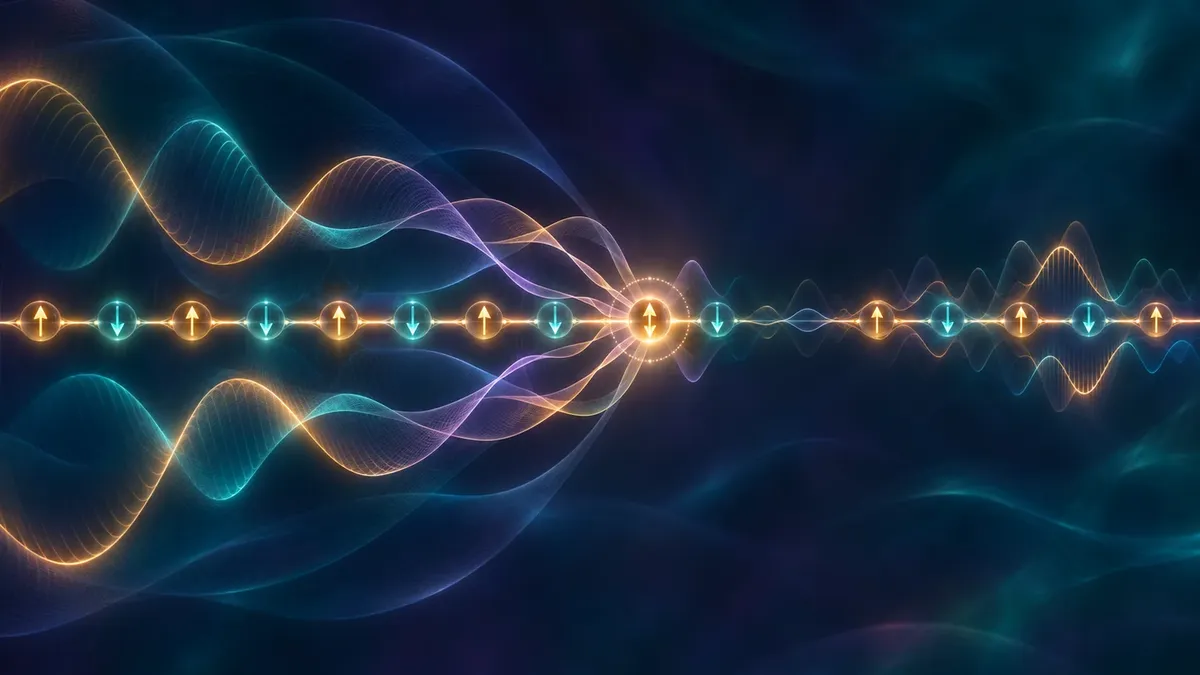
An isolated quantum system never stops evolving coherently as a whole. Yet sequences of events within it can sometimes be described as if they had ordinary probabilities. Jie Gu’s preprint asks when local dynamics can help make that description consistent—and what must be assumed for the argument to work.
When can quantum histories have ordinary probabilities?
A quantum system can be isolated and still show behavior that looks classical in some respects. One way physicists describe this is the decoherent histories framework: specify possible outcomes at a succession of times, then calculate how much the corresponding sequences—histories—interfere with one another. If interference between different histories is sufficiently small, their calculated weights can obey the usual probability sum rules when outcomes are grouped together.
That is a narrower claim than saying the system has become classical. It does not by itself establish that the system is predictable, has no memory, or has left durable records of past events. Jie Gu’s preprint, “Decoherent Histories from Local Spectral Dephasing in Quantum Many-Body Systems,” asks whether a more local property—loss of memory in a measured quantity—can help suppress interference across a whole prescribed family of histories.
From frequencies to memory
The paper studies a local projector, a mathematical representation of a yes-or-no measurement on a limited part of a system. The projector’s changing correlations can be understood as a weighted collection of oscillations at the system’s energy-difference frequencies, also called Bohr frequencies. As these components acquire different phases, they may cancel one another. This is local spectral dephasing: memory in the chosen local observable fades on average, even though the isolated system as a whole continues to evolve unitarily.
The weights matter. A frequency counts more when the chosen projector has larger matrix elements connecting the corresponding energy states. Gu defines a measure of how much of that weighted spectral signal lies inside any frequency interval narrow enough to remain unresolved during a chosen observation window. The first main theorem establishes an equivalence, in the appropriate limits across sequences of systems and observation windows: this weighted concentration vanishes if and only if the absolute time-averaged connected correlation vanishes.
In plain terms, the frequency-domain and time-domain tests describe the same asymptotic loss of local memory. The result is about averages, not steady, point-by-point decay: correlations can return at particular times. Nor does it say that simply having many distinct energy differences guarantees dephasing. Their projector-weighted distribution, including clusters of nearby frequencies, is what matters at finite resolution.
When local memory loss controls histories
The second theorem connects this local test to interference among histories. Its setting is specific: the alternatives are fixed in advance as complete sets of projectors; the waiting times between observations are sampled independently and uniformly from a stated interval; the initial state obeys an upper bound on its largest eigenvalue; and every history has a positive reference weight that cannot become too small.
Under these conditions, weak local memory provides a sufficient route to suppressing normalized interference across all distinct histories in the prescribed family with high probability over the sampled waiting times. “Normalized” matters: a small raw overlap need not mean weak interference compared with the probabilities of the two branches. The theorem also gives an explicit bound whose usefulness depends on the number of histories, the waiting-time window, and the state and branch-weight conditions. At finite size the bound can be too large to establish a useful probability of success.
The result concerns a selected family of projective histories—not arbitrary sequences of interventions. It does not establish general memorylessness, classical predictability, or the existence of physical records. Other mechanisms, including approximate conservation or records, can also produce decoherent histories; local memory loss is one sufficient mechanism, not a necessary condition.
Lattices and numerical illustrations
For translation-invariant lattices, the paper derives conditions that can make the local spectral criterion hold at long times. The analysis assumes nondegenerate energy levels and bounds on how many pairs of energy states share a nonzero energy difference. With fixed local measurement support and suitable behavior of those gap multiplicities as the lattice grows, the authors show that suitable observation windows exist. They do not derive a universal timescale for reaching them: closely spaced frequencies may take a long time to resolve.
The paper illustrates the ideas with a one-dimensional spin chain. Exact diagonalization estimates the relevant spectral weights; sparse time evolution and trace-sampling methods estimate interference in a four-observation family. The reported calculations show the quantities involved in the theorems and illustrate their behavior for the simulated system. They do not prove the large-system assumptions or directly test the theorem’s full probability bound. Some numerical diagnostics use finite frequency resolution or finite sampling, and the paper explicitly notes that these estimates are not exact determinations of all spectral properties or interference values.
An appendix gives a separate example using dual-unitary Floquet circuits, where an exact relation for certain local correlations before the system’s causal region wraps around the ring supplies a memory bound. That result, too, applies under specified conditions; it does not imply that all other, higher-order forms of memory vanish.
The central contribution is therefore a mathematical bridge: a suitably dispersed, locally weighted spectrum can imply weak time-averaged local memory, which under additional assumptions can imply weak interference across a fixed family of histories. Important open questions include proving useful timescales for broad classes of Hamiltonians and extending the result to histories whose length grows with system size. This article reports a preprint, not an independently established scientific consensus; its proofs, assumptions, and numerical limitations should be assessed in that context.
- quantum decoherence
- decoherent histories
- spectral dephasing
- quantum many-body systems
- local memory
- spin chains
Reviewed cross-references
These connections were reviewed by a model, not independently fact-checked by a human. Similarity does not imply agreement; consult the original papers and the evidence below.
When quantum histories nearly decohere, which leave records?
Shared method: Both analyze interference between histories through off-diagonal history overlaps: Gu proves a probabilistic suppression result for fixed-length families under independent waiting times and stated state and branch-weight assumptions, while Strasberg and coauthors numerically study a random-matrix model and report recoherence in some long histories. The shared object is the history-overlap analysis, not an identical procedure; the numerical findings do not establish or refute Gu’s theorem.
Model review: · openai-codex/gpt-6-luna
Evidence and provenance
Selected excerpts, not complete papers. PDF extraction can omit figures or damage equations, tables and reading order; sources may be preprints.
2611.33888v1 — Original paper
Excerpt reference:
static/papers/2611.33888v1.md:1926-1976
Basis: Paper text
Source SHA-256:2378fdb0e23a15f7a8bc3d864fe025185c6ff344082d1638e73620c4780d14392611.33888v1 — Original paper
Excerpt reference:
static/papers/2611.33888v1.md:767-927
Basis: Paper text
Source SHA-256:2378fdb0e23a15f7a8bc3d864fe025185c6ff344082d1638e73620c4780d14392601.19703v2 — Original paper
Excerpt reference:
static/papers/2601.19703v2.md:72-123
Basis: Paper text
Source SHA-256:8a9c5cbf6d9a79ae5fb25deeb57ef26cb010ed71a260fd64ade66eb6bfbb09882601.19703v2 — Original paper
Excerpt reference:
static/papers/2601.19703v2.md:2430-2497
Basis: Paper text
Source SHA-256:8a9c5cbf6d9a79ae5fb25deeb57ef26cb010ed71a260fd64ade66eb6bfbb0988
Related reading
Automatically matched by shared topic keywords. These links do not imply that the sources agree or establish a consensus.
When quantum histories nearly decohere, which leave records?
Source published
Shared keywords: quantum decoherence
How matter-wave interferometers could detect dark matter’s subtle effects
Source published
Shared keywords: quantum decoherence
A hybrid method brings huge spin baths within reach
Source published
Shared keywords: quantum decoherence
A more stable way to model quantum environments at finite temperature
Source published
Shared keywords: quantum decoherence
When quantum jumps become classical probabilities
Source published
Shared keywords: quantum decoherence