TRANSMISSION // 2611.33883v1
TyxonQ connects quantum chemistry to the wider workflow
Source published
TyxonQ links quantum solvers with classical chemistry and simulation tools. Small tests check its interfaces, but do not demonstrate quantum advantage or validate hardware workflows.
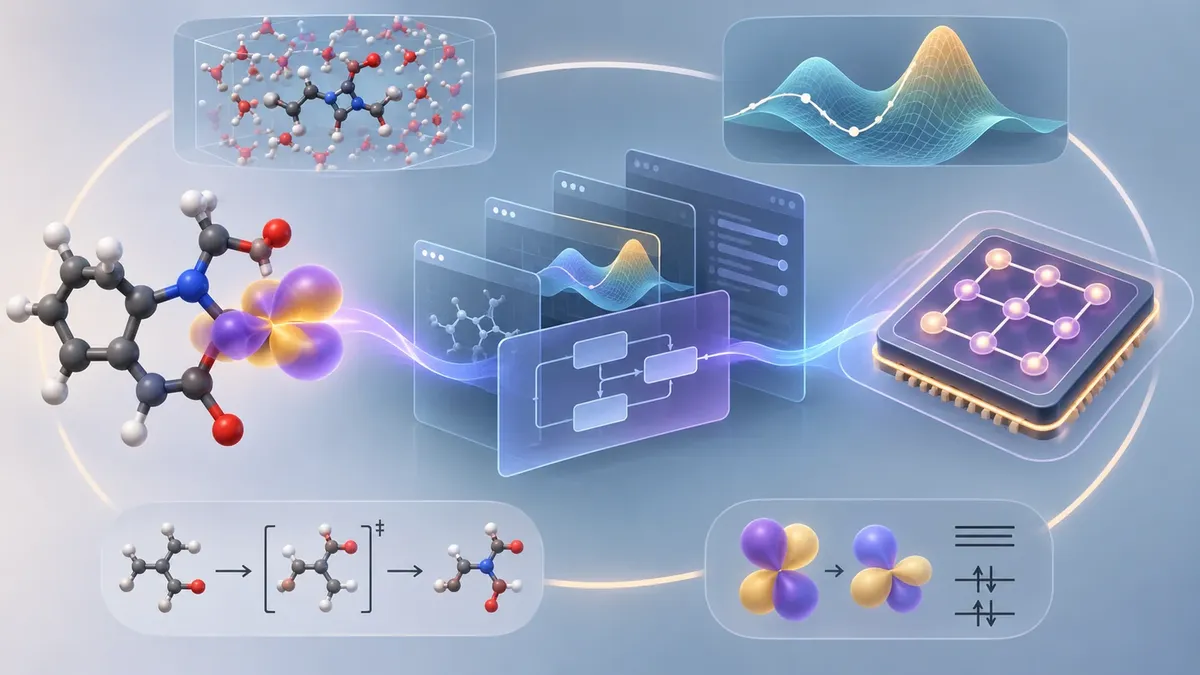
A quantum chemistry calculation is more than a quantum circuit: it must fit into a larger chain of molecular modeling, energy and force calculations, and sometimes molecular dynamics. TyxonQ is designed to connect those pieces while leaving much of the work classical.
Quantum computing in chemistry is often discussed in terms of algorithms and circuits. But a molecular calculation also needs a model of its environment, a way to calculate forces, and software that can pass results to an optimizer or simulation engine. The question behind TyxonQ is practical: can a shared software layer connect these parts so researchers can try a quantum solver on a selected piece of a calculation without rebuilding the entire workflow?
The framework described by Xiaoran Li and colleagues divides work among classical molecular mechanics, conventional electronic-structure calculations, and, where appropriate, a quantum solver for selected orbitals or molecular fragments. These are options, not steps that every calculation must use. A quantum computer is not asked to handle the whole molecule. Researchers must still decide which region and orbitals to model; TyxonQ does not automatically identify where quantum treatment is needed or whether the chosen model captures the chemistry.
Four hand-offs, one workflow
TyxonQ organizes the connections as four interfaces: from a molecular setup to an electronic problem; from that problem to a classical or quantum solver; from quantum calculations to a simulator or hardware backend; and from the assembled energy and gradient to a classical consumer. A gradient describes how energy changes as atoms move and can be used to calculate forces.
The implementation builds on existing tools rather than claiming new chemistry methods. It connects PySCF-based calculations and embedding approaches with conventional fragment solvers, variational and sampling-based quantum methods, and adapters for software including ASE, i-PI, OpenMM, LAMMPS through i-PI, and MDI. Classical simulation engines and conventional calculations remain responsible for their parts of the workflow.
A key concern is consistency at these boundaries. Different tools may use different units, orbital or bit orderings, and force conventions. A plausible energy at one molecular geometry may still be unsuitable for dynamics if the energy surface is not smooth as atoms move. TyxonQ includes a safeguard for one sampling-based scanner: it freezes the sampled subspace across geometries unless the user explicitly accepts potentially discontinuous behavior. This does not establish that every supported method produces reliable forces or stable dynamics.
What the tests show
The paper evaluates interface behavior, not whether quantum computers outperform classical methods. The authors report small calculations involving hydrogen, lithium hydride, and water, with selected active spaces. For water, they compared a scanner’s energy and gradient with reference calculations and a finite-difference gradient check. They also tested energy-and-force conversion through ASE and ran a short geometry-optimization check. These tests support the claim that particular pieces of the workflow can be connected and checked; they are not evidence of a new chemical prediction or broad solver accuracy.
Other demonstrations include electrostatic embedding and a small fragment workflow using sampling followed by a classical recovery step. The authors also tested whether simple circuit descriptions survived export and import through OpenQASM and JSON formats. These are checks of specific software contracts, not proof that artifacts will work on every device. The generated pulse-language artifact, for example, was not validated for external replay.
The reported timing comparison is limited too. For hydrogen, lithium hydride, and water, the tested scanner path took 2.04, 2.32, and 3.16 times as long, respectively, as direct PySCF CASCI calculations in that run. The paths do different work, including variational-solver optimization and mean-field updates, so these ratios do not isolate the cost of the interfaces or establish a general performance trend.
What remains uncertain
The evaluation did not submit jobs to quantum hardware. Hardware-provider adapters are assessed from source code, not end-to-end device runs. ASE was the only downstream consumer exercised in the reported evaluation; molecular-dynamics trajectories and the other listed consumer integrations were not independently reproduced there. Larger embedding and periodic workflows likewise have weaker evidence than the small executed examples. Timings came from one machine and one software environment.
The paper also describes unfinished integration work. Provider discovery is not yet a general plugin system, adding a provider can require code changes, and the base installation has substantial dependencies. The authors do not benchmark solver accuracy, speed, or memory against other frameworks.
TyxonQ’s contribution is best understood as an integration layer with tested examples, not a demonstration of quantum advantage or a turnkey route to industrial-scale quantum chemistry. The work is an arXiv preprint and may not have undergone peer review. Its results should be read within the authors’ stated scope: specific interface checks on small systems, with hardware, scale, and broader reproducibility still to be established.
- quantum chemistry
- quantum computing
- TyxonQ
- molecular simulation
- QM/MM
- scientific software
Reviewed cross-references
These connections were reviewed by a model, not independently fact-checked by a human. Similarity does not imply agreement; consult the original papers and the evidence below.
A leaner orbital basis for quantum chemistry
Supporting evidence: Both papers identify choices about the electronic problem as important under quantum-resource limits: TyxonQ describes active-space and embedding choices as central to feasible calculations, while Deb and Prasannaa report that reoptimized minimal basis sets can improve some energies at a fixed qubit count, with limitations for other systems. These are complementary, not directly compared approaches; the basis-set results do not validate TyxonQ workflows.
Model review: · openai-codex/gpt-6-luna
Evidence and provenance
Selected excerpts, not complete papers. PDF extraction can omit figures or damage equations, tables and reading order; sources may be preprints.
2611.33883v1 — Original paper
Excerpt reference:
static/papers/2611.33883v1.md:13-64
Basis: Paper text
Source SHA-256:e9de3168b784bf754dbcc83e9216d1ee0bd017520a7f243de572ddce76583b192608.02119v3 — Original paper
Excerpt reference:
static/papers/2608.02119v3.md:192-246
Basis: Paper text
Source SHA-256:7350b878fc7f74c19f316960e104ced5d97322be7b537629ab04ad02936cee222608.02119v3 — Original paper
Excerpt reference:
static/papers/2608.02119v3.md:1594-1662
Basis: Paper text
Source SHA-256:7350b878fc7f74c19f316960e104ced5d97322be7b537629ab04ad02936cee22
Related reading
Automatically matched by shared topic keywords. These links do not imply that the sources agree or establish a consensus.
Fulqrum speeds up the classical step in quantum-assisted energy calculations
Source published
Shared keywords: quantum chemistry, quantum computing, scientific software
Hydrogen stand-ins help transfer quantum circuit settings to larger molecules
Source published
Shared keywords: molecular simulation, quantum chemistry
PyCC is a research toolkit for quantum chemistry
Source published
Shared keywords: quantum chemistry, scientific software
A randomized approach to Coulomb simulation
Source published
Shared keywords: quantum chemistry
A smarter way to split fermion simulations across quantum processors
Source published
Shared keywords: molecular simulation, quantum computing