TRANSMISSION // 2611.33864v1
How Autonomy Forces Isotropic Noise Responses
Source published
Xu Chen and Xue Ma report mathematical thresholds linking autonomous encoded qubits to depolarizing-style isotropy, plus separate results for Pauli noise and restricted readouts.
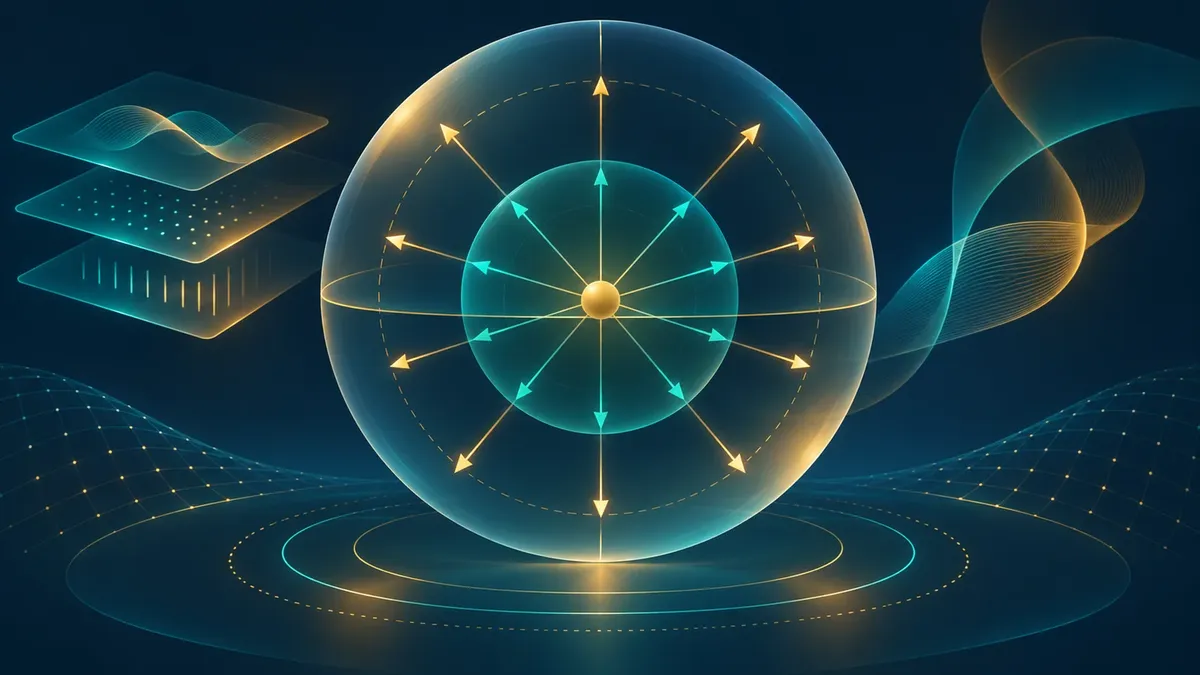
When does autonomy in encoded qubits force noise to affect distinguishability uniformly? A preprint by Xu Chen and Xue Ma gives a threshold for this depolarizing-style response and reports related results for Pauli noise and readout resources.
What does isotropy mean here?
Quantum states can be distinguished by how far apart they are in trace distance. Under depolarizing noise, that distance is multiplied by a common factor: the shrinkage is the same across directions. This uniform scaling is the isotropic response at the heart of the paper—not a claim that every kind of quantum noise has this property.
The authors ask how many encoded qubits must be autonomous for autonomy to force this response. In the abstract, an encoded qubit is autonomous if its reduced input state determines its output. The work studies when that condition implies isotropy.
A threshold for generic encodings
For a system of dimension (D=2^n), where (D\geq4), the abstract reports a sharp threshold of ((D^2+5)/3) generic encodings: autonomy at that threshold forces isotropy. “Generic” is the abstract’s characterization; it does not explain how such encodings are selected.
The threshold is reported as two more encodings than state tomography requires. This is a comparison of counts for the respective mathematical tasks, not a claim that the tasks are interchangeable. The abstract does not give the derivation or further details of the tomography comparison.
Pauli noise and restricted readouts
For Pauli noise, the abstract reports a distinct result: one generic encoding suffices. It also considers Pauli testing with one-bit readouts and no quantum memory or reference. Under those restrictions, switching encodings cuts the worst-case cost for the Pauli test by a factor of (D), up to logarithmic factors. The abstract does not specify the cost measure or spell out a testing procedure, so those details cannot be assessed from the available evidence.
The abstract also states an existence result: for any family of encodings, there is a channel with leakage (O(D^{-3/2})) that can transmit one bit perfectly and erase another. The abstract does not explain the construction, so this report cannot describe how the channel achieves that behavior.
What the evidence can—and cannot—show
These are mathematical claims about encoded qubits, noise channels and readout restrictions. The supplied abstract does not report experiments. Its results therefore should not be read as evidence that a particular device or physical noise process has an isotropic response. That is an editorial scope note, rather than a finding attributed to the authors.
This account is based on the abstract, not the full paper. It does not provide proofs or enough detail to assess the definitions and assumptions behind “generic,” the cost comparison, or the leakage result. The source is an arXiv preprint. The supplied record does not establish whether it has undergone peer review, so its review status remains unknown here.
- quantum information
- autonomous encoded qubits
- isotropic response
- depolarizing noise
- Pauli noise
Related reading
Automatically matched by shared topic keywords. These links do not imply that the sources agree or establish a consensus.
A step-by-step strategy for recovering quantum states
Source published
Shared keywords: quantum information
A Noise Boundary for Quantum-Memory Learning
Source published
Shared keywords: pauli noise
Why Incoherent Quantum Codes Struggle with Noise
Source published
Shared keywords: depolarizing noise, quantum information
A convergent hierarchy probes classical explanations of quantum states
Source published
Shared keywords: depolarizing noise, quantum information
When quantum magic cannot be distilled
Source published
Shared keywords: quantum information