TRANSMISSION // 2611.33822v1
AI agents learn to reuse procedures as tasks unfold
Source published
MetaDecomp matches stored procedures to an agent’s progress and fills in missing steps. Its abstract reports the highest mean performance in four of five benchmark settings and lower inference-token use than two comparison methods.
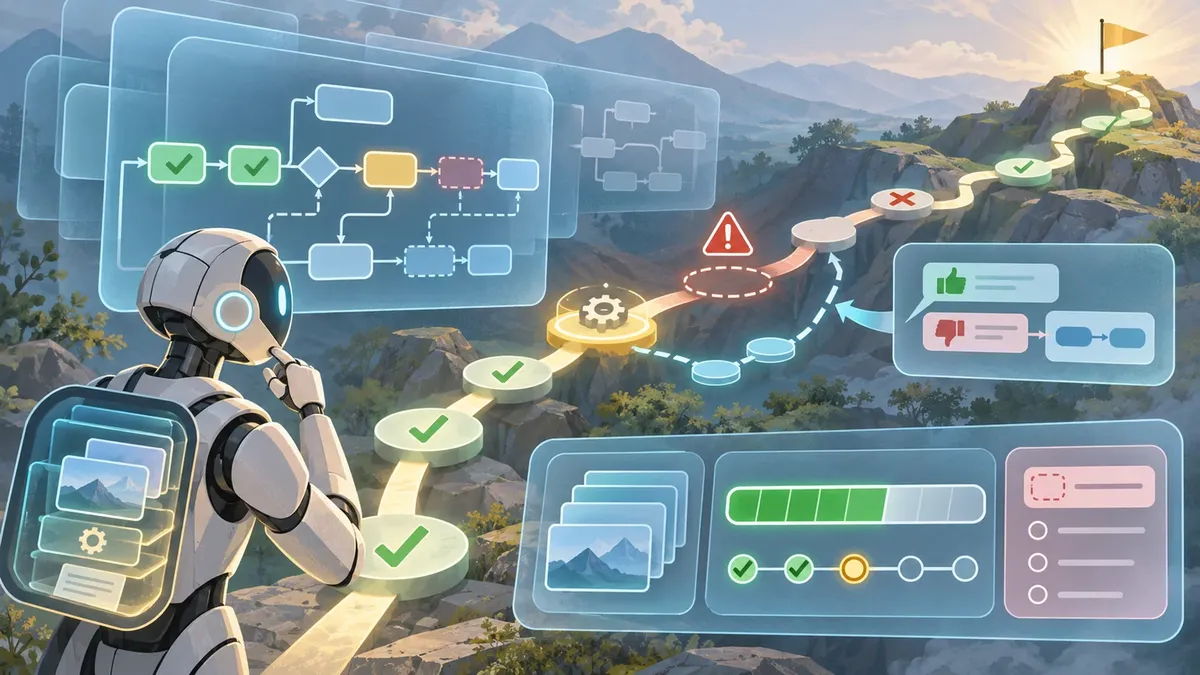
A saved procedure helps only if an agent can tell when it fits—and what remains to be done. MetaDecomp is designed to make that judgment as a task progresses.
A language agent handling a long task may benefit from earlier successful attempts. But saving a sequence of steps is not enough: the agent must also recognize when it applies and where it fits in the current work. MetaDecomp, described in an arXiv preprint, is a framework for adapting task breakdowns as progress unfolds.
The system represents progress using abstract states and stores procedures connecting those states. Each procedure is a directed acyclic graph of operations and dependencies. This structure describes not only actions, but how they relate to stages of a task.
MetaDecomp works in two loops. In the outer loop, it builds procedural memory from successful training executions. When it learns new distinctions between progress states, it revisits historical executions, reassesses their state assignments and reorganizes the procedures they support. In the inner loop, memory is fixed: the agent adjusts an initial task breakdown in response to environmental feedback, combining relevant stored procedure fragments with task-specific steps absent from memory.
The authors evaluated the method on ALFWorld and ScienceWorld over three seeds. The abstract reports that MetaDecomp achieved the highest mean performance among compared methods in four of five settings. One example is an 86.3% success rate on ALFWorld with Qwen3-4B. It also reports fewer inference tokens than ReAct and AutoRefine in all five settings.
Ablations found reduced performance when the initial state schema was fixed or when historical executions were not reassigned as state distinctions changed. The authors’ cross-benchmark analysis also identifies a low-performance area where partial memory coverage degrades success relative to hidden memory; higher coverage improves success, while lower coverage changes little. The abstract does not give the full tables or detailed definitions of these coverage conditions, so these findings cannot be examined in depth from the available source.
This account is based on the abstract, not the full paper. It does not establish how results varied across seeds or provide enough detail to assess every comparison. The abstract describes an arXiv preprint; it does not establish a peer-review or publication status. Broader evaluation across tasks, models and real-world settings would help clarify how widely the results apply; that is an editorial inference, not a limitation stated in the abstract. The authors say code will be released upon acceptance, rather than indicating it is already available.
- AI agents
- language models
- task decomposition
- procedural memory
- MetaDecomp
- ALFWorld
- ScienceWorld
Reviewed cross-references
These connections were reviewed by a model, not independently fact-checked by a human. Similarity does not imply agreement; consult the original papers and the evidence below.
Teaching LLM Agents What to Remember
Supporting evidence: Both studies report efficiency benefits from representing agent state more selectively: MetaDecomp reports fewer inference tokens than ReAct and AutoRefine across five settings, while Chittepu et al. report reduced policy-input tokens with near-reference task success. The comparison is bounded: MetaDecomp uses learned task-progress states and procedural memory, whereas the other study learns recurrent history abstractions; their token measures and baselines differ.
Model review: · openai-codex/gpt-6-luna
Evidence and provenance
Selected excerpts, not complete papers. PDF extraction can omit figures or damage equations, tables and reading order; sources may be preprints.
2611.33822v1 — Original paper
Excerpt reference:
static/papers/2611.33822v1.md:15-123
Basis: Paper text
Source SHA-256:a7d06a8475af578d23cf60e64e8c4b9f99e00c5f2f3bfa7d4722d8a10737a9612611.31800v1 — Original paper
Excerpt reference:
static/papers/2611.31800v1.md:15-63
Basis: Paper text
Source SHA-256:92c669fdef14aa2e57bb1f6618b1f7fe89be9c6eff650a02033a8c439dc43804
Related reading
Automatically matched by shared topic keywords. These links do not imply that the sources agree or establish a consensus.
Why AI memory signals may miss a coming performance drop
Source published
Shared keywords: ai agents
How a design agent learns from past work
Source published
Shared keywords: ai agents, procedural memory
Wiki-style memory helps AI agents repeat workplace tasks in preprint study
Source published
Shared keywords: ai agents, procedural memory
When Should an AI Agent Call for Backup?
Source published
Shared keywords: ai agents, language models, task decomposition
Can tiny language agents learn to act from scratch?
Source published
Shared keywords: ai agents, language models