TRANSMISSION // 2611.33812v1
KnitNet uses feedback to search for RNA sequences
Source published
KnitNet uses verifier feedback to refine RNA sequence candidates. Its abstract reports improved results on computational benchmarks; the available evidence is limited to that abstract.
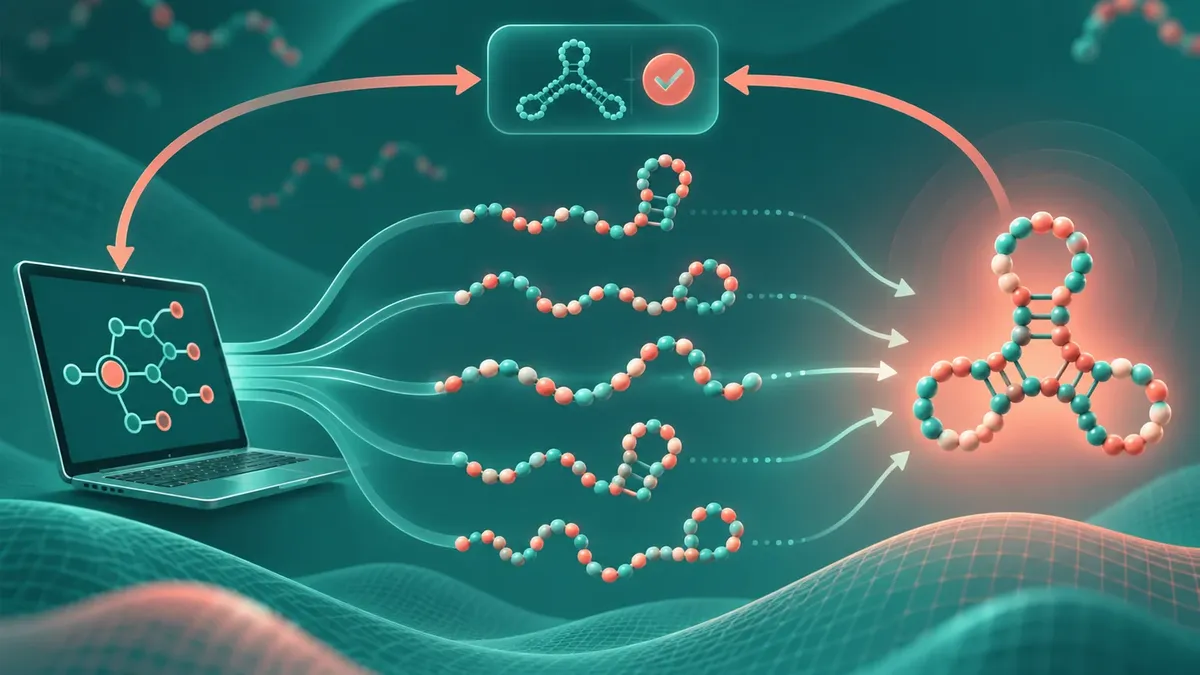
RNA inverse design starts with a desired structure and seeks a nucleotide sequence that folds into it. KnitNet is a framework for using verifier feedback to guide that search. Its reported results are computational; the source available here is the paper’s abstract.
RNA inverse design asks a practical-sounding question with a difficult search behind it: given a desired RNA structure, which nucleotide sequence will fold into that shape? Many candidate sequences may be possible, and changes to nucleotides can have effects beyond the position being edited.
The paper introduces KnitNet, a framework that uses computation at inference time to refine candidate sequences. According to the abstract, it starts from candidates generated for a target secondary structure and uses mismatches between candidate folds and the target to infer nucleotide dependencies and adapt its repair strategy. An online surrogate—a learned estimate used to help guide choices—also updates during the search to predict promising edits. The abstract describes the approach at a high level; it does not provide enough detail to reconstruct its implementation.
What the authors report
Across five secondary-structure benchmarks, the authors report an average increase of 21 percentage points in exact solve rates over continued sampling, alongside 70% less time-to-solve. The abstract does not give benchmark-by-benchmark results or specify the conditions behind these averages, so they should be read as the authors’ summary rather than a complete comparison.
For OpenKnot57, the authors report exact computational matches for all complex, pseudoknotted structures in their evaluation. The abstract calls this a first for the method; that priority claim is not independently verified by the information available here.
The authors also report results for three-dimensional design: 7.8% higher structural self-consistency than per-target reinforcement learning and 39.3% faster. The abstract does not define the measure or describe the evaluation setup in detail. It says KnitNet generalizes across RNA design settings by changing the optimization signal to match the verifier used in each setting.
How to interpret the evidence
These figures describe computational evaluations, not demonstrated laboratory performance. The abstract alone does not let readers assess the benchmark protocols, variation across runs, verifier details, or how broadly the results apply. Those are limits of the evidence available for this account, not findings about what the full paper contains.
An exact computational match means a candidate matched a target under the study’s evaluation procedure; it does not by itself establish biological function or experimental folding. The results therefore suggest that verifier-guided search may improve performance in the reported tests, but do not show that it will succeed for every RNA design task.
The source is an arXiv paper, and this account is based on its abstract rather than full-paper methods and results. The claims are consequently best treated as preliminary: evaluating their scope would require examining the full study and its benchmarks.
- RNA inverse design
- RNA structure
- KnitNet
- computational biology
- machine learning
- inference-time search
Reviewed cross-references
These connections were reviewed by a model, not independently fact-checked by a human. Similarity does not imply agreement; consult the original papers and the evidence below.
One Energy Lens for Many Kinds of Machine Learning
Shared method: Both describe inference-time refinement using a generator and verifier: the EBM tutorial characterizes iterative refinement as sampling from a residual EBM combining them, while KnitNet uses fold-verifier feedback to guide sequence repairs. This is a conceptual connection, not evidence that KnitNet implements the tutorial’s EBM formulation.
Model review: · openai-codex/gpt-6-luna
Evidence and provenance
Selected excerpts, not complete papers. PDF extraction can omit figures or damage equations, tables and reading order; sources may be preprints.
2611.33812v1 — Original paper
Excerpt reference:
static/papers/2611.33812v1.md:65-98
Basis: Paper text
Source SHA-256:855c9c24886b8d7d5bb26332e417d35b06339aaeabf488cbe5ce23cf1c3482532611.14383v1 — Original paper
Excerpt reference:
static/papers/2611.14383v1.md:7465-7507
Basis: Paper text
Source SHA-256:3162c1566e8545448b2fe15f91b090ca9c82d46ca3165dced3dddd5580aa7a4a
Related reading
Automatically matched by shared topic keywords. These links do not imply that the sources agree or establish a consensus.
An AI agent turns peptide-design evidence into testable sequence edits
Source published
Shared keywords: computational biology
CellCanon links cell-response predictions to evidence and revises them with observations
Source published
Shared keywords: computational biology
A second look at debiased machine learning
Source published
Shared keywords: machine learning
Machine Learning May Distort Confidence in Portfolio Sharpe Ratios
Source published
Shared keywords: machine learning
Can simulated quantum guidance help train classical AI?
Source published
Shared keywords: machine learning