TRANSMISSION // 2611.33806v1
Can simulated quantum guidance help train classical AI?
Source published
QPAT uses a simulated quantum prior during training, then removes it for classical prediction. Six benchmarks report gains, but hardware tests remain to be done.
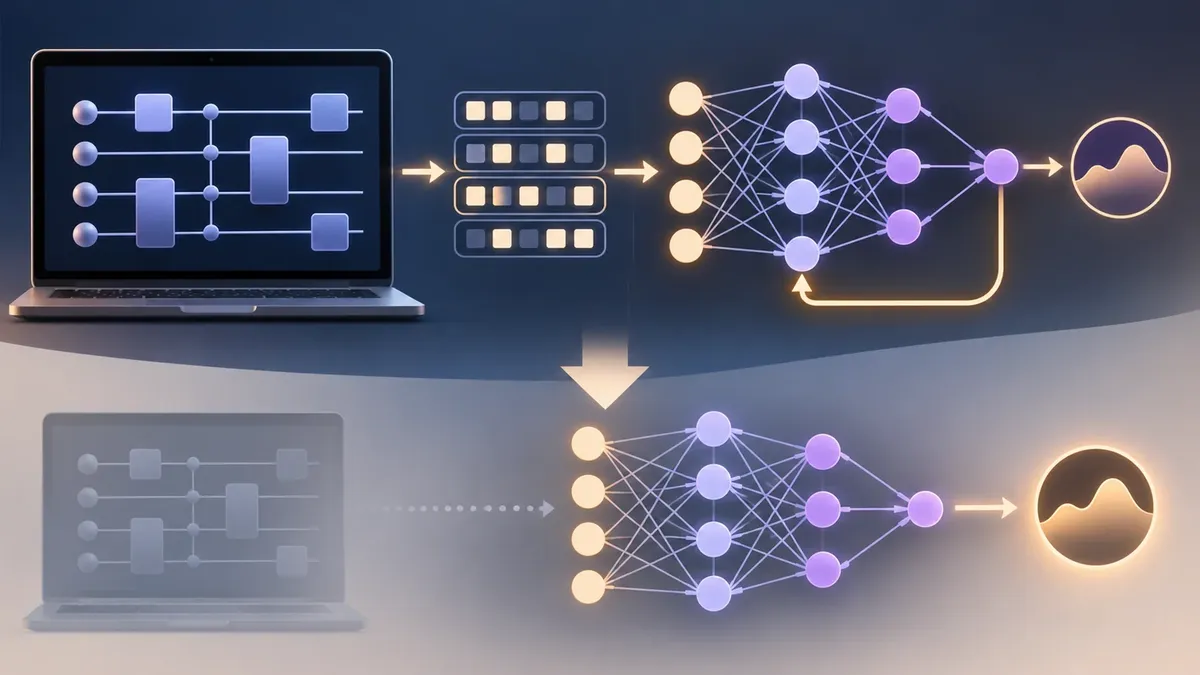
Can a quantum circuit’s learned patterns help a classical model, even when the circuit is no longer used at prediction time? In a preprint, Yixiong Chen presents QPAT, a framework that uses a quantum-circuit simulator during training and evaluates the resulting model with the quantum component switched off. Results across six benchmarks are encouraging, but they do not show that training on a physical quantum computer would produce the same outcomes.
Quantum machine learning aims to use quantum systems to represent patterns that may be difficult for classical models to capture. Yet a model that needs a quantum processor for every prediction would also need ongoing hardware access and repeated measurements. QPAT, short for QCBM-Prior-Assisted Training, explores a different arrangement: use a quantum-circuit simulator to provide a learned signal during training, then make predictions with a classical neural network alone.
The paper’s central question is whether that signal can improve a classical model enough for the benefit to remain after the quantum component is removed. Yixiong Chen evaluates the approach on six benchmark datasets covering time-series forecasting, image classification and text classification.
How QPAT works
QPAT uses a Quantum Circuit Born Machine (QCBM), a parameterized circuit that produces bitstrings when measured. In the reported experiments, this circuit was simulated. A classical network converts each input—such as an image or sentence—into a feature representation. Independently, the QCBM generates a bitstring, which is projected into the same feature space and added to the classical representation before the model makes a prediction.
The QCBM does not receive the task’s input data. Instead, the training procedure scores its generated bitstrings according to their usefulness for the task. Training alternates between updating the classical model and optimizing the QCBM, rather than passing gradients back and forth through a tightly coupled quantum-classical system.
A mechanism called “Drop-Prior” randomly switches off the prior during classical-model training. The aim is to discourage the model from depending entirely on a signal that will be absent at deployment. The paper compares predictions made with the prior enabled against predictions from the same trained model with the prior removed.
What the benchmarks report
The experiments use LSTMs for forecasting, ResNet-18 for images and DistilBERT for text. The datasets are Exchange and influenza-like illness forecasting, breast-ultrasound and aircraft image classification, and the RTE and TREC text-classification tasks. The author reports that QPAT models generally outperform their classical backbones, with gains largely retained when the prior is removed. Many comparisons also show lower variation across three random seeds.
For both forecasting datasets, for example, the paper reports lower test-set mean squared error for the QPAT-trained LSTM during classical inference than for the ordinary LSTM. The study also compares the QCBM prior with a uniform random prior and a learned Restricted Boltzmann Machine (RBM) prior on one dataset from each domain. The QCBM versions have better reported mean results on the selected metrics in these comparisons. This is evidence against those specific alternatives in those tests—not proof that quantum priors outperform every classical approach.
The paper describes the effect of Drop-Prior as implicit distillation: the classical model may absorb useful structure during training and retain it when the prior is absent. Its mathematical analysis proposes that randomly dropping the prior acts as a regularizer and can reduce over-reliance on it. This is an interpretation of the method, not evidence that the model uses a capability unavailable to classical systems.
What remains uncertain
Most importantly, all experiments used a quantum simulator, not physical quantum hardware. The findings therefore do not establish how the approach would perform under real hardware noise or what its practical training costs would be on a quantum processor. QPAT removes quantum execution at prediction time, but its training process still involves generating and optimizing the QCBM prior—in this study, in simulation.
The evidence also has a limited empirical scope: six benchmarks, three random seeds and small- to medium-scale backbones. The paper identifies larger models, other ways of combining the prior with classical features, and changes to the Drop-Prior rate and QCBM update schedule as topics for future work. Results on these datasets cannot establish gains across all models or real-world applications.
QPAT is a proposed training-and-deployment strategy supported by promising benchmark results, not a demonstration of practical quantum advantage. The source is an arXiv preprint and may not have undergone peer review. Independent replication, broader comparisons and experiments on physical quantum hardware will be needed to assess the approach’s robustness and usefulness.
- quantum machine learning
- hybrid AI
- quantum circuit Born machine
- classical inference
- machine learning
Related reading
Automatically matched by shared topic keywords. These links do not imply that the sources agree or establish a consensus.
Can quantum machine learning train without measurements?
Source published
Shared keywords: quantum machine learning
Why quantum machine-learning models can lose sensitivity
Source published
Shared keywords: quantum machine learning
Selecting training examples for quantum machine learning
Source published
Shared keywords: quantum machine learning
A reported quantum gap on an engineered task
Source published
Shared keywords: quantum machine learning
Choosing a quantum data encoding, with help from an agent
Source published
Shared keywords: quantum machine learning