TRANSMISSION // 2611.33791v1
Why AI Still Misses Details in Complex Documents
Source published
ExtractBench Pro tests AI extraction on synthetic documents with tricky rules, diagrams, charts and long pages. The top system got 61 of 100 documents perfectly right.
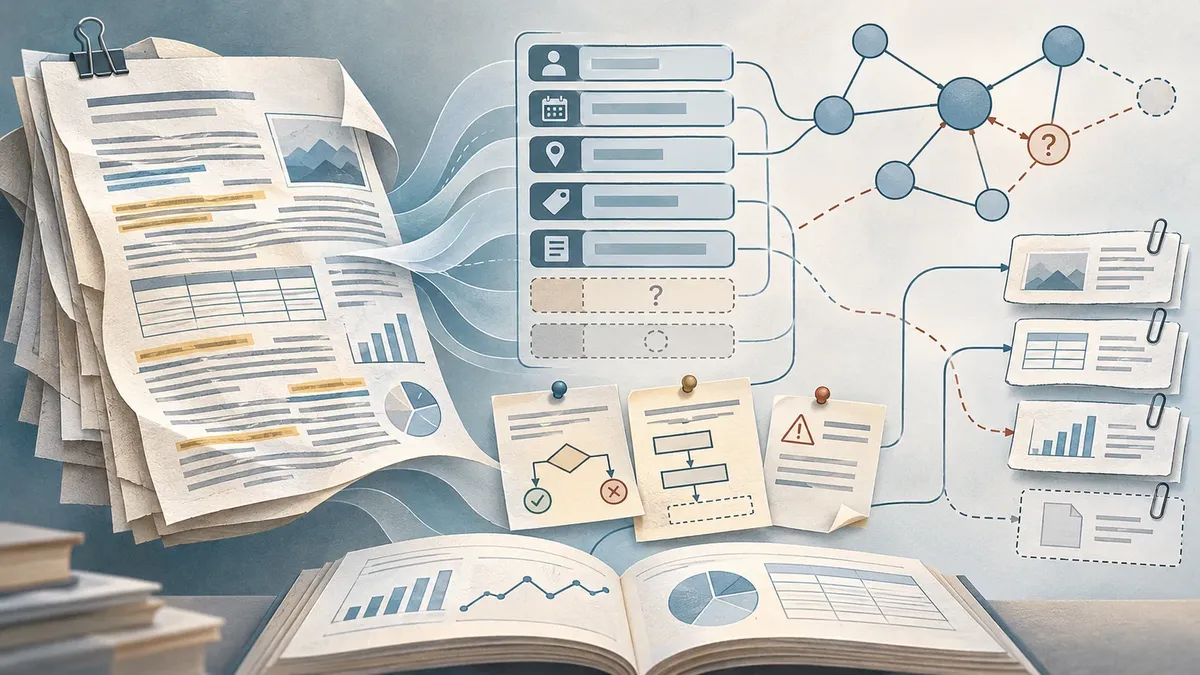
Turning a document into accurate structured data can take more than reading text: systems may need to apply local definitions, trace diagrams or calculate totals. ExtractBench Pro tests these harder cases. None of the evaluated systems extracted more than 61 of its 100 documents without a scored error.
Extracting information from a PDF sounds straightforward: read the document, fill in fields and return a structured answer. But real documents can hide rules in distant sections, use specialized terminology or present information in charts and diagrams. A system may get most fields right and still make an error that calls for human checking.
A new benchmark, ExtractBench Pro, asks how current AI systems handle these demanding cases. The researchers evaluated 10 coding-agent configurations and eight configurations of specialized extraction APIs. The strongest system produced a completely correct extraction for 61 of the 100 test documents. Here, “perfect” means every scored value in a document matches the answer key—not simply that average accuracy is high.
Building difficult documents with known answers
The benchmark contains 100 synthetic documents across seven domains, including finance, energy, government, healthcare, law and real estate. They were generated by 90 configurable programs that create each document, its extraction schema and the expected answers from shared underlying data. Generating answers alongside documents gives the researchers a defined reference for scoring systems.
The documents cover six challenge groups: interpretation rules, custom terminology, conditional aggregation, relational diagrams, charts and maps, and unusually long single pages. A task might require applying a rule printed far from a table, deciding which records count toward a total, or following connections in a network diagram. On a long sheet, viewing the whole page can make details hard to read, while cropping can lose context such as the scale.
The authors drew challenges from real documents and conventions, then used pilot systems and verification feedback to refine the generated tasks. Programmatic checks, agent review and human review were used to assess whether documents supported their answer keys. The design offers control and repeatability, but synthetic documents are not identical to ordinary workplace files.
Accuracy is not the same as a flawless document
The researchers measured value accuracy, evidence grounding, cost and completion time. Value F1 summarizes how well extracted fields match expected values. The perfect-document rate is stricter: one scored value error means the document is not perfect. Grounding adds a further test: whether a correct value is linked to the right source location.
Claude Code Opus 5.5 had the highest reported perfect-document rate, at 61%; Codex GPT-6 Astra reached 59%, and LlamaExtract Agentic Plus Max Effort reached 56%. The paper reports that the strongest general-purpose coding agents outperformed specialized extraction APIs on perfect-document rate and Value F1, but at higher cost per page. Among the specialized services, LlamaExtract offered lower-cost options; its highest-accuracy configuration came close to the strongest coding agent on these measures at a lower reported cost per page.
No system led every challenge group. And a strong average does not guarantee a document can be accepted without correction. Across all 18 configurations, at least one system was perfect on 91 documents. This is an “oracle” result: it assumes someone knows which system to choose for each document. It is not the performance of one system or of a tested automatic routing method.
Where systems stumble—and what remains uncertain
Inspection of coding-agent traces showed examples of image processing and code used to measure visual features or calculate values. But one misread rule or missed condition could spoil a chain of reasoning. Agents also struggled to ground calculated answers: a derived total may depend on several source values and instructions, rather than one obvious location.
The authors identify important limits. The benchmark was deliberately made difficult, and its challenge-dense documents do not represent typical workloads. Pilot performance influenced document selection, and some pilot systems were later evaluated on the benchmark. The study did not measure human extraction performance or quantify document diversity. It also reports one result per system and document, so it does not establish run-to-run variability.
A small realism study asked six volunteers to identify the real page in pairs containing one real page and one benchmark page, or abstain. The reported identification rate was 23.8% for ExtractBench pages and 37.9% for ExtractBench Pro pages. Pro pages were therefore easier to distinguish from real pages than the earlier benchmark’s pages. The 37.9% rate was below the study’s 50% coin-toss reference; the authors describe this as indicating a reasonable degree of realism. The study is small, and handwriting and the absence of brand logos were noted as fidelity gaps.
ExtractBench Pro is best understood as a stress test, not a forecast of everyday extraction accuracy. Its results highlight that document automation must do more than recognize text: systems also need to apply local rules, connect evidence across pages and visuals, and calculate correctly. The source is an arXiv preprint; the results reported here describe the authors’ benchmark and evaluation, not a universal measure of real-world performance.
- document extraction
- artificial intelligence
- AI benchmarks
- synthetic documents
- multimodal AI
- data accuracy
Reviewed cross-references
These connections were reviewed by a model, not independently fact-checked by a human. Similarity does not imply agreement; consult the original papers and the evidence below.
Can AI spot fields it may have misread?
Supporting evidence: Both papers highlight reliability beyond aggregate extraction accuracy: ExtractBench Pro reports that no tested system perfectly extracted more than 61% of its challenge-dense documents, while Srivastava and Casas Hernandez report that token-based field confidence can identify extraction errors on CORD receipts and Kleister NDA contracts. Their results suggest field-level uncertainty could be relevant to reviewing imperfect extractions, but the confidence method was not evaluated on ExtractBench Pro’s documents or challenge types.
Model review: · openai-codex/gpt-6-luna
Evidence and provenance
Selected excerpts, not complete papers. PDF extraction can omit figures or damage equations, tables and reading order; sources may be preprints.
2611.33791v1 — Original paper
Excerpt reference:
static/papers/2611.33791v1.md:134-172
Basis: Paper text
Source SHA-256:5151a32eaaddadeead8a0f42b1d581fd155ac4ddb348dcd33ee8cd4e4823b99f2611.30119v1 — Original paper
Excerpt reference:
static/papers/2611.30119v1.md:13-92
Basis: Paper text
Source SHA-256:488d8e2315e8dc8acb2e4020a96c281c75ff1b2015ff7f4f9e62d1d5fdf914cc2611.30119v1 — Original paper
Excerpt reference:
static/papers/2611.30119v1.md:1245-1312
Basis: Paper text
Source SHA-256:488d8e2315e8dc8acb2e4020a96c281c75ff1b2015ff7f4f9e62d1d5fdf914cc
Related reading
Automatically matched by shared topic keywords. These links do not imply that the sources agree or establish a consensus.
AI Can Draw Charts—But Can It Make Them Work?
Source published
Shared keywords: ai benchmarks, multimodal ai
An AI critic that remembers what happened—and checks where it clicks
Source published
Shared keywords: ai benchmarks, artificial intelligence, multimodal ai
When AI Agents Investigate Legal Evidence, Finding Documents Isn’t Enough
Source published
Shared keywords: artificial intelligence
A Reconstruction-Based Test for AI Image Descriptions
Source published
Shared keywords: ai benchmarks, multimodal ai
How well can multimodal AI handle school-level science?
Source published
Shared keywords: ai benchmarks, multimodal ai