TRANSMISSION // 2611.33788v1
Generating Synthetic Patient Journeys from Clinical Requests
Source published
InterGenEHR+ turns natural-language clinical scenarios into synthetic electronic health records and patient timelines. In a study focused on patients receiving VV-ECMO, the authors report promising statistical, predictive and clinician-rated results—but say other settings need validation.
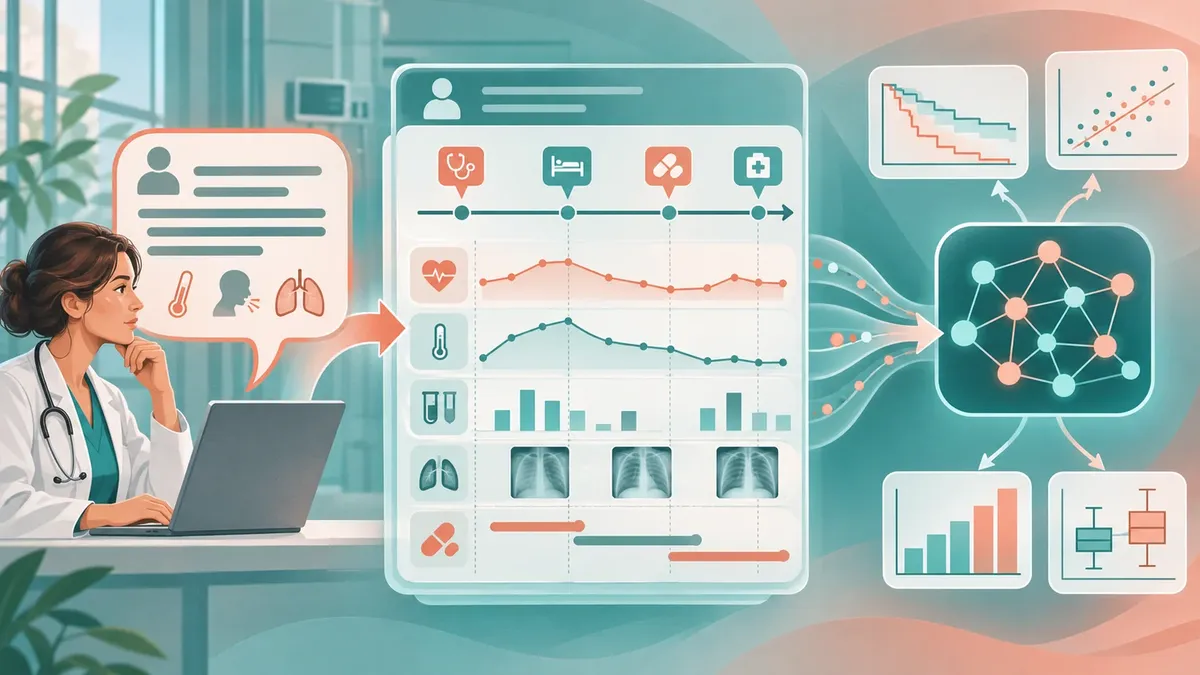
Could researchers test a clinical prediction model on a patient scenario that is difficult to find in available records? InterGenEHR+ is a framework designed to generate synthetic health records and longitudinal patient trajectories from clinician-specified requests.
Electronic health records capture how patients’ conditions and care change over time, but unusual clinical scenarios can be difficult to evaluate with existing data. InterGenEHR+ aims to let users describe a scenario in natural language and generate synthetic tabular records or patient timelines for testing machine-learning models. The authors focus their evaluation on venovenous extracorporeal membrane oxygenation (VV-ECMO), a form of critical care support.
The framework can optionally use a large language model to translate a clinical request into structured constraints. For generating records at a single point in time, it uses conditional variational autoencoders and diffusion models. For longitudinal trajectories, it uses diffusion models. The authors assessed how well requests were parsed, how closely generated data matched real-data distributions, performance on imputation and mortality prediction, adherence to specified clinical constraints, and clinical plausibility.
The abstract reports that Gemma 3 4B with few-shot prompting performed best at parsing requests, with a low rate of adding unsupported constraint slots. Different generation models performed well on different tasks: IGE-TabDDPM and IGE-PMVAE did well for single-time-point records, while IGE-CSDI, IGE-FGTI and IGE-MTSCI led on different measures of longitudinal fidelity. The abstract does not provide the numerical results, so the size of these differences cannot be assessed here.
In mortality-prediction tests, synthetic cohorts retained predictive utility when models were evaluated on real test data. This result was reported across five random seeds and three classifiers. Clinicians’ ratings also supported the plausibility of generated trajectories and their alignment with requested scenarios. These findings suggest the framework could help create targeted test cases in the evaluated VV-ECMO setting; they do not establish that synthetic records can replace real clinical data or support patient care.
The evidence has important limits. The evaluation described in the abstract uses a single, specialized cohort of 874 patients receiving VV-ECMO. The authors explicitly say that use in other clinical settings requires further validation. The abstract does not give detailed scores, describe the cohort’s representativeness, or provide enough information to judge how well the generated records preserve privacy or handle scenarios unlike those in the source data.
This article is based on the paper’s abstract, not a full-text review, so methodological details and qualifications may be missing. The work is an arXiv preprint; the supplied source does not establish that it has undergone peer review. Its results are therefore best read as an initial evaluation of a research framework, not evidence of clinical readiness.
- synthetic health records
- electronic health records
- clinical AI
- longitudinal data
- diffusion models
- VV-ECMO
Related reading
Automatically matched by shared topic keywords. These links do not imply that the sources agree or establish a consensus.
Why chart-reading guidance can help AI—and still reveal errors
Source published
Shared keywords: clinical ai, synthetic health records
Can AI Judges Spot Unsafe Clinical Actions?
Source published
Shared keywords: clinical ai, electronic health records
MedUIGym tests whether AI can navigate clinical software
Source published
Shared keywords: clinical ai, electronic health records
Why Samplers Matter for Medical AI Fairness
Source published
Shared keywords: diffusion models
A model that tracks changing ICU physiology
Source published
Shared keywords: clinical ai