TRANSMISSION // 2611.33776v1
How a quantum system might keep its own time
Source published
A theoretical preprint proposes a mathematical framework for quantum systems that sustain rhythmic motion and synchronize with an oscillator. Its conclusions depend on strong assumptions.
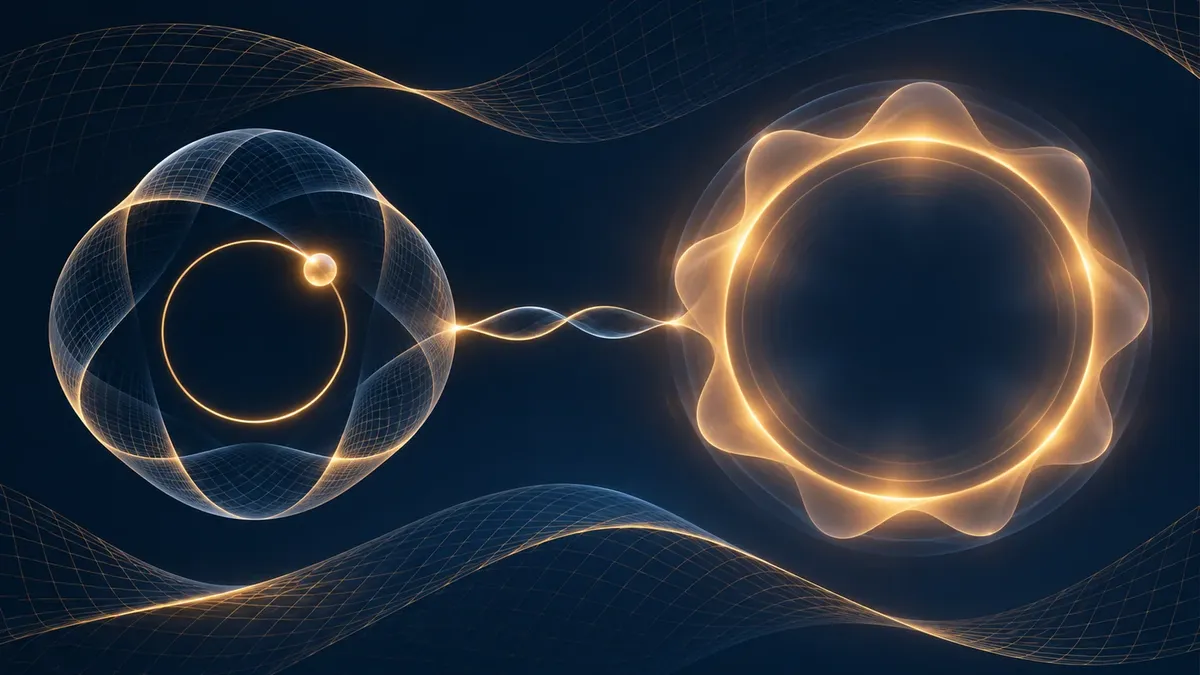
Can a quantum system keep oscillating without being driven by an external clock? A theoretical preprint proposes a framework for answering that question—and argues that the mathematics of such rhythms depends on both feedback and the system’s dimensionality.
A swing keeps moving if it receives well-timed pushes. A self-sustained oscillator is different: it maintains a rhythm through its own dynamics, without an external signal repeatedly setting its pace. The quantum version raises a puzzle. Dissipation—the influence of an environment—often makes a system settle down. What kind of system–environment interaction could instead support stable, repeating motion and allow it to synchronize with another oscillator?
In a preprint, Nana Siddhartha develops a mathematical framework for this question. The paper’s central claim is conditional: if a quantum system has certain symmetry and positivity properties, couples reciprocally to a self-sustaining phase oscillator, and supports a stable, synchronizable periodic attractor, then its reduced dynamics must have a particular general structure. The paper does not explain how the environment’s oscillation first arises; it takes that rhythm as given.
A path-integral route to the dynamics
The author uses a geometric path-integral construction, describing the dynamics through an action integrated over a surface rather than the more familiar line-like trajectory. The paper argues that this construction can represent contraction toward a stable cycle. It treats the oscillator’s phase as circular: after a full turn, the phase returns to its starting point.
In this picture, the interaction can be organized into integer-valued winding changes—roughly, counts of how the phase wraps around its circle. The paper uses these winding sectors to derive a reduced master equation: a rule for how the quantum system’s state changes after accounting for the environment. The proposed dynamics include state-dependent coherent feedback, which affects the system’s quantum evolution, alongside dissipative gain and damping.
The analysis is mathematical rather than experimental. The author states general results under assumptions including U(1) phase symmetry, a reciprocal phase interface, and an entrainable stable periodic orbit. The paper also presents model constructions for a single qubit, two qubits that interact indirectly through a shared phase oscillator, and a bosonic oscillator, and examines their predicted behavior.
What the paper claims
The main result is a classification claim: under the stated assumptions, the allowed generator—the mathematical rule for the system’s evolution—has a universal operator form. A second claim concerns the difference between finite- and infinite-dimensional systems. In finite dimensions, the paper argues, purely dissipative gain saturation cannot sustain the proposed cycle; coherent feedback is required. For infinite-dimensional systems with unbounded ladder operators, it says purely dissipative saturation can be allowed.
The paper also proposes a topological condition. It argues that the interaction manifold must have a nontrivial fundamental group equal to the integers, selecting a circular U(1) phase as the relevant geometry. In plain language, the framework says that the interaction must allow meaningful winding around a loop. The author derives a leading-order polynomial form of the proposed master equation and presents the qubit and oscillator examples as realizations of the framework. These are theoretical results, not reports of laboratory demonstrations.
How to interpret the result
The theorems do not claim that every quantum oscillator behaves this way, or that every periodic quantum signal is a stable attractor. They apply to a specifically defined class of models, including an assumed self-sustaining environment and a periodic orbit that persists even when the environment’s direct entraining signal is removed. The paper’s topological conclusion is likewise tied to its chosen phase-interface and path-integral setup; it should not be read as an established rule for all quantum systems.
The article is an arXiv preprint, not evidence of peer review. Its conclusions are theoretical, and the examples are model constructions rather than experimental tests. The supplied paper text is lengthy and equation-heavy, and extraction may not preserve every equation or qualification accurately. Independent scrutiny would be needed to assess the derivations, assumptions, and claimed generality. The paper also leaves open the origin of the background oscillator and identifies broader networks and other forms of dynamics as future work.
For curious readers, the useful takeaway is a proposed way to connect feedback, mathematical positivity, and phase-loop geometry to quantum rhythms. Whether this framework proves robust and useful beyond its assumptions remains an open question.
- quantum dynamics
- quantum limit cycles
- quantum synchronization
- open quantum systems
- path integrals
- preprint
Related reading
Automatically matched by shared topic keywords. These links do not imply that the sources agree or establish a consensus.
Watching a shared quantum environment can sharpen synchronization
Source published
Shared keywords: quantum synchronization
How Gaussian wave packets trace quantum motion in open systems
Source published
Shared keywords: open quantum systems
Simulating quantum noise by enlarging the quantum system
Source published
Shared keywords: open quantum systems
Quantum entanglement could build patterns that outlast it
Source published
Shared keywords: open quantum systems
Quantum limit cycles may help spins sense more precisely
Source published
Shared keywords: quantum limit cycles