TRANSMISSION // 2611.33775v1
AI navigates heart scans, but clinical use is unproven
Source published
CHD-Bench tests whether vision-language models can explore 3D heart scans to identify congenital defects. Interactive viewing improved one model’s scores, but clinical applicability still needs expert validation.
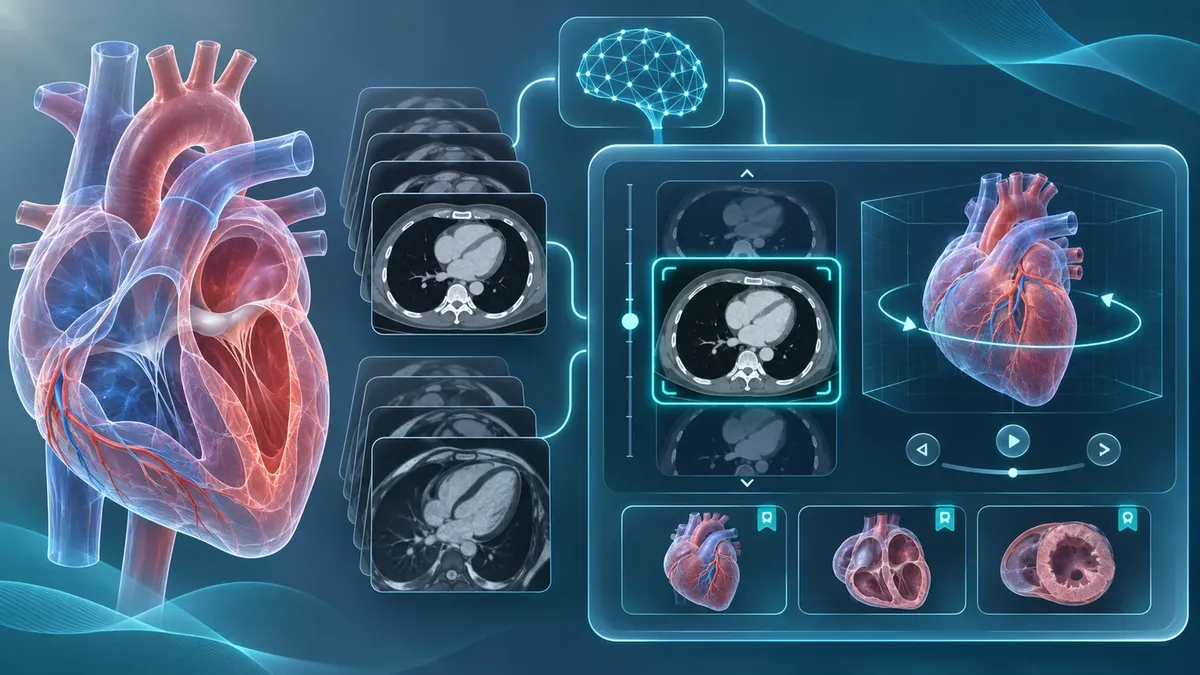
Congenital heart disease varies widely, and some diagnoses depend on understanding how heart structures relate in three dimensions. A new benchmark lets AI models choose which parts of CT and MRI scans to inspect. The strongest system scored better with interactive viewing than with fixed views, but the study does not establish whether this approach is safe or useful in patient care.
Congenital heart disease (CHD) includes many different abnormalities. In complex cases, understanding the spatial relationships between heart chambers and major vessels can help clinicians assess the anatomy. They may scroll through scan slices and manipulate 3D views. Could an AI model do something similar—choosing what to inspect as it works toward a diagnosis?
A research team introduces CHD-Bench, a test for this question, and CHD-Harness, software that lets vision-language models (VLMs) examine scans inside the 3D Slicer imaging environment. The models were evaluated off the shelf, without CHD-specific fine-tuning. The work is a preprint, so its results should be read as research findings rather than evidence of clinical usefulness.
Letting a model choose what to inspect
CHD-Bench contains 247 CT and MRI scans from three cohorts, with labels covering 38 types of congenital heart defect. The task is multi-label: a model reports whether each defect on a cohort’s list is present or absent, because a scan can have several diagnoses.
With CHD-Harness, interactive models could use 22 tools to navigate slices, change views, manipulate a 3D display, inspect predicted outlines of six heart structures, and save views as supporting evidence. Each examination was limited to 75 tool calls. Researchers compared these models with systems that received scans in one pass, a volumetric image classifier, and published rule-based results.
The cohorts differed in imaging modality and in which defects they included. Two were public; the third was a private dataset collected at Amrita Institute of Medical Sciences. Some defect types appeared in only one to three cases, making estimates for those rare classes uncertain.
Interactive examination helped one model
Among the systems tested, Gemini 4 Argon using CHD-Harness had the highest macro F1 scores: 0.63 on each public cohort and 0.43 on the private cohort. Its mean across the three cohorts was 0.56. Macro F1 averages performance across defect types, giving each type equal weight. These are benchmark scores, not the probability that an individual diagnosis is correct.
In an experiment with Gemini 4 Argon, replacing interactive examination with a fixed set of views lowered mean macro F1 from 0.56 to 0.45. This suggests that choosing views and following up on observations helped this model on these scans. It does not show that interaction will benefit every model or dataset. Removing segmentation masks or 3D-view tools changed the mean score only slightly. The paper reports examples where segmentation helped identify heart chambers and 3D views helped trace the origins of major vessels, but these results do not establish broad benefits across cases.
Scores varied across cohorts. Gemini’s macro F1 was lower on the private cohort than on the public cohorts, and its precision was also lower. Precision reflects how often predicted defects matched the reference labels. However, the authors note that labels can omit related diagnoses, so some apparent disagreements may reflect differences in how anatomy is classified rather than straightforward mistakes. They also describe errors involving similar conditions and cases where a model’s observations did not make it into its final diagnosis.
What the results cannot establish
The benchmark measures agreement with dataset labels; it does not test how well the system would support decisions in routine care. Some conditions have very few examples, and each model was evaluated only once per scan, leaving run-to-run variability unmeasured. The authors also say that clinical applicability remains to be established through further validation with expert readers. The scores do not show that the system can safely diagnose patients, improve outcomes, or replace clinicians.
The paper compares its result on ImageCHD with a published rule-based method, but notes that differences in diagnostic annotations prevent a strictly equivalent comparison. The authors release the benchmark and software code, allowing others to examine and use the evaluation materials. As a preprint, the study may not yet have undergone peer review.
The main contribution is a framework for testing a different AI workflow: giving a model access to imaging software and recording how it explores a scan. CHD-Bench offers a shared setting for evaluating future systems. Its results suggest that interactive inspection can improve benchmark performance for a particular model, while leaving the question of clinical value open.
- congenital heart disease
- medical imaging
- vision-language models
- artificial intelligence
- CHD-Bench
- 3D Slicer
Related reading
Automatically matched by shared topic keywords. These links do not imply that the sources agree or establish a consensus.
Teaching medical AI to stop inventing findings can also expose what it misses
Source published
Shared keywords: medical imaging, vision language models
One model, five medical imaging specialties
Source published
Shared keywords: medical imaging, vision language models
CLASP looks beyond a model’s final answer to spot unfamiliar medical images
Source published
Shared keywords: medical imaging, vision language models
How SCRA-CLIP Tries to Spot Subtle Image Anomalies
Source published
Shared keywords: medical imaging, vision language models
A rule bank helps revise AI-generated CT reports
Source published
Shared keywords: medical imaging, vision language models