TRANSMISSION // 2611.33768v1
A Star-Shredding Black Hole Far from a Galaxy’s Center?
Source published
A ZTF archive search and follow-up observations point to AT 2024dky as a possible tidal disruption event around a black hole outside its host galaxy’s center.
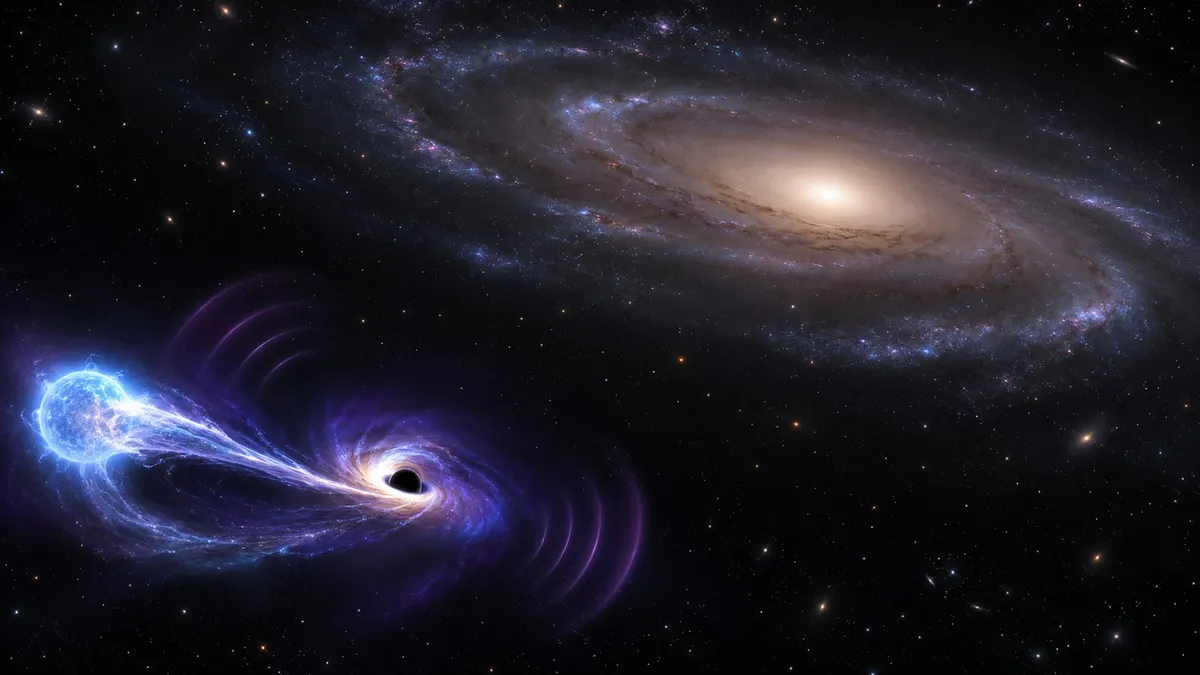
A bright, blue flare appeared several thousand light-years from the center of a massive, quiet galaxy. Researchers argue that AT 2024dky may be a star torn apart by a black hole living away from a galactic center—but the evidence supports a candidate, not a confirmed identification.
A tidal disruption event (TDE) happens when a star passes close enough to a black hole for the black hole’s gravity to pull it apart. The resulting debris can feed the black hole and produce a flare. Most searches for these events focus on galaxy centers, where massive black holes are expected to reside. But black holes can also be found elsewhere in galaxies, and their flares may be overlooked if searches require a central location.
In a new preprint, Yuhan Yao and colleagues report AT 2024dky, an event they identify through a retrospective search of data from the Zwicky Transient Facility (ZTF). The candidate lies about 4.26 kiloparsecs—roughly 14,000 light-years in projection—from the center of its host galaxy. The researchers’ evidence makes a TDE interpretation compelling, while leaving other explanations possible.
Looking beyond galaxy centers
The team searched ZTF records for transients with TDE-like changes in brightness, without requiring them to occur at a galaxy’s center. They used two independent selection approaches: a pipeline applying explicit, physics-motivated cuts, and a modified machine-learning classifier. AT 2024dky ranked highly in both searches. The authors say details of the complete candidate sample and search methods are to be presented in future work, so this paper does not yet provide the full population-level results.
They then examined optical observations from ZTF and ATLAS, and obtained later observations with the Keck telescope, the Very Large Array (VLA), Einstein Probe and Chandra. These facilities probe different kinds of light: optical and ultraviolet emission from the transient, radio emission that can trace shocks or outflows, and X-rays that may come from hot material near a black hole.
A flare with several TDE-like clues
The host is a massive, mostly inactive galaxy about 1.1 billion light-years away. AT 2024dky reached an optical peak absolute magnitude of −18.5 and stayed blue for 80 days after peak. Its brightness rose and faded over weeks. A blue, relatively steady color can fit a TDE, but it is not unique to one; some kinds of supernova can also remain blue.
Follow-up observations added clues. About 858 days after the event’s reference date, Keck detected ultraviolet light at the transient’s position, while finding no corresponding detection in the red optical band. Two days later, the VLA detected a radio source at the same location. Its measured radio luminosity was about 1.26 × 10³⁸ erg per second. The combination of late ultraviolet and radio emission is consistent with a TDE, though radio-bright supernovae can produce some similar signals.
The galaxy’s properties also matter. Its estimated stellar mass is about 100 billion Suns, while its recent star formation is very low. The authors find that this kind of host resembles the hosts of known off-nuclear TDEs and is less typical of several types of supernova that remain under consideration. That comparison supports the TDE explanation; it does not by itself establish what caused the flare.
What remains uncertain
The observations do not settle the case. The researchers had no early-time spectrum, which could have supplied additional diagnostic information. Their comparisons leave interacting supernovae—especially some types with dense surrounding gas—as alternatives, although the host and late-time observations weigh against them. The paper also reports no confirmed X-ray detection from the transient: Einstein Probe’s weak apparent signal was not statistically significant, and Chandra found no source at its position. These non-detections are compatible with more than one explanation and depend in part on assumptions about the source’s spectrum.
The black hole’s mass is inferred indirectly, not measured. The authors favor a mass around 100,000 to one million Suns, but their estimates depend on models of how an accretion disk emits light and on how much material reaches it. Different assumptions produce different estimates; the paper explicitly describes the mass as highly uncertain. Nor can the observations determine how the black hole came to be away from the galaxy’s center. Several possible formation routes remain open.
AT 2024dky therefore illustrates why looking across entire galaxies can matter: a flare away from a nucleus may reveal a black hole that ordinary central searches miss. But it remains a candidate. This account is based on the authors’ arXiv preprint, a version posted for public discussion that may not yet have undergone peer review. The paper’s conclusions—and the eventual results of its broader search—could be revised as methods, data and follow-up observations develop.
- AT 2024dky
- tidal disruption event
- off-nuclear black hole
- Zwicky Transient Facility
- galaxy transients
- astronomy
Related reading
Automatically matched by shared topic keywords. These links do not imply that the sources agree or establish a consensus.
Infrared echoes trace dust around lower-mass black holes
Source published
Shared keywords: zwicky transient facility
A Search for Supernovae That Fade to a Rhythm
Source published
Shared keywords: zwicky transient facility
Bright supernovae reveal how surrounding gas shapes their light
Source published
Shared keywords: zwicky transient facility
Reading the rhythms of active galaxies
Source published
Shared keywords: zwicky transient facility
A Calibration Gap Challenges a Supernova-Based Hubble Constant Claim
Source published
Shared keywords: zwicky transient facility