TRANSMISSION // 2611.33761v1
ScanAR tests row-wise decoding in a preprint
Source published
A preprint proposes generating image-token rows in parallel to reduce sequential decoding, while retaining a unified text-and-image model interface. Its results vary by benchmark and model.
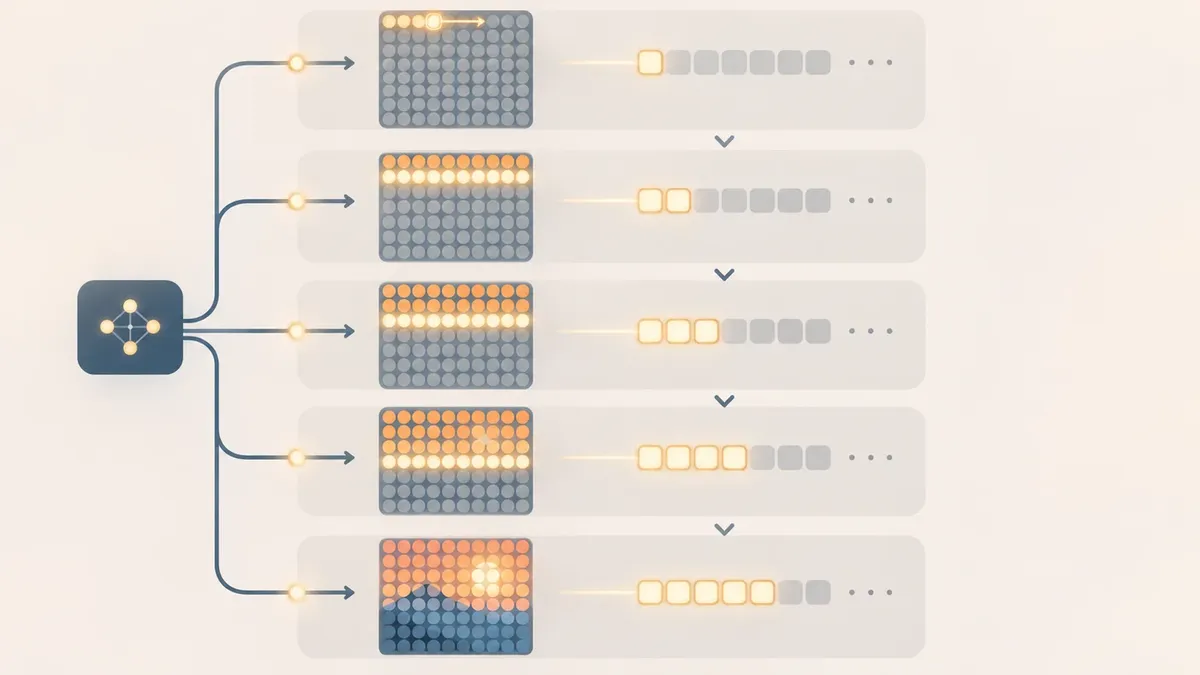
Unified autoregressive models generate text and images through a shared sequence of tokens, but raster-order image generation can require many sequential predictions. ScanAR changes the visual-token dependencies so later rows can be predicted in parallel. The approach reduces decoding depth in the authors’ tests, with a trade-off: tokens within each row do not condition on one another as they do in standard raster decoding.
In a unified autoregressive model, text and images are represented in a shared token sequence and generated using a common next-token prediction process. That design supports mixed text-and-image outputs, but image generation can be slow: a visual grid decoded in raster order requires a sequential prediction for every token. A preprint by Jingen Qu and colleagues proposes ScanAR, which uses the image’s row structure to reduce the number of sequential decoding steps while keeping the shared model interface.
How row-scan decoding works
For an image grid with height H and width W, ScanAR generates the first row from left to right, as in raster decoding. It then predicts the tokens of each later row in parallel, using the hidden state at the same column in the completed row above. Rows still follow one another sequentially. Text and other nonvisual tokens retain their standard autoregressive dependencies.
The method keeps the existing visual-token grid, model backbone, vocabulary, and output head, and adds no parameters, according to the paper. The authors describe both training from scratch and post-training an existing model. After generating the first row, the model also performs a non-sampling “commit” operation: it processes that row with within-row visibility so its states can be used to predict the second row.
The paper distinguishes sampling steps from effective decoding depth. Its schedule has H + W − 1 sampling steps; when the extra first-row commit is counted, the effective depth is H + W for a grid with more than one row. Raster decoding has H × W sequential steps. These counts describe sequential depth, not the total amount of computation: a parallel row still requires a model operation on multiple tokens.
Parallel prediction changes what each token can use as context. Within a later row, tokens are conditionally independent given the completed rows, rather than depending on preceding tokens in that same row. ScanAR therefore approximates, rather than exactly reproduces, raster decoding. The authors note that this may matter for image content with strong fine-grained dependencies across a row.
What the reported tests found
The researchers tested ScanAR in image-only benchmarks and unified multimodal models. In a matched inference comparison on Emu3.5-Image-34B, generating 512 × 512 images took 64.60 seconds with raster decoding and 4.69 seconds with ScanAR, a reported 13.8-fold speedup. ScanAR scored 82.36 on GenEval, a text-to-image benchmark. Among the post-training acceleration methods compared using the same data, this was the highest score. A raster model fine-tuned on that data scored 82.01, which the authors say indicates that the data contributed to the quality gain; the comparison suggests ScanAR retained comparable benchmark quality while decoding faster in this setting.
On class-conditional ImageNet generation, ScanAR models trained from scratch had the highest reported throughput and Inception Score at each of four model sizes. Their FID results were mixed compared with raster LlamaGen: ScanAR’s FID was higher (worse) at the B, L, and XXL sizes, and slightly lower (better) at XL. The results therefore do not show a consistent FID improvement over raster decoding.
The paper also reports tests on a 34-billion-parameter unified model for embodied-scene generation, interleaved image–text output, and video. Overall scores were close to those of raster references, but individual measures differed. For instance, the ScanAR video result had lower motion measures, alongside higher scores on some task-judged measures. These comparisons do not isolate the decoding change: the authors note differences in checkpoints or post-training, and say their ScanAR models were adapted on a narrow mixture of robotics-related data.
Limits and open questions
The Emu3.5 comparison provides the paper’s clearest matched speed test. Other results use different models, datasets, or evaluation setups, so they do not establish that the same speed or quality trade-off will hold across applications. The row-wise independence assumption could also be consequential for content with important within-row detail. The authors’ own U0 comparisons cannot cleanly distinguish decoding effects from post-training effects.
ScanAR is presented in an arXiv preprint, not as a peer-reviewed publication in the supplied source. Its findings have not been independently confirmed here. The paper proposes and evaluates a way to reduce sequential visual decoding while retaining the unified output interface; the reported experiments are evidence for that method in specific settings, not a general guarantee of speed or image quality.
- ScanAR
- autoregressive image generation
- multimodal AI
- parallel decoding
- image generation
Related reading
Automatically matched by shared topic keywords. These links do not imply that the sources agree or establish a consensus.
A Reconstruction-Based Test for AI Image Descriptions
Source published
Shared keywords: multimodal ai
Reconstruction Alignment: Teaching Models to Rebuild Images
Source published
Shared keywords: image generation, multimodal ai
Can an image generator learn from its own critiques?
Source published
Shared keywords: image generation, multimodal ai
How AI Can Build an Image from Several Visual Clues
Source published
Shared keywords: image generation, multimodal ai
Prism uses a model’s own text and images to guide further training
Source published
Shared keywords: image generation, multimodal ai