TRANSMISSION // 2611.33757v1
Can Coding-Agent Improvements Travel to New Tasks?
Source published
TransHarness changes a coding agent’s execution rules—not its model weights—to help improvements carry across benchmarks. Tests show gains in several configurations, but uncertainty remains.
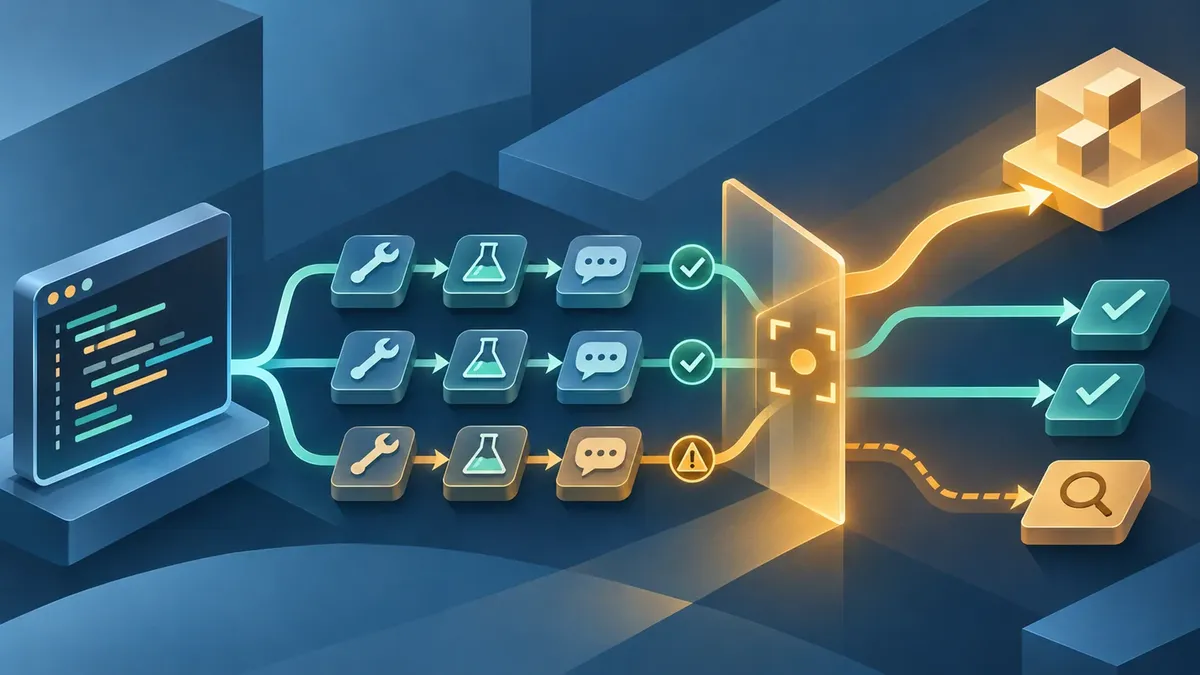
Coding agents can improve when their software harness learns from past attempts. But do those changes help with new tasks, or merely fit the benchmark used to develop them? A preprint introduces TransHarness, a method designed to make harness interventions selective and responsive to evidence from each task.
A coding agent is more than a language model. Its harness is the surrounding software that manages tool use, feedback and checks that a task is complete. Researchers can modify this system without changing the model’s learned weights. The challenge is that a harness tuned on one set of tasks may perform worse on another: a new rule might fix some failures while disrupting tasks the agent already handled correctly.
The authors of TransHarness ask whether harness improvements can transfer between coding benchmarks. Their central idea is to learn not a fixed repair for a particular coding problem, but a policy for when to intervene and what to reconsider. For example, a prompt might ask an agent to check whether its tests cover the stated requirements after a test passes. The target task’s requirements and evidence—not a memorized answer from the source task—should determine what, if anything, needs changing.
Learning from paired attempts
The method starts with successful and failed attempts at the same source task. Comparing these trajectories can reveal a decision that differed between the two attempts. From that contrast, the system proposes an intervention: a trigger based on observable execution context, paired with diagnostic guidance. The trigger might activate after a particular kind of test result; the guidance asks the agent to reassess a decision using the current task’s evidence.
TransHarness screens candidate interventions in two ways. First, it replays them across trajectories from other source tasks to check whether they activate selectively, rather than indiscriminately or mainly during successful executions. Second, an independent semantic assessment checks whether the diagnosis is supported, whether the guidance depends on the original task’s specific solution, and whether proposed corrections are grounded in failed checks or explicit requirements. The selected interventions are combined into a harness and frozen before evaluation on target benchmarks.
For each model–harness configuration, the study uses 300 source trajectories: three runs on each of 100 tasks selected from SWE-bench Pro, across 11 repositories. The target tests are DeepSWE v1.1, with 113 tasks, and Terminal-Bench 2.1, with 89. The authors evaluate three models across multiple model–harness configurations, including lightweight and native harnesses; the configurations vary by benchmark rather than crossing every model with every harness. They also compare methods using a shared model, starting harness and source trajectories, and run ablations that remove or change parts of TransHarness.
Gains, with a caution about uncertainty
The paper reports improvements for each tested model on both benchmarks across the configurations listed. In one configuration, DeepSeek V4.1 Flash with Mini-SWE rises from 73.2% to 76.4% on DeepSWE v1.1. With the DeepSeek Harness on Terminal-Bench 2.1, its score rises from 89.9% to 95.5%. These are results for specific model–harness–benchmark combinations, not a guarantee that the same gain will occur elsewhere. The authors also report that these top scores exceed cited GPT-6 Astra benchmark scores by 2.4 and 5.6 percentage points, respectively. Those comparisons should be read in light of the paper’s evaluation settings and cited public scores.
An intervention can rescue failures but also cause regressions. In the paired DeepSWE comparison, TransHarness recovered 13.0% of executions and regressed on 9.7%; the reported net improvement was 3.2 percentage points. In an ablation, delivering guidance at the first eligible event rather than using learned triggers reduced the score to 72.6%. Recovery remained close to the full method (12.7% versus 13.0%), but regressions rose from 9.7% to 13.3%. Replacing evidence-based reassessment with a prescribed correction also reduced performance. These comparisons are consistent with the proposal that timing and task-grounded guidance matter, though they do not establish that these are the only factors.
There is meaningful uncertainty. The reported 95% confidence interval for the 3.2-point DeepSWE gain with Mini-SWE spans −2.4 to 8.8 points, so it includes no improvement. The corresponding Terminal-Bench gain also has an interval spanning zero. Across three DeepSWE runs, the gain varied from zero to 6.2 points. The results suggest potential transfer, but the size and reliability of gains remain uncertain in these evaluations.
The source is an arXiv preprint; the supplied metadata and paper text give different November 2026 dates, so no exact date is stated here. Its results concern particular benchmarks, models and execution systems. They do not show that the approach transfers to every programming task or real-world deployment. Although the authors report differences between their source tasks and target benchmarks, benchmark tests cannot capture every kind of distribution shift. Independent replication and evaluation in additional settings would help clarify how broadly the approach works.
- coding agents
- AI harnesses
- benchmark transfer
- software engineering
- artificial intelligence
Reviewed cross-references
These connections were reviewed by a model, not independently fact-checked by a human. Similarity does not imply agreement; consult the original papers and the evidence below.
Meta² teaches AI agents when to change their working setup
Shared method: Both use contrasts between agent executions to derive guidance for harness changes: TransHarness builds intervention policies from same-task successes and failures, while Meta² contrasts runs under different evolution conditions to learn a reusable Meta-Skill. The methods differ in how guidance is applied: TransHarness selects policies for deployment, whereas Meta² uses a within-run evolver for task-local edits; their benchmark results therefore are not directly comparable.
Model review: · openai-codex/gpt-6-luna
Evidence and provenance
Selected excerpts, not complete papers. PDF extraction can omit figures or damage equations, tables and reading order; sources may be preprints.
2611.33757v1 — Original paper
Excerpt reference:
static/papers/2611.33757v1.md:223-341
Basis: Paper text
Source SHA-256:bd7cbfb593d7698a349694ac71023e524c862ed9027a4fc367956b94f9577c682611.05139v1 — Original paper
Excerpt reference:
static/papers/2611.05139v1.md:53-95
Basis: Paper text
Source SHA-256:b3e7a26cd08d39e3a698ef615f63c77dc7f68c0896cc83d87475824dc4888de1
Related reading
Automatically matched by shared topic keywords. These links do not imply that the sources agree or establish a consensus.
When AI Coding Agents Should Delegate
Source published
Shared keywords: artificial intelligence, software engineering
A benchmark asks coding agents to show their work
Source published
Shared keywords: coding agents, software engineering
Can Coding Agents Make Staff-Level Decisions?
Source published
Shared keywords: software engineering
Teaching Coding Agents the Hidden Structure of On-Device AI
Source published
Shared keywords: coding agents, software engineering
A tougher coding benchmark finds leading AI agents still struggle to finish the job
Source published
Shared keywords: software engineering