TRANSMISSION // 2611.33749v1
How a smaller vision model learns fine-grained classes
Source published
STAND distills a large vision model into a smaller student, evaluated on class-incremental benchmarks with few examples for new classes.
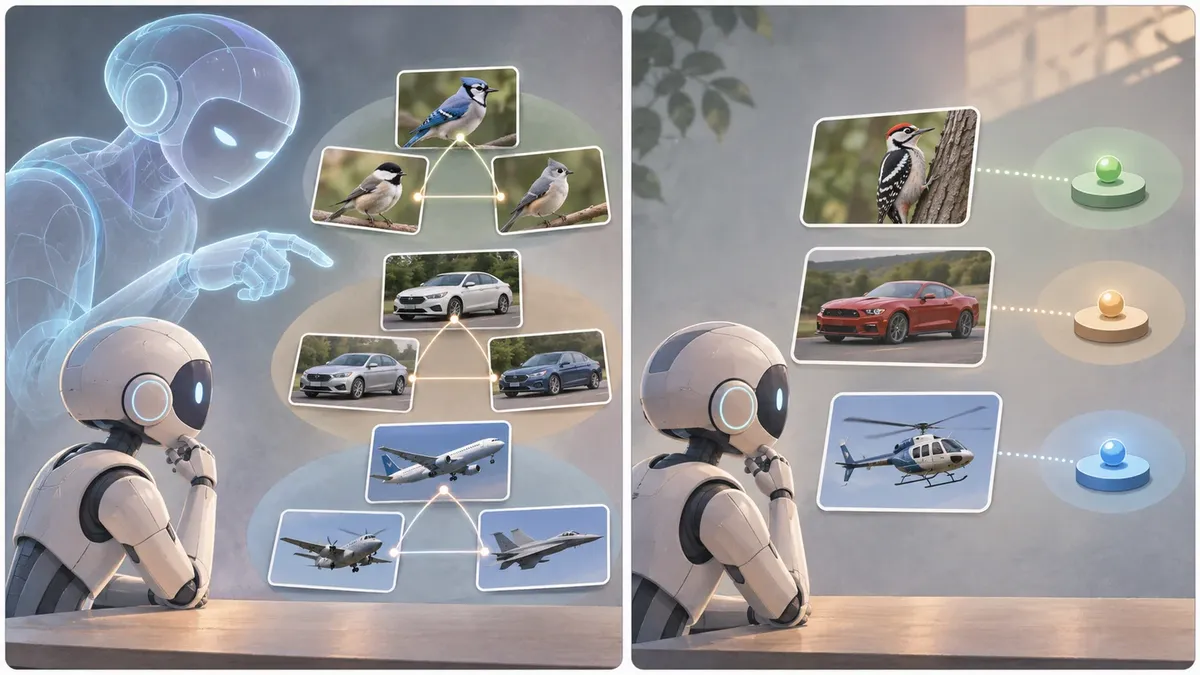
Imagine distinguishing similar bird species, car models or aircraft types from photographs. These examples illustrate a research challenge, not a tested real-world service: a model must learn new categories from a handful of images while retaining earlier knowledge. A study introduces STAND, which transfers knowledge from a pretrained vision model to a smaller one, then evaluates the student on image-classification benchmarks.
Learning new classes without forgetting old ones
A model trained to recognize one set of categories may struggle when new ones arrive. In few-shot class-incremental learning, it first learns base classes from a larger training set, then encounters new classes in successive sessions, with only a few labeled examples for each. It must recognize all classes seen so far. The challenge is especially sharp for fine-grained categories, where classes differ in subtle visual details.
Vision foundation models can provide useful visual representations, but using a large model as the deployed classifier can be computationally expensive. That is the motivation for transferring its knowledge to a smaller student; it does not mean every large model has the same cost in every setting. The researchers ask whether a student can absorb knowledge that helps with classes not included in its base-class training—not merely imitate the teacher on familiar categories.
How STAND trains its student
STAND uses a pretrained vision model as its teacher and trains a smaller student on the base classes. In the main experiments, the default teacher is DINOv3-L and the student is a ResNet-12 trained from scratch. The student is frozen after base-session training. The authors’ rationale is that updating its representation with very few later examples risks overfitting and forgetting; this is the method’s design choice, not a claim that all such updates must fail.
The method changes what the student sees and what it learns to match. It transfers a fixed copy of the teacher’s classifier for base classes, and uses learned projectors to compare teacher and student outputs in a shared space. For each original training image, STAND creates two composite images: it independently samples images, resizes them, and pastes them at random locations on separate copies of the original. Both models process these composites during training.
Two objectives guide the transfer. Relation distillation teaches the student to reproduce how the teacher relates each composite image to reference images. Difference distillation teaches it how those relationships change between the two composites. In this way, the student is trained on patterns of visual similarity, rather than only the base-class labels.
For later classes, the frozen student represents each class with a prototype: an average feature vector from its labeled examples. A prototype estimated from few images can have reduced similarity to test images of that class. STAND’s length calibration adjusts prototype magnitudes to address this imbalance. A strength parameter controls the adjustment; the reported experiments use a value of 0.5. The method therefore does not automatically or necessarily fully restore the similarity difference.
What the benchmarks showed
The main comparison covers four fine-grained datasets: FGVC-Aircraft, Stanford Cars, CUB-200 birds and Stanford Dogs. In these protocols, new classes arrive in five-shot sessions; the base classes have more training images. Results for the main comparison use a ResNet-12 trained from scratch and average three random seeds. The paper reports that STAND had the highest average and final accuracy among the compared incremental methods on each of these four datasets. For example, its average accuracy was 76.60% on FGVC-Aircraft and 85.57% on Stanford Cars. These are benchmark results, not a guarantee of performance elsewhere.
The authors also evaluated CIFAR-100 and miniImageNet, whose classes are less fine-grained, and EMDS-7, using a separate three-shot incremental protocol. Tests with other student backbones and teachers examine whether results depend on a particular model choice. The paper cautions that a larger or more accurate teacher did not always yield a better student.
Ablations explore the method’s components on FGVC-Aircraft and Stanford Cars. In the reported settings, relation distillation provided substantial gains, adding difference distillation improved results further, and length calibration particularly benefited new classes. The fixed classifier’s effects were comparatively small and were not uniformly positive across every reported metric. These are findings from specific ablation experiments, not proof that each component will have the same effect in other tasks.
The paper also measures efficiency under particular conditions. It reports about nine GPU minutes for training a ResNet-18 version on CUB-200, including teacher preparation, and about 1.5 milliseconds per image for ResNet-12 inference at 84-by-84 input size. Its comparison with larger-backbone methods uses 224-by-224 inputs for those methods, so the figures should not be read as a universal speed ranking.
What remains uncertain
The experiments evaluate defined datasets and protocols; they do not establish how STAND would perform in every real-world setting. Its student does not continue learning from the teacher when new classes arrive: after base-session training, the teacher and training-only modules are discarded. The authors identify continued distillation during later sessions and using multiple teachers as future directions.
This account is based on an arXiv preprint. The paper describes benchmark comparisons and experiments, but the available source does not establish independent confirmation or peer review. Its “state-of-the-art” claim applies to the comparisons reported, not to all possible methods or applications.
- computer vision
- few-shot learning
- class-incremental learning
- knowledge distillation
- vision foundation models
- fine-grained recognition
Reviewed cross-references
These connections were reviewed by a model, not independently fact-checked by a human. Similarity does not imply agreement; consult the original papers and the evidence below.
MADJEPA: Three Training Stages for Medical Anomaly Detection
Shared method: Both studies use teacher–student knowledge distillation: STAND transfers a vision foundation model’s knowledge to a student for fine-grained few-shot class-incremental recognition, while MADJEPA distills an encoder into a student to help detect medical-image anomalies. The distillation objectives and tasks differ, so this methodological overlap does not establish comparable performance.
Model review: · openai-codex/gpt-6-luna
Evidence and provenance
Selected excerpts, not complete papers. PDF extraction can omit figures or damage equations, tables and reading order; sources may be preprints.
2611.33749v1 — Original paper
Excerpt reference:
static/papers/2611.33749v1.md:165-228
Basis: Paper text
Source SHA-256:a998bd2b7ebdb372adebf72f64448fb28e1261fef5aadc14bf681f451894ce182611.25194v2 — Original paper
Excerpt reference:
static/papers/2611.25194v2.md:349-446
Basis: Paper text
Source SHA-256:457fc05df05314354783df883105d9007e6401e8c3d3dbd80bba4d25e8c4ad5f
Related reading
Automatically matched by shared topic keywords. These links do not imply that the sources agree or establish a consensus.
When Should CLIP Adapt—and When Should It Stand Pat?
Source published
Shared keywords: computer vision, few shot learning
Can Fixed Reservoir Features Support Continual Learning?
Source published
Shared keywords: class incremental learning, computer vision
A gazelle classifier that shows its work
Source published
Shared keywords: computer vision
Can a smaller EfficientNet learn from a larger one?
Source published
Shared keywords: computer vision, knowledge distillation
Teaching AI Without Its Original Data
Source published
Shared keywords: computer vision, knowledge distillation