TRANSMISSION // 2611.33748v1
Why AI-written chip repairs need more than a passing test
Source published
REFORGE evaluates an LLM-assisted method for repairing hardware code, recording separate evidence for bug removal, behavior preservation, security and implementation cost.
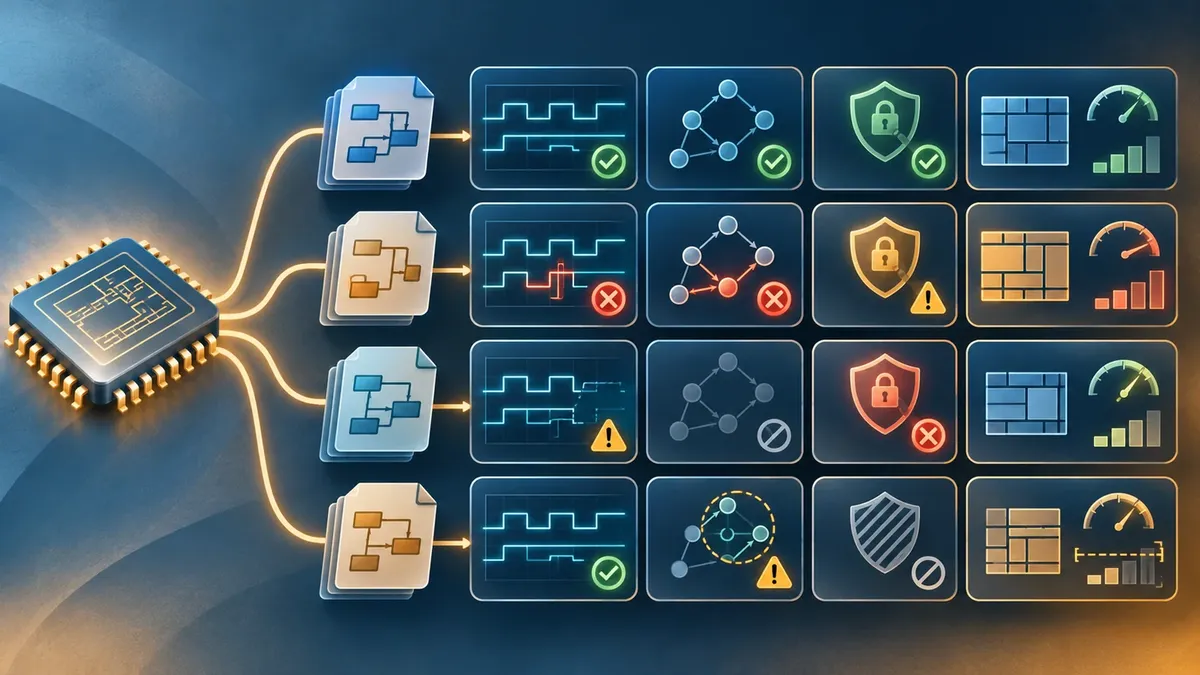
A hardware description can compile and pass a testbench yet still contain a defect, change behavior elsewhere or leave a security weakness. REFORGE, evaluated across three benchmark suites and three language-model backends, treats repair as a series of distinct checks—not a single pass-or-fail result.
A chip’s behavior is often described in RTL, or register-transfer-level code. Large language models can suggest edits, but a repair that compiles or passes a testbench has not necessarily fixed the original bug. It may also alter previously correct behavior, leave a security weakness in place or exceed implementation constraints.
That gap between a plausible patch and a well-supported repair is the problem addressed by REFORGE, a framework described by Tanvir Hossain and colleagues. The authors ask whether structural context and verification-tool feedback can help language models generate checked repairs. They also examine whether verified variants remain different after synthesis, and the computational and implementation costs of generating them.
A repair is more than a patch
REFORGE profiles a design for features such as clocks, resets, counters, state machines, memories and security-sensitive signals. It asks a language model to propose complete RTL variants, then records results from separate checks. One successful check is not treated as proof of overall correctness.
The checks cover syntax and simulation, formal analysis against a reference design where available, preservation of behavior outside the bug-triggering case, security scans and synthesis-based estimates of area, delay and power. Records capture relevant verdicts, proof depths, counterexamples, tool availability and cost measurements where those results are available. A required check that cannot be run blocks selection as an evidence-complete repair; failed checks can inform later attempts.
The authors compare three prompting setups: a basic request with source code; one that adds structural context and repair directions; and a guided version that also supplies the previous round’s blocking diagnosis. The primary evaluation comprises 288 runs across three language-model backends and three benchmark suites: CirFix, a security-related RTL suite assembled by the authors, and a Hack@DAC OpenTitan defect.
More checked repairs, with qualifications
On CirFix, runs producing a checked repair rose from 32 of 63 with basic prompting to 45 of 63 with structural context and 51 of 63 with context plus diagnosis. For the Hack@DAC OpenTitan benchmark, every tested configuration repaired the defect. These results describe the evaluated settings; they do not establish performance on other designs or models.
A central finding is that different checks support different claims. Across the reported campaign, functional replay alone reports 3.9 times more repairs than the full set of applicable checks. This is a comparison within this evaluation, not a universal repair-rate ratio. A passing testbench is useful evidence, but does not establish preservation in untested cases or that implementation costs meet a budget.
The security suite illustrates the distinction. The authors report 199 selected candidates that passed configured differential security checks but lacked checked functional replay. Their functional status is therefore unchecked, not repaired. Similarly, bounded formal analysis addresses only the checked horizon; it is not an unbounded proof. A clean scan speaks only to weaknesses covered by the configured detectors.
The team also evaluated whether verified RTL variants remain different after synthesis. For 408 candidate pairs drawn from identical-PPA groups, a Yosys SAT miter found the pairs functionally equivalent. The result shows why textual variation should not automatically count as hardware diversity. The authors’ similarity scores are selection aids, not proof that implementations differ; the exact-equivalence finding applies to the pairs checked, not every variant in the campaign.
What the results do—and do not—show
The results are descriptive, not a compute-matched causal comparison. The paper uses one seed, and the 63 CirFix observations per prompt setup represent 21 bugs tested across three backends—not 63 independent bugs. Guided prompting also used more tokens than basic prompting in some comparisons. Model snapshots and providers’ default decoding temperatures were unavailable, limiting exact reproduction. Security tests cover defined examples and rules, not unknown vulnerabilities; one of the ten security examples was excluded from security conclusions because the detector did not cover it.
REFORGE’s contribution is an evidence-accounting framework as well as a repair method: it records which checks a candidate passed, which results are bounded or unavailable, and what those results support. It does not remove the need for expert judgment, complete specifications or broader testing. The manuscript states that it has been accepted for publication at DATE 2027 and is an initial author version; the final proceedings version is forthcoming.
- RTL repair
- large language models
- hardware verification
- formal methods
- hardware security
- REFORGE
Reviewed cross-references
These connections were reviewed by a model, not independently fact-checked by a human. Similarity does not imply agreement; consult the original papers and the evidence below.
ChipOmni uses engineering checks to guide AI chip design
Shared method: Both frameworks use feedback from external verification or engineering tools to guide iterative RTL work: REFORGE records checks and blocking diagnoses for repair variants, while ChipOmni incorporates tool feedback into a broader design-and-revision workflow. This is a methodological overlap, not evidence of equivalent scope or performance; REFORGE evaluates RTL bug repair, whereas ChipOmni spans multiple EDA tasks. The comparison is based on selected excerpts from preprint text, not independent human fact-checking.
Model review: · openai-codex/gpt-6-luna
Evidence and provenance
Selected excerpts, not complete papers. PDF extraction can omit figures or damage equations, tables and reading order; sources may be preprints.
2611.33748v1 — Original paper
Excerpt reference:
static/papers/2611.33748v1.md:13-51
Basis: Paper text
Source SHA-256:914aa6c73b055572a16064550849ec45156d935ddf71724f17163795f36fa6af2611.13020v1 — Original paper
Excerpt reference:
static/papers/2611.13020v1.md:194-269
Basis: Paper text
Source SHA-256:c8516f423b179834bf3d3b6ab91c10df4b294f68a28e4477ee1362b69f1a4c03
Formal Guidance for AI-Generated RTL
Shared method: Both use verification results to steer RTL refinement: REFORGE uses verification-guided diagnosis during repair iterations, while Layered Formal Guidance uses assertion failures and counterexamples to target revisions. The latter also addresses underspecified natural-language requirements, as described in its introduction; the methods have different aims, so their outcomes are not directly comparable. This connection is based on selected preprint excerpts, not independent human fact-checking.
Model review: · openai-codex/gpt-6-luna
Evidence and provenance
Selected excerpts, not complete papers. PDF extraction can omit figures or damage equations, tables and reading order; sources may be preprints.
2611.33748v1 — Original paper
Excerpt reference:
static/papers/2611.33748v1.md:52-114
Basis: Paper text
Source SHA-256:914aa6c73b055572a16064550849ec45156d935ddf71724f17163795f36fa6af2611.30766v1 — Original paper
Excerpt reference:
static/papers/2611.30766v1.md:239-312
Basis: Paper text
Source SHA-256:ad6c4b767ec56de19010b335ac9206a0d7d17f8bcbda26e9ecfea33d4cc4275d2611.30766v1 — Original paper
Excerpt reference:
static/papers/2611.30766v1.md:70-136
Basis: Paper text
Source SHA-256:ad6c4b767ec56de19010b335ac9206a0d7d17f8bcbda26e9ecfea33d4cc4275d
Related reading
Automatically matched by shared topic keywords. These links do not imply that the sources agree or establish a consensus.
Finding the Hidden Signals That Could Put Hardware at Risk
Source published
Shared keywords: hardware security, large language models
ChipOmni uses engineering checks to guide AI chip design
Source published
Shared keywords: hardware verification
Using entailment graphs to make AI formalization safer
Source published
Shared keywords: formal methods, large language models
A classifier translates robot instructions into temporal logic
Source published
Shared keywords: formal methods
When a Hardware Glitch Can Disable an AI Model’s Refusals
Source published
Shared keywords: hardware security