TRANSMISSION // 2611.33730v1
A Quantum Algorithm Tightens the TSP Time Bound
Source published
A theoretical algorithm lowers the known exponential-time bound for quantum solutions to the traveling salesman problem, combining dynamic programming, set systems and amplitude amplification.
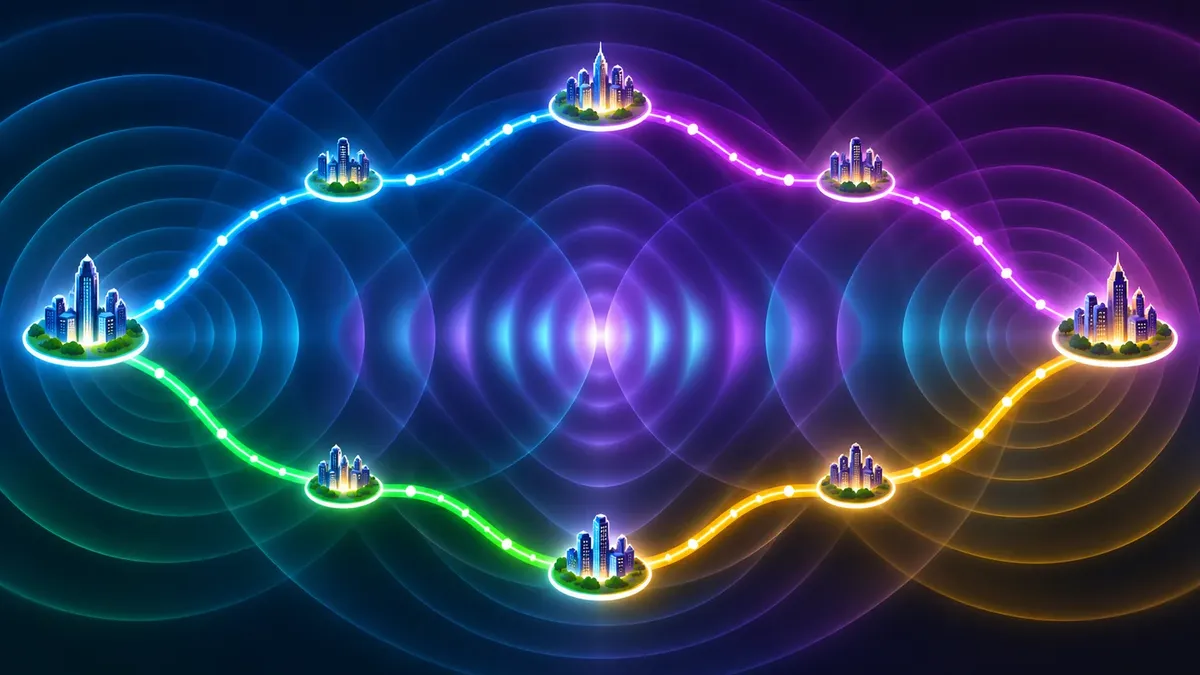
Finding the shortest round trip through a set of cities is a classic hard problem. A new theoretical result improves the best known quantum running-time bound for solving it exactly—but it is an algorithmic guarantee, not a demonstration of faster performance on today’s quantum computers.
The traveling salesman problem (TSP) asks for the cheapest route that visits every city once and returns to the start. It is a familiar example of a problem whose possible routes multiply rapidly as cities are added. For general edge weights, the standard Bellman–Held–Karp dynamic-programming method takes time that grows roughly as 2^n, apart from polynomial factors, where n is the number of cities.
Masayuki Miyamoto’s arXiv preprint, “Faster Quantum Algorithms for TSP and More,” asks whether quantum search can improve that exponential growth rate. It presents a bounded-error quantum algorithm with running time O*(1.70961^n), improving on the previously best-known quantum bound of O*(1.7274^n). Here O* suppresses factors that grow only polynomially with the input length. This is a mathematical upper bound under the algorithm’s stated model, not a measurement from a quantum device.
Combining two algorithmic ideas
The approach brings together quantum minimum-finding and a technique based on set systems. A set system is a selected family of subsets—in this case, subsets of cities. The classical dynamic program can be restricted to such a family, reducing how many path costs need to be stored. The challenge is to choose a family that is compact while still being likely to include the subsets associated with an optimal tour.
The algorithm divides a tour into four consecutive paths of different sizes. It uses dynamic programming to calculate path costs for smaller city sets, while the set-system construction limits the larger collection of sets considered in another part of the computation. Quantum minimum-finding searches among possible splits, and amplitude amplification boosts the chance of finding a useful split when success is initially unlikely. The paper’s analysis chooses path sizes and coloring parameters so the costs of precomputation, searching and amplification combine to give the stated time bound.
This is not simply Grover’s search applied to every possible tour. Rather, quantum search is embedded in a structured dynamic program that reuses calculated path costs. The paper also describes space–time tradeoffs: under specified total-space bounds, it gives alternative running-time bounds. In addition, it derives the same quantum time upper bound for Minimum Set Cover, Directed Feedback Arc Set, One-Sided Crossing Minimization and Shortest Common Superstring, using related constructions or a reduction.
What the improvement means—and what it doesn’t
The exponential base falls from 1.7274 to 1.70961. Because that base is raised to the number of cities, a reduction can matter asymptotically as problem size grows. But the result does not establish that a practical quantum computer can solve real-world routing problems faster than classical software. The paper analyzes an idealized algorithm and relies on a quantum random-access memory (QRAM) model, in which precomputed classical data can be read coherently—even when the address is in superposition—in one time step. Building and operating hardware with the required capabilities is a separate challenge not settled by this analysis.
The theorem covers directed or undirected graphs with binary-encoded integer edge weights, and the algorithm reports if no Hamiltonian cycle exists. Its running-time statement allows bounded error: the algorithm succeeds with high probability as formalized in the paper, rather than guaranteeing a correct answer on every run. Repetition and verification are included in the analysis. The bound also hides polynomial factors, so it is not a complete runtime estimate for a particular number of cities or hardware platform.
This is a theoretical improvement to the best known bound discussed in the preprint, not proof that no faster algorithm exists. Nor does it show a quantum advantage in an experiment: the source reports no device trials or benchmark measurements. The paper credits AI assistance for finding and optimizing numerical parameters and for drafting and revising the exposition. That disclosure does not establish whether the proof is correct, but it is relevant context when assessing the work.
This article is based on the arXiv v1 preprint, posted November 25, 2026. A preprint may not yet have been peer reviewed, and its claims or details can change in later versions. The source provides a detailed algorithm and mathematical analysis, but this summary is not an independent verification of the proof. The central takeaway is precise but limited: under the paper’s QRAM assumptions, the proposed construction lowers the theoretical exponential running-time base for exact TSP from 1.7274 to 1.70961.
- quantum algorithms
- traveling salesman problem
- dynamic programming
- Grover search
- amplitude amplification
- quantum complexity
Reviewed cross-references
These connections were reviewed by a model, not independently fact-checked by a human. Similarity does not imply agreement; consult the original papers and the evidence below.
Quantum oracles count edges to find cliques and hitting sets
Shared method: Both works use Grover-based amplification: Miyamoto combines Grover search and amplitude amplification with dynamic programming for weighted TSP, while Piñero et al. construct clique and hitting-set oracles for Grover search. The shared method is bounded to amplification of marked candidates; the problems, oracle constructions, and reported complexity measures differ, so their performance bounds are not directly comparable.
Model review: · openai-codex/gpt-6-luna
Evidence and provenance
Selected excerpts, not complete papers. PDF extraction can omit figures or damage equations, tables and reading order; sources may be preprints.
2611.33730v1 — Original paper
Excerpt reference:
static/papers/2611.33730v1.md:13-40
Basis: Paper text
Source SHA-256:fb54467f0b8a0453e6ea9218bfe9f5eba5c5216256dfa9f96c1cb42d3f85761e2611.10640v1 — Original paper
Excerpt reference:
static/papers/2611.10640v1.md:13-42
Basis: Paper text
Source SHA-256:89110bfc6723ee7d03357d98e81e6c6d4adc03ce9c41c6d13c2985489a7dc1fe
Related reading
Automatically matched by shared topic keywords. These links do not imply that the sources agree or establish a consensus.
How noise changes the best stopping point for quantum search
Source published
Shared keywords: amplitude amplification, grover search
Quantum search sharpens theoretical bounds for hard graph problems
Source published
Shared keywords: quantum algorithms
How quantum algorithms can transport samples through nonreversible chains
Source published
Shared keywords: amplitude amplification, quantum algorithms
Dicke states from every qubit, with no extras
Source published
Shared keywords: amplitude amplification
Quantum oracles count edges to find cliques and hitting sets
Source published
Shared keywords: grover search