TRANSMISSION // 2611.33729v1
Classical light challenges a Wigner–Bell probability rule
Source published
A theoretical study finds that Malus-law intensity patterns in nonseparable classical light can violate a Wigner–Bell bound—without showing quantum nonlocality.
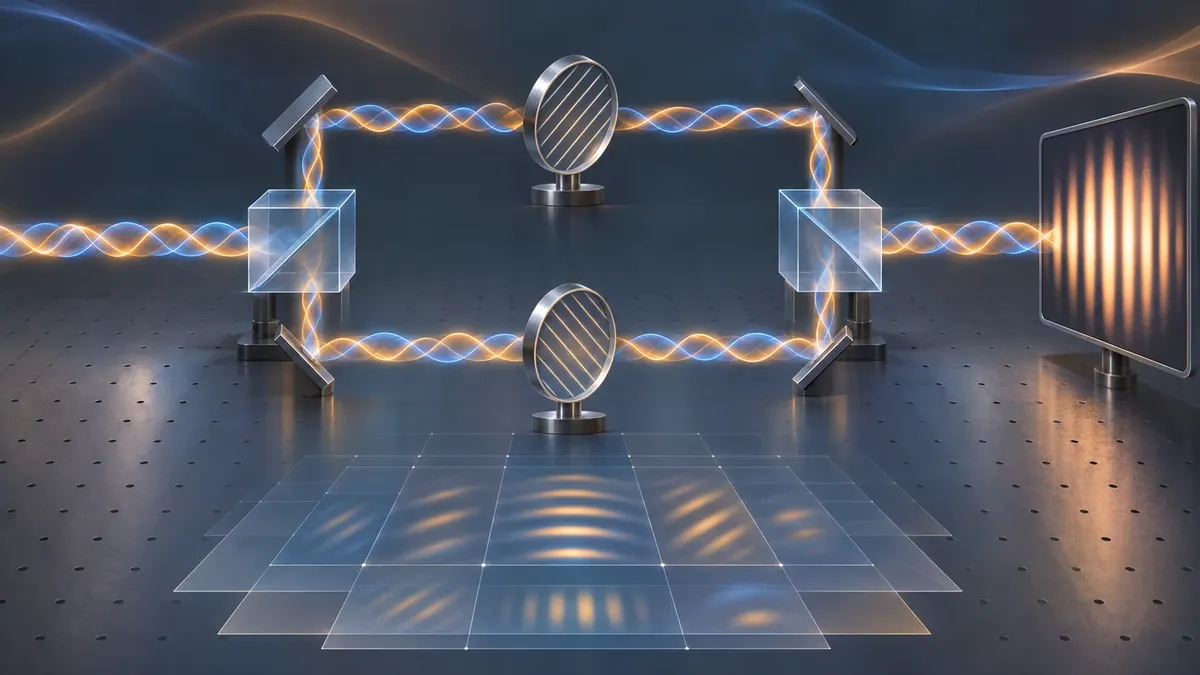
Bell-type inequalities are often linked to quantum nonlocality. But what if a similar probability bound is violated by an ordinary classical light field? Xiao-Feng Qian’s study explores what such a result does—and does not—mean.
A violation of a Bell-type inequality is often presented as evidence of quantum nonlocality. But these inequalities also encode a mathematical requirement: that statistics gathered under different measurement settings can be combined into one consistent probability model. Xiao-Feng Qian’s theoretical study asks what happens when that requirement is tested using classical light rather than spatially separated quantum particles.
The paper examines the Wigner–Bell inequality, a probability-based constraint that assumes results for several possible measurements can be represented by one nonnegative global joint distribution. In plain language, probabilities measured in different settings must fit together as pieces of a single, consistent table—even when those settings cannot be used at the same time.
The analysis applies this idea to a light beam with two nonseparable degrees of freedom, such as polarization and a pair of spatial or temporal modes. “Nonseparable” here means the beam’s degrees of freedom are correlated and cannot be described as independent components. They are internal features of one beam, not particles at distant locations.
From optical intensities to probabilities
The analysis begins with an assumed model for how the two subsystems respond to their respective analyzers. Each subsystem’s response depends on its own setting, while correlations between outputs are mediated by a shared parameter. The model also requires a common underlying description across measurement settings. These assumptions take the place of spatial locality in this optical scenario; they do not mean the optical subsystems are uncorrelated.
For the classical beam, joint probabilities are represented by normalized output intensities: the share of the beam’s total intensity registered in each channel. Their angular dependence follows Malus’ law, the familiar rule describing how light passes through a polarizer as its orientation changes. Qian derives the Wigner–Bell bound under the model’s assumptions and compares it with these intensity-based probabilities.
For an idealized field with perfect equal-setting correlations, the calculated probabilities exceed the bound for a range of analyzer orientations. In one symmetric choice of settings, the violation occurs across a finite interval, with a maximum Wigner excess of 1/8 for that family. The paper also describes a broader region of violating settings, rather than a single isolated configuration. These are theoretical results, not measurements from a completed experiment.
The paper derives an extended version of the bound for imperfect equal-setting correlations, which can arise from imperfect preparation, alignment or detection. In this case, a positive excess by itself is not enough to establish a violation: it must be larger than the measured mismatch probability. An experimental claim would also need to account for statistical and systematic uncertainty.
What the violation means
The result does not show that classical electrodynamics fails, that Malus’ law is wrong, or that the beam transmits influence faster than light. Nor does it demonstrate spatial Bell nonlocality: the two degrees of freedom are carried within a single classical field.
Instead, the violation rules out a more specific construction. Under the stated assumptions, the pairwise statistics from different measurement contexts cannot all be marginals of one nonnegative global distribution. The tension is between context-dependent optical projections and the requirement for a single, setting-independent probability assignment. The paper relates this issue to contextuality, while noting that broader claims about generalized noncontextuality require carefully specified assumptions.
Qian proposes an interferometric experiment to reconstruct the required joint probabilities using intensity measurements. In the proposed setup, the light is divided into two paths; projections prepare the components, which are then recombined so their interference can help determine the probabilities. The proposal uses a classically nonseparable thermal-light field, and the second degree of freedom could be encoded in different kinds of optical modes. The paper proposes this as a route to testing the prediction; it does not report that the experiment has been performed.
A result about assumptions, not faster-than-light effects
The work helps separate ingredients behind Bell-type results. Hilbert-space-like structure, correlations and measurement context can produce a violation of a probability bound in classical wave optics. That observation does not, by itself, establish the specifically quantum phenomenon of spatial nonlocality.
The source is an arXiv preprint, and the supplied material does not establish that it has undergone peer review. Its central claim is a theoretical analysis accompanied by a proposed experiment, so experimental validation remains a next step. The result is best read as an analysis of what follows from a particular probability model—not as evidence that classical light reproduces every feature of quantum Bell tests.
- Wigner–Bell inequality
- classical optics
- nonseparable light
- Malus’ law
- joint probability
- contextuality
Reviewed cross-references
These connections were reviewed by a model, not independently fact-checked by a human. Similarity does not imply agreement; consult the original papers and the evidence below.
Quantum nonclassicality is a problem of fitting the pieces together
Shared method: Both papers frame a Bell-type constraint as a test of whether statistics from different measurement contexts can be marginals of one nonnegative global distribution. The optics paper applies this to context-dependent projections of one classical field under a stipulated factorized-response assumption; Svozil presents the marginal problem more generally and discusses other settings. This is a shared probabilistic framework, not evidence that the papers test the same system or assumptions.
Model review: · openai-codex/gpt-6-luna
Evidence and provenance
Selected excerpts, not complete papers. PDF extraction can omit figures or damage equations, tables and reading order; sources may be preprints.
2611.33729v1 — Original paper
Excerpt reference:
static/papers/2611.33729v1.md:1791-1843
Basis: Paper text
Source SHA-256:3509f1e8d5f436afab4d2cf0f441013447b7b6d9215b7fbcb5b1f5906372f7f12611.28674v1 — Original paper
Excerpt reference:
static/papers/2611.28674v1.md:12-77
Basis: Paper text
Source SHA-256:687737bebbf59e0aa7fd8ee4671a470529a1b0ff7b3d719e6fee01e3f300618d