TRANSMISSION // 2611.33728v1
When 3D scenes look right but interactions fail
Source published
Asset4D-Bench evaluates whether AI coding agents can rebuild editable Blender scenes that recover objects, motion and interactions. Correct motion can coexist with failures in contact or support.
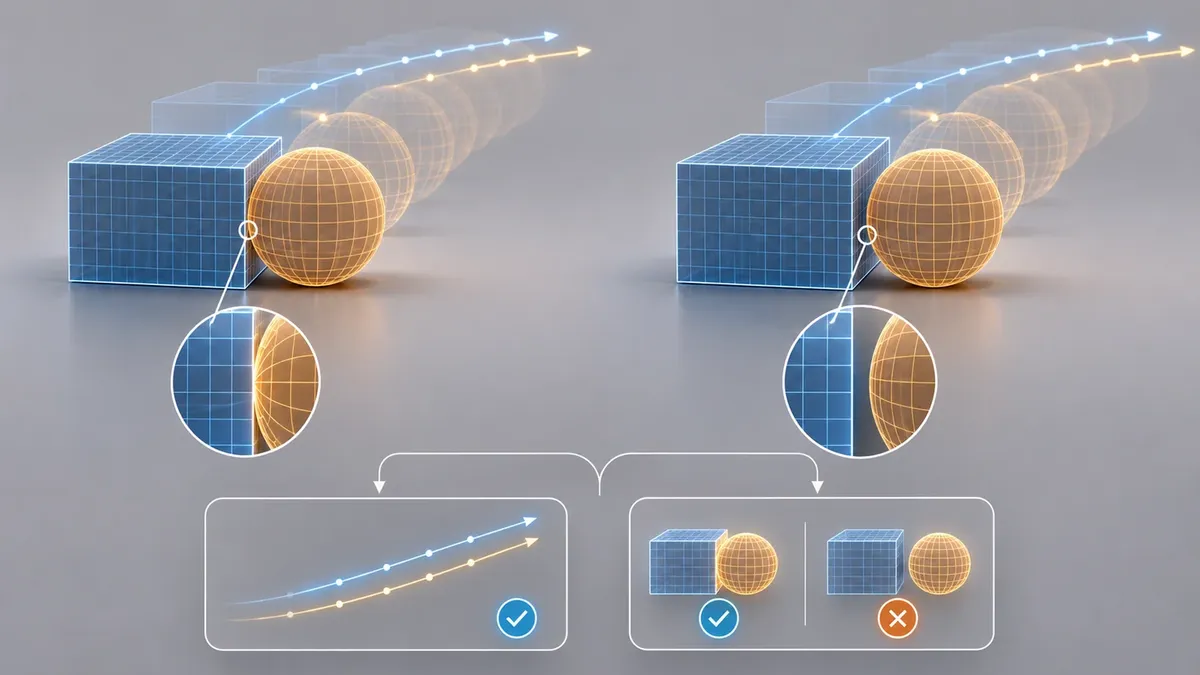
A cart can follow the right path while its cargo floats above the deck. Asset4D-Bench tests whether AI coding agents can recreate editable 3D scenes that capture both motion and interactions between objects.
An object can follow the right path and still fail to behave like the scene it is meant to reproduce. Cargo might not rest on a cart; two parts might meet without locking. Asset4D-Bench asks whether AI coding agents can reconstruct visual references as editable Blender projects that capture objects, motion and relationships between objects.
That distinction matters when a scene is meant to be inspected, changed or replayed—not just rendered as a convincing image. The benchmark evaluates submitted projects by measuring scene properties at specified moments.
Four ways to test reconstruction
The benchmark contains 114 task conditions across four tracks. In image editing, agents modify a supplied scene to match a target image while preserving other content. Video reconstruction tasks provide either a fuller set of starter assets or a partial package. A fourth track asks agents to build scenes from scratch using visual observations.
The full- and partial-asset versions of paired video tasks share their reference videos, targets and scorecards, but differ in the assets supplied. The from-scratch tasks were selected separately. The study reports 228 archived scores for two evaluated configurations, gpt-6.1-sol and gpt-6-astra, both at xhigh reasoning effort.
For evaluation, submissions were executed, saved and reopened before the researchers measured them against the reference at specified times. The paper documents limits to this process: clean-host replay is incomplete, and some archived evaluation adapters depend on absolute paths. Scores assess geometry, dynamics, relationships and camera consistency. Relationship checks can ask whether objects touch, whether a load remains supported, or whether events happen in the required order. A separate strict-completion rule requires a sufficiently high score, enough evidence and full credit on critical criteria.
Motion can succeed while relationships fail
The clearest comparison comes from 24 from-scratch tasks for each model. Both earned full dynamics credit on 14 tasks. Among those 14, Sol received zero relationship points on three, while Astra did so on eight. Matching the scored motion therefore did not guarantee that the scene captured how objects interacted.
The paper’s examples show what such discrepancies can look like. In Sol’s Q22 reconstruction, the distinct alignment stage present in the reference is absent from the recovered scene, and the claws stop short of the collar. In Astra’s Q14 reconstruction, the scene earned full dynamics credit, but shield-cap vertices were found inside the projectile where the reference shows separation. These are selected diagnostic examples, not evidence that every reconstruction from either model has the same problem.
Across the 24 from-scratch tasks, mean recovered fidelity was 66.29 for Sol and 59.78 for Astra. Under the benchmark’s fixed scoring weights, relationship points account for 5.15 points of the 6.50-point difference. This is an arithmetic breakdown of the archived scores, not evidence that one capability caused the overall gap. Aggregate scores can also conceal important errors: two Astra scenes scored above 80 but failed a critical relationship check.
What the scores cannot establish
A low video score does not necessarily mean a scene was built successfully but reconstructed poorly. Of 46 zero scores among 120 video entries, 44 reflected confirmed failures to execute the original submission, so scene geometry and motion were unmeasured. Some projects were later recovered or remeasured; the archive distinguishes those scene scores from original delivery outcomes.
The benchmark cannot establish whether full starter assets help. Although paired tasks were designed with shared references and different asset packages, archived runs vary in execution and recovery policies. Those differences prevent a causal estimate of starter-asset effects. Track averages describe the recorded submissions, not the isolated impact of the assets.
More broadly, the measurements test specified properties under particular scorecards and tolerances. They do not certify forces, arbitrary hidden states, or behavior after a user edits a scene. Whether the results generalize to alternative valid scene constructions, independent judgments or different scoring choices remains open. The study does not establish comprehensive human agreement. Interactive gameplay, counterfactual physics and improvements from iterative feedback were not tested.
Asset4D-Bench separates plausible animation from a broader kind of reconstruction: an editable scene whose objects and interactions can be examined at observed event times. Its measurements can expose cases where motion matches the scorecard while contact, support or event order does not.
- 3D reconstruction
- AI coding agents
- Blender
- 4D scenes
- scene interaction
- benchmark
Related reading
Automatically matched by shared topic keywords. These links do not imply that the sources agree or establish a consensus.
Why 3D reconstruction needs more than a close fit
Source published
Shared keywords: 3d reconstruction
A 360-degree image can map a room—but not every surface
Source published
Shared keywords: 3d reconstruction
A pixel-level test for when generated videos bend reality
Source published
Shared keywords: 3d reconstruction
How an AI agent builds a 3D object from video
Source published
Shared keywords: 3d reconstruction
How Embodied-VGGT keeps long 3D reconstructions aligned
Source published
Shared keywords: 3d reconstruction