TRANSMISSION // 2611.33723v1
A Berry-Connection View of Superconductivity
Source published
A preprint proposes that stable Berry-connection states can carry dissipation-free current, offering a different interpretation of superconductivity. Its claims remain theoretical.
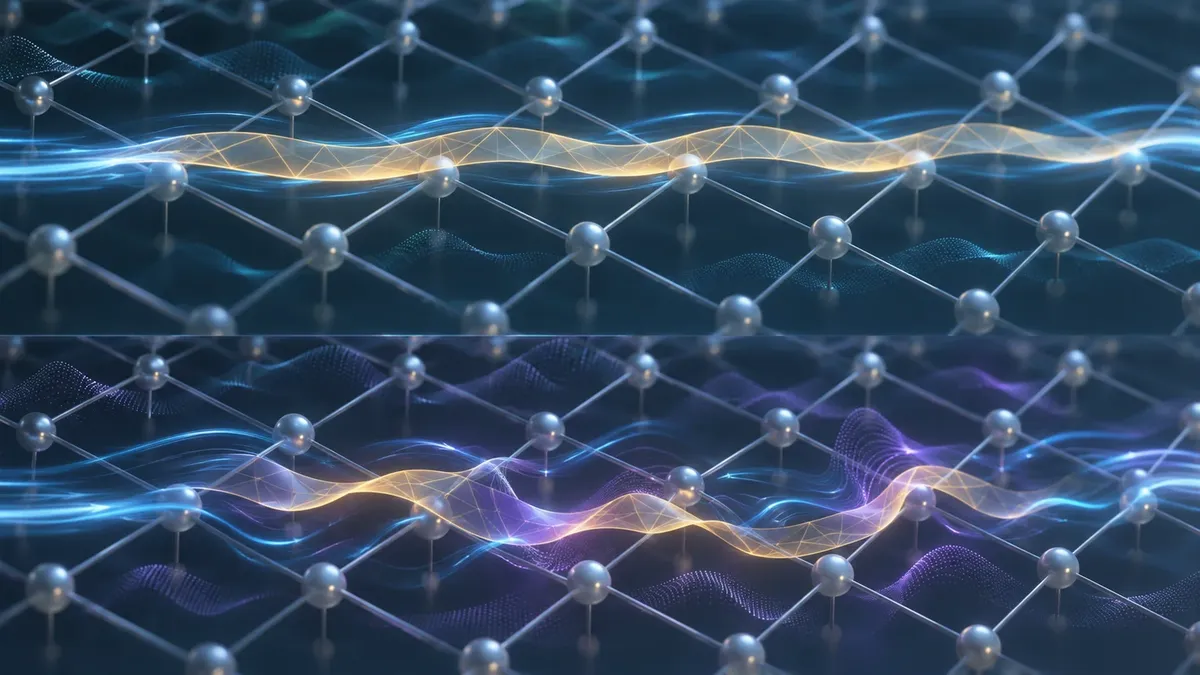
What makes a current flow without electrical resistance? Hiroyasu Koizumi’s preprint develops a proposed answer based on fluctuations in a geometric quantity called the Berry connection, rather than treating electron pairing as the whole story.
Superconductors can carry electrical current without the ordinary energy loss associated with resistance. The standard microscopic account, rooted in Bardeen–Cooper–Schrieffer (BCS) theory, connects this behavior to electrons forming pairs and to an energy gap. In a new arXiv preprint, physicist Hiroyasu Koizumi argues for a different, though related, emphasis: superconductivity arises when a particular geometric feature of many-electron quantum states remains stable against fluctuations.
The proposal centers on a Berry connection constructed from a many-electron wave function. Berry connections are geometric quantities used to describe quantum states; here, Koizumi builds one from the many-electron wave function and relates it to a phase variable, called χ, in the description of current. The paper explicitly does not assume that this construction involves adiabatic evolution. In its framework, fluctuations in χ can produce random transitions between quantum states. States unaffected by the resulting dissipation are identified as superconducting.
From gauge freedom to a stability condition
The paper also offers an interpretation of electromagnetic gauge invariance—the fact that different mathematical choices for electromagnetic potentials can describe the same observable electric and magnetic fields. Koizumi treats this invariance as a way of identifying parts of the description that remain unaffected by fluctuations in the gauge-related phase. In this account, a stable spatial gradient of χ is a hallmark of the superconducting state.
This is a theoretical construction, not a report of a new experiment. The paper develops the Berry connection from a many-electron wave function, introduces χ as a field, and quantizes it. To represent random transitions, it uses a Lindblad equation, a mathematical framework for describing changes in a quantum system under dissipative processes. The author then identifies states that avoid dissipation in this model and connects them to supercurrent.
The preprint also applies the framework to a superconducting-to-normal transition in a magnetic field. It analyzes changes in magnetic-field energy and current-carrier kinetic energy, and argues that their balance can describe a reversible transition without Joule heating. This is an explanation proposed within the theory; the paper does not present a new measurement of such a transition.
What the proposal claims—and what it does not establish
Koizumi says the approach addresses disagreements between conventional theory and experiment, including a discrepancy involving the effective mass inferred from the magnetic field generated when a superconductor rotates (the London moment). The paper further claims that its framework retains major results of BCS theory. These are the author’s claims about the theory’s scope, not independent confirmation that it resolves those issues. The evidence presented is mathematical development and discussion of prior work, rather than new experimental data or a systematic test against competing explanations.
That distinction matters because the paper proposes a substantial reinterpretation of superconductivity. Showing that a model has dissipation-free states is not, by itself, enough to establish that those states explain real materials or outperform existing accounts. The preprint does not provide a broad comparison with alternative theories or new experimental results that would settle those questions.
The source is a version-one preprint on arXiv, which means it is publicly available but is not necessarily peer reviewed. Its extracted text includes equations, and extraction can make technical details harder to assess; this accessible account therefore sticks to the paper’s stated framework and conclusions. Readers should treat the proposed connection between Berry-connection stability and superconductivity as a research hypothesis, not settled consensus.
The paper’s central question is nevertheless clear: could resistance-free current be understood through the stability of a geometric, phase-related field amid quantum fluctuations? Koizumi’s answer is yes, within the model he develops. Whether that account provides a reliable, experimentally supported alternative or complement to conventional superconductivity theory remains open.
- superconductivity
- Berry connection
- gauge invariance
- quantum physics
- BCS theory
- arXiv preprint
Related reading
Automatically matched by shared topic keywords. These links do not imply that the sources agree or establish a consensus.
A Magnetic-Drive Proposal for Paired Quantum Emission
Source published
Shared keywords: gauge invariance
How fast can Yang–Baxter circuits grow in complexity?
Source published
Shared keywords: quantum physics
A broader message-passing method for tensor networks
Source published
Shared keywords: quantum physics
Why Some Thermal Quantum Memories Need Redundancy
Source published
Shared keywords: quantum physics
How Non-Invertible Symmetries Classify Quantum Pumps
Source published
Shared keywords: quantum physics