TRANSMISSION // 2611.33722v1
Can AI models learn to think less through practice?
Source published
A method called FLUENT trains looped models to use earlier predictions, aiming to reduce computation without sacrificing task performance. Tests span simulated environments, language benchmarks and a real robot.
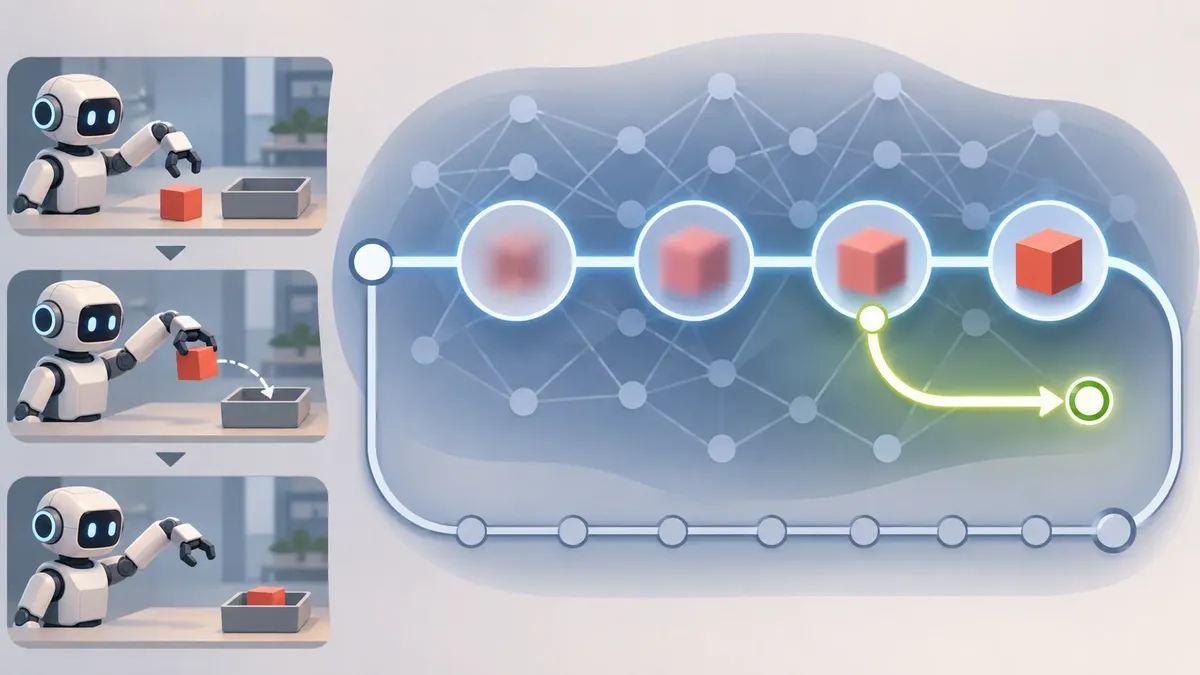
Repeated practice can make a task easier for a person. Could it also teach an AI model to spend less computation on familiar work? A new preprint proposes a way to train models to exit their repeated processing sooner—and tests it across several settings.
The question: can experience reduce computation?
Some AI models process information by repeatedly applying the same block of computation. These are called looped models. They can produce a prediction after each loop, so in principle a model can stop early when an intermediate answer is good enough. But simply making early predictions available does not ensure they are useful, or that the model will choose to use them.
The paper asks whether practice can improve both the predictions made at earlier loops and the model’s ability to stop at those loops. Its proposed method, FLUENT, updates the model using its own predictions rather than extra task labels or rewards.
Three parts to the training method
FLUENT uses a frozen copy of the model before practice as a teacher. First, Translate trains an early prediction to match the teacher’s final-loop prediction. Second, Anchor keeps the current model’s final-loop output close to that same teacher. This matters because the loops share weights: changing the model to improve an early prediction can also change its later predictions.
Third, Gate trains a stopping policy. During training, the gate weighs how much a prediction differs from the current final-loop output against the computation cost of continuing. In effect, it learns when an earlier answer is close enough to justify stopping. The gate uses these comparisons as training signals; the paper says they are not needed as inputs at inference.
Tests across games, robots and language
The researchers evaluated FLUENT in four settings. In the Crafter survival game, models practiced in fixed worlds and were also tested in newly generated ones. Compared with supervised fine-tuning (SFT), FLUENT achieved more in-game accomplishments in the new worlds while selecting a shallower average prediction depth. For one model size, the reported averages were 8.40 accomplishments at depth 2.66 with FLUENT, versus 7.19 at depth 3.63 with SFT. The paper also tested a setting that actually skips computation for tokens that exit early; new-world achievement averages remained above the SFT result for both model sizes.
In LIBERO, a simulated robot-manipulation benchmark, FLUENT reported 93.5% average success while using 3.97 action-head iterations per chunk. The compared RD-VLA baseline reported 91.9% success at 6.27 iterations. With both methods forced to use four iterations, FLUENT’s reported success was 92.3%, compared with 82.2% for RD-VLA.
The real-robot test involved moving specified objects to target locations. Compared with the SFT policy, reported success rose from 62.29% to 74.57%. Mean completion time among successful episodes fell from 69 to 31 seconds. FLUENT also used fewer action-head iterations per chunk. The authors report that its success advantage remained when they added delay to match the SFT policy’s timing cadence, suggesting the result was not just a consequence of moving faster.
For language models, FLUENT’s mean accuracy was 65.4%, close to the initial model’s 65.3%, while mean selected depth fell from 3.05 to 2.48—a reported reduction of 18.7%. This was an average across the paper’s chosen evaluation metrics, not evidence that every task or individual answer was unchanged.
What the results do—and don’t—show
The experiments suggest that training early predictions and training the stopping policy together can improve the balance between task performance and computation in these tested systems. The components matter: the paper’s ablations indicate that improving shallow predictions alone did not reliably produce the best gated performance. A model must both generate useful early answers and learn when to use them.
The gains are not uniform. The paper notes that some settings mainly reduced depth rather than improving performance. Its authors also identify a key constraint: practice relies on the initial model’s predictions, so it cannot provide supervision for knowledge the model does not have. Results from selected benchmarks and robot setups do not establish that FLUENT will help across other models, tasks or deployment conditions. Nor do the reported depth measures always mean computation was skipped: the paper distinguishes dense readout from its separate ragged-execution test.
This account is based on the arXiv preprint identified as version 1, not an independently verified or necessarily peer-reviewed publication. Preprint findings can change, and the available source does not establish how the method compares under every practical cost, safety or reliability measure. The study is a promising demonstration of practice-based early exit, not proof that AI systems generally learn to think less.
- looped models
- early exit
- adaptive computation
- self-distillation
- robot learning
- FLUENT
Reviewed cross-references
These connections were reviewed by a model, not independently fact-checked by a human. Similarity does not imply agreement; consult the original papers and the evidence below.
A Diffusion Model With Adjustable Depth
Shared method: Both papers distill predictions from a teacher to train a looped model: FLUENT transfers the frozen initial model’s final-loop prediction to early predictions and anchors the current final prediction to that teacher, while Dooop trains each loop toward a pretrained diffusion teacher through fixed-point iteration. The shared method is teacher-based distillation across loop depths; the objectives and evaluated tasks differ, so this does not establish comparable outcomes.
Model review: · openai-codex/gpt-6-luna
Evidence and provenance
Selected excerpts, not complete papers. PDF extraction can omit figures or damage equations, tables and reading order; sources may be preprints.
2611.33722v1 — Original paper
Excerpt reference:
static/papers/2611.33722v1.md:84-259
Basis: Paper text
Source SHA-256:570997ef1f4b8d0b34d3f2230943524806c542331a9bd8436f4b9535c5fa29572611.31977v1 — Original paper
Excerpt reference:
static/papers/2611.31977v1.md:94-145
Basis: Paper text
Source SHA-256:9b01aceb1a10bce763783cc4af124be5b56a581e02251f3ba1eba216c3eba99e
Related reading
Automatically matched by shared topic keywords. These links do not imply that the sources agree or establish a consensus.
DepthMSA asks which modalities need the most computing power
Source published
Shared keywords: adaptive computation, early exit
Teaching robot policies to handle stale observations
Source published
Shared keywords: robot learning, self distillation
AlterNet tests whether language models can learn when to stop computing
Source published
Shared keywords: adaptive computation
A language model that can stop early—or switch models
Source published
Shared keywords: early exit
A Transformer That Stops When Its Reasoning Settles
Source published
Shared keywords: adaptive computation