TRANSMISSION // 2611.33712v1
PowerFix turns circuit failures into repair plans
Source published
A simulation-based flyback benchmark suggests that physics-guided diagnosis and tightly checked edits can help an LLM repair failed converter designs—but hardware tests are still ahead.
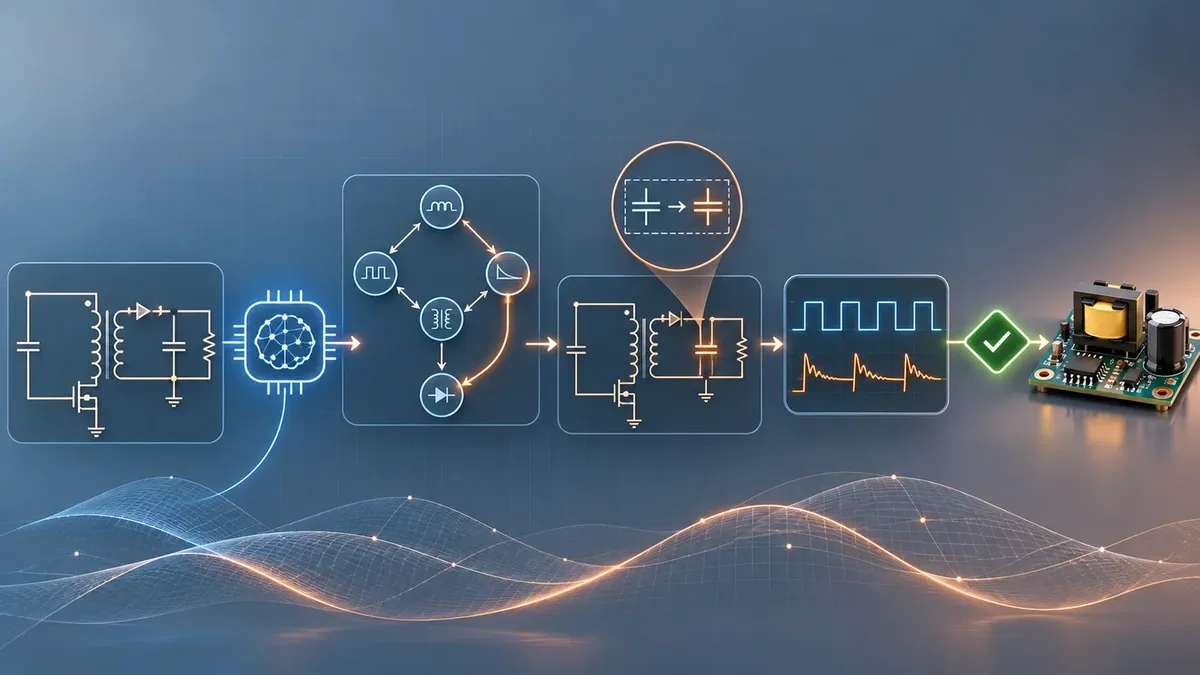
Power converters must meet many interacting electrical limits, so fixing one fault can leave another behind. PowerFix pairs an LLM planner with a physics-based diagnostic graph, restricted edits and simulation checks. In a 96-task flyback benchmark, the system verified more repairs than the tested LLM baselines, though the results remain limited to an offline workflow.
Power converters regulate electrical power in devices and systems ranging from renewable energy equipment to vehicles. Designing one means satisfying several constraints at once: a component change that fixes a voltage problem, for example, might cause another operating limit to fail. That makes repair more than simply editing a design until the original warning disappears.
A team led by Can Wang, Shi Qiu and Fanfan Lin presents PowerFix, a framework for repairing converter designs that fail engineering checks. The researchers ask whether an LLM can help choose repairs while physical rules and deterministic software constrain what it may change—and while tests prevent an unverified candidate from replacing the original design.
Diagnosis before editing
PowerFix is built around a four-stage loop. It first records failed checks and their evidence. A topology-specific graph, called PowerDiagGraph, links those failures to possible physical causes, relevant design variables and permitted repair routes. The graph is prepared in advance for a converter topology; it is not created or expanded by the LLM during a repair.
The LLM ranks the available routes. It does not directly rewrite the design: a deterministic compiler turns a selected route into edits to authorized fields. Each proposed repair is tested on a separate copy of the design. Static checks, analytical engineering checks and circuit simulations are used, and the candidate is accepted only if all required checks pass. Otherwise, the original remains unchanged; validation results can inform another planning round.
The team evaluated the method on 96 failed flyback-converter designs. The benchmark included 72 designs with an injected single fault, 12 with interacting fault pairs and 12 held-out failures produced by the researchers’ design generator. The last group had no single known correct repair. An external scorer checked completed designs against the engineering regression rather than relying on the repair system’s own judgment.
More verified repairs, with important qualifications
Under the primary comparison, PowerFix achieved a 78.7% verified repair success rate, compared with 30.1% for the strongest of three LLM baselines. Here, a verified repair had to resolve the target failure and pass the full required checks. The reported rate weights the three benchmark groups equally, so it is not simply the share of all 96 tasks repaired. In raw counts, PowerFix verified 85 of 96 tasks in this setting.
The advantage was not uniform across task types. On the 12 coupled-fault cases, PowerFix verified 11; the strongest baseline verified two. For the 12 generator-produced natural failures, the estimated gain was uncertain: the paired confidence interval included zero, so the authors do not claim a statistically clear improvement for that group. Some baseline methods also repaired tasks PowerFix missed.
With three additional rounds of replanning, PowerFix’s group-weighted rate rose to 88.4%, verifying 91 of 96 tasks. Much of this increase came from three additional repairs in the small natural-failure group. Two further rounds added simulation work without another verified repair. Replanning therefore helped on this benchmark, but the result does not establish that more retries will always pay off.
An ablation study removed individual parts of the workflow. Removing graph-guided diagnosis caused the largest reported drop in repair success. Removing isolated validation changed the success rate much less, but the system then handed back 22 designs that the external scorer found invalid. This distinction matters: a repair system should not only find fixes, but also withhold candidates that fail checks.
What remains unknown
These are offline, simulation-based results for flyback converters and the checks encoded in the workflow. The 12 natural failures came from one design generator, and they are not a random sample of failures in real engineering practice. The baseline workflows did not have matched compute budgets; PowerFix used about four times as many workflow simulations as the tool-using baseline in the primary comparison. Its design also depends on a graph and an authorization map prepared for each topology, whose setup costs were not included in per-task costs.
Most importantly, passing a simulation regression does not prove that a physical prototype will behave as predicted. The authors say hardware validation and transfer to another converter topology remain future steps. Engineer review time and acceptance were not measured, and even comprehensive encoded checks can miss requirements they do not represent.
The paper is an arXiv preprint, and this account is based on the supplied paper text; preprints may not have undergone peer review. PowerFix offers evidence that structured diagnosis and validation can make LLM-assisted repair more reliable within a particular simulated workflow—not evidence that the system is ready to design or approve hardware on its own.
- PowerFix
- power converters
- large language models
- engineering design
- circuit simulation
- AI repair
Reviewed cross-references
These connections were reviewed by a model, not independently fact-checked by a human. Similarity does not imply agreement; consult the original papers and the evidence below.
SAFTAC trains language models to design and repair analog circuits in simulation
Shared method: Both use simulation feedback to guide circuit revision: PowerFix uses failed validation to diagnose and replan repairs to flyback converters, while SAFTAC trains models to revise analog netlists using diagnostic feedback. This is a shared feedback-loop approach, not evidence of comparable performance; the circuit types, workflows and evaluation settings differ.
Model review: · openai-codex/gpt-6-luna
Evidence and provenance
Selected excerpts, not complete papers. PDF extraction can omit figures or damage equations, tables and reading order; sources may be preprints.
2611.33712v1 — Original paper
Excerpt reference:
static/papers/2611.33712v1.md:71-106
Basis: Paper text
Source SHA-256:4049e13a59208c6cc8d25dea7c047c1d9f98706e4a067c500353e022e4baf6282611.08543v1 — Original paper
Excerpt reference:
static/papers/2611.08543v1.md:110-170
Basis: Paper text
Source SHA-256:c2694423dc54b5c3fa1d27f10a1fca7e9b75bf4731cc57c9ff3d742e583c3adb
Why AI-written chip repairs need more than a passing test
Shared method: Both frameworks condition repair on engineering checks and require validation evidence before treating a candidate as successful: PowerFix commits a patch only after required design checks pass, while REFORGE records separate verification results for RTL variants. The systems address different artifacts and check suites, so this connection does not establish equivalent guarantees.
Model review: · openai-codex/gpt-6-luna
Evidence and provenance
Selected excerpts, not complete papers. PDF extraction can omit figures or damage equations, tables and reading order; sources may be preprints.
2611.33712v1 — Original paper
Excerpt reference:
static/papers/2611.33712v1.md:71-106
Basis: Paper text
Source SHA-256:4049e13a59208c6cc8d25dea7c047c1d9f98706e4a067c500353e022e4baf6282611.33748v1 — Original paper
Excerpt reference:
static/papers/2611.33748v1.md:13-51
Basis: Paper text
Source SHA-256:914aa6c73b055572a16064550849ec45156d935ddf71724f17163795f36fa6af
Related reading
Automatically matched by shared topic keywords. These links do not imply that the sources agree or establish a consensus.
Can AI agents choose better engineering optimizers?
Source published
Shared keywords: engineering design, large language models
An AI model optimizes a stent design in simulations
Source published
Shared keywords: engineering design, large language models
An AI agent helps design a sub-terahertz transmitter—with human oversight
Source published
Shared keywords: circuit simulation
Spiking AI estimates power-converter wear from current signals in simulations
Source published
Shared keywords: circuit simulation
How Moral Concepts Are Organized Inside Language Models
Source published
Shared keywords: large language models