TRANSMISSION // 2611.33711v1
Can Magnetic White Dwarfs Keep Nearby Planets Temperate?
Source published
White dwarfs fade as they cool, but their magnetic fields may offer another heat source to nearby rocky planets. A model study suggests induction heating could extend temperate conditions in some scenarios. Its results rely on uncertain assumptions, including maximum heat deposition, and do not establish that any planet is habitable.
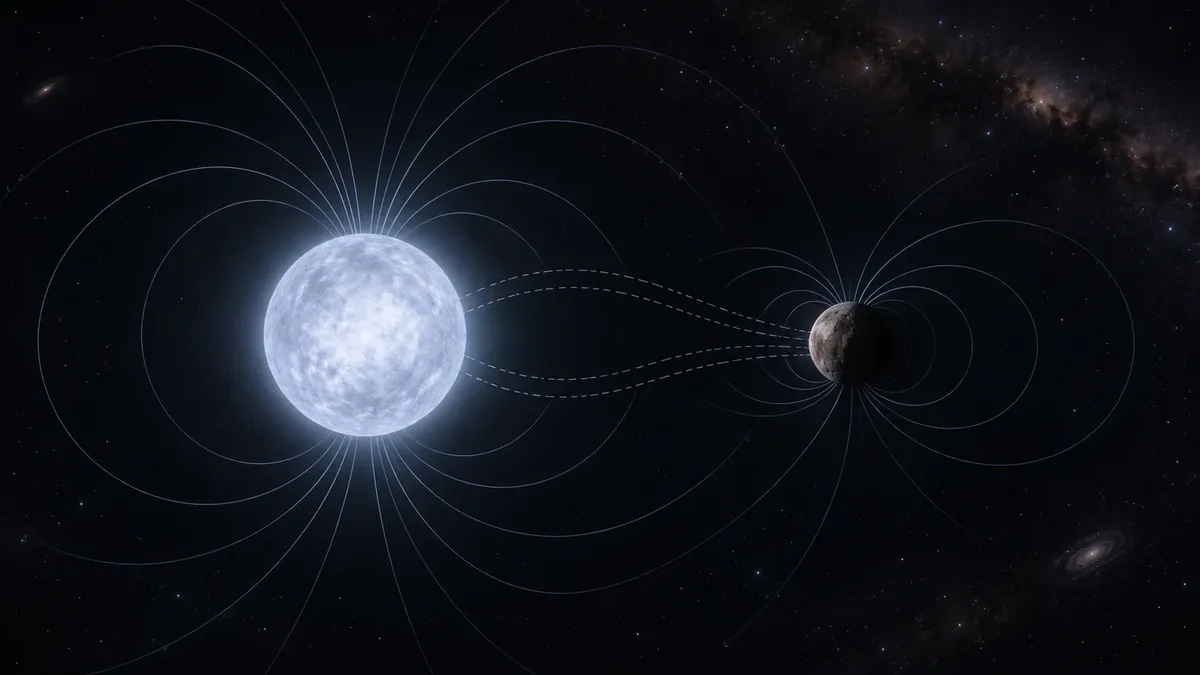
A white dwarf’s light dims over time, changing where its warmth alone could support temperate surface temperatures. Could a planet moving through the star’s magnetic field make up some of that lost heat? A modeling study explores this possibility and finds that magnetic induction could help under specific conditions.
White dwarfs are compact remnants of stars that have exhausted their nuclear fuel. Evidence of planetary debris around them suggests that material from rocky bodies can survive—or be delivered into—very close orbits. But white dwarfs cool and fade, so the region warmed by starlight shifts inward. Could a magnetic white dwarf provide another source of energy for a nearby rocky planet?
Xueyuan Wang and colleagues model a process called magnetic unipolar induction. A conducting planet moving through a star’s magnetic field can develop an electrical voltage. If the planet’s orbit and the star’s rotation are not synchronized, that voltage can drive currents through a modeled circuit linking the two. Electrical resistance dissipates some energy as heat. The idea is related to the electrical interaction between Jupiter and Io, though the study examines a different kind of system.
The researchers combined white-dwarf cooling tracks with an orbit-dependent model of induction heating. They calculated the combined energy from starlight and modeled electrical dissipation, then identified orbital regions associated with surface temperatures between 273 and 373 kelvin. That interval is a thermal proxy: it does not establish that liquid water is present, or that a planet has an atmosphere or climate capable of supporting it.
In the calculations, induction heating can partly offset the fading starlight for some combinations of orbital distance and stellar spin. This can preserve an outer temperate region in the model as the white dwarf cools. Some scenarios also produce a narrow inner region at late times, when modeled induction heating supplies much of the energy. The effect depends on magnetic-field strength and on the difference between the planet’s orbital motion and the star’s rotation. In the model, synchronized motion produces no induction voltage and therefore no induction heating.
The researchers also modeled three illustrative planets whose orbits migrate over time. With efficient heat deposition and a constant assumed resistance at the star’s magnetic footpoints, they report cumulative time in the 273–373 K range that is 2.9–4.4 times longer with induction heating than with starlight alone along those same modeled paths. This comparison applies to those examples and assumptions, not to white-dwarf planets generally. Some plotted intervals extend beyond the model’s criterion for communication along the magnetic field lines; the paper identifies those portions as formal extrapolations, not results established within that criterion.
The largest caveat is how much electrical energy actually warms a planet’s surface. The habitability maps assume the maximum: all modeled planetary ohmic power is counted as surface heat. The authors describe this as an upper-limit calculation. The real fraction depends on poorly known electrical properties and current paths. The model also uses simplified planetary layers and a dipole magnetic field; it does not calculate atmospheric heat transport, atmospheric loss, or conductivity changes as a planet heats in a fully coupled way. The authors test parameterized increases in resistance at the star’s magnetic footpoints as it cools and find that stronger increases can reduce or shift the modeled temperate intervals.
Close orbits bring another complication: tidal forces can disrupt a planet. The study excludes or flags orbits inside an estimated Roche limit, but the actual disruption boundary depends on the planet’s structure and material strength. And a temperature range alone cannot establish surface liquid water, much less habitability.
This is a theoretical model, not an observation of a planet being heated by a white dwarf. Its conclusions are conditional on a steady magnetic-circuit regime and, in the headline habitability calculations, highly efficient heat deposition. The source is an arXiv preprint; the supplied information does not establish its publication or review status. The study therefore presents magnetic induction as a possible supplement to starlight in modeled systems—not evidence that planets around white dwarfs are habitable.
- white dwarfs
- magnetic induction
- planetary habitability
- unipolar induction
- rocky planets
- stellar magnetic fields
Related reading
Automatically matched by shared topic keywords. These links do not imply that the sources agree or establish a consensus.
Changing red-dwarf winds could reshape magnetic links with nearby planets
Source published
Shared keywords: stellar magnetic fields
A white dwarf’s abrupt magnetic switch hints at compact atmospheric regions
Source published
Shared keywords: stellar magnetic fields, white dwarfs
Why the Timing of Atmospheric Heating Matters for Planetary Spin
Source published
Shared keywords: rocky planets
A nearby star system emits low-frequency radio waves—but what powers them?
Source published
Shared keywords: stellar magnetic fields
Magnetic fields can weaken stellar waves—and help generate them
Source published
Shared keywords: stellar magnetic fields