TRANSMISSION // 2611.33704v1
A single hologram shapes twisted light into 128-dimensional states
Source published
A phase-only hologram lets researchers set the amplitudes and phases of orbital-angular-momentum modes. In their experiment, a 128-dimensional state reached 82% fidelity.
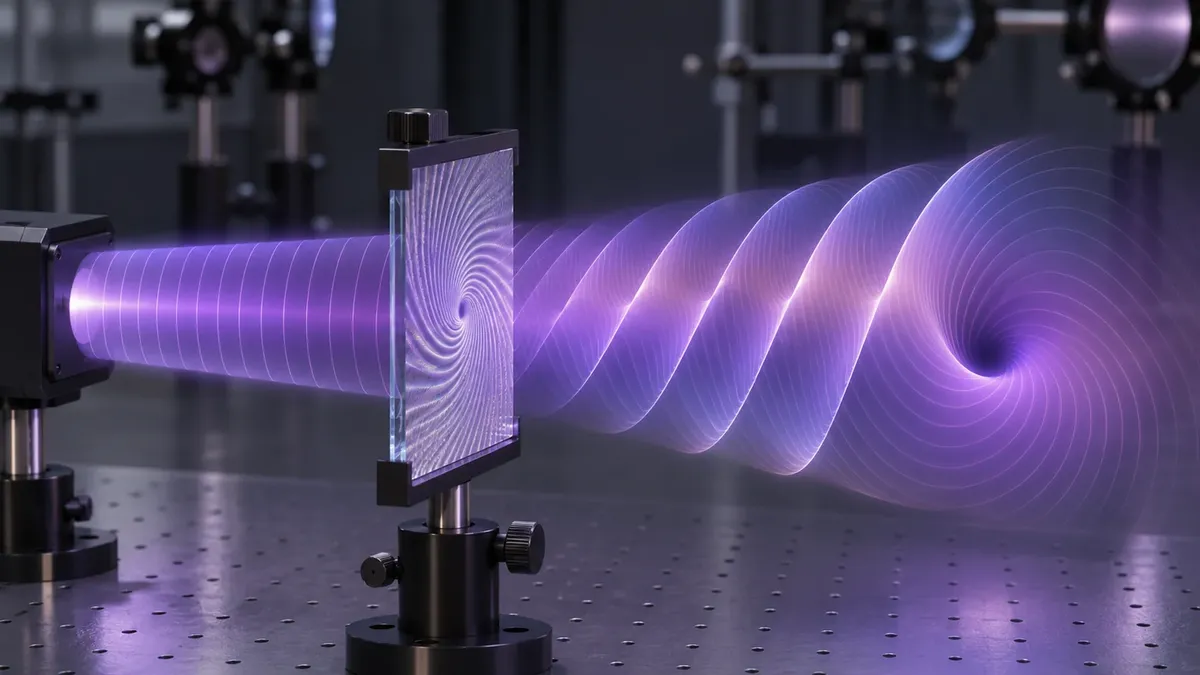
Light can carry information in the twist of its wavefront. Researchers report a way to shape that twist into complex, high-dimensional patterns using one phase-only hologram—a simpler arrangement than approaches that add extra modulation stages.
The challenge of shaping twisted light
A light beam’s orbital angular momentum (OAM) is linked to the spiral pattern of its wavefront. Different OAM modes can serve as distinct states in an information system. In principle, there is no fixed upper limit on the number of available modes, making OAM attractive for encoding information in many dimensions.
Preparing a chosen combination of modes means specifying each mode’s amplitude—the strength of its contribution—and its phase, which determines how it combines with the others. A phase-only hologram changes a beam’s phase directly, but does not directly set its amplitude. The researchers address the challenge of controlling both properties in a chosen high-dimensional state.
Hao Sheng and colleagues ask whether one phase-only hologram can prepare OAM states with chosen amplitudes and phases, including states with many modes, without adding further modulation stages.
One hologram, many modes
The team designed an iterative algorithm to calculate a phase pattern for a spatial light modulator (SLM). Starting from a target OAM state, the algorithm repeatedly adjusts the phase-only pattern to bring the resulting field closer to that target. Its strategy is to work in an expanded set of dimensions: the components in the intended OAM subspace must match the target, while components outside it do not affect the state within that subspace, according to the authors.
In the experiment, a Gaussian laser beam illuminated the first SLM, displaying the calculated hologram. A second SLM and a single-mode optical fibre were used to measure the resulting beam. The researchers projected onto individual OAM modes and combinations of pairs, then used the measurements to reconstruct the state through quantum state tomography. This method estimates a state from measurements; here, the source was a laser beam and the reported measurements were of optical power.
The researchers compared calculated generation efficiency with two other phase-only approaches: blazed-grating modulation and multiple-pixel encoding. For equally weighted modes with zero relative phase, their calculation showed higher efficiency, particularly for dimensions of 10 and above, where the paper reports a twofold enhancement. In a four-dimensional experimental example, measured efficiency was 39%; the paper gives a theoretical value of 51% and says the difference is consistent with about 80% overall coupling efficiency in the setup.
Fidelity at larger dimensions
The team tested states with different numbers of OAM modes and different amplitude and phase patterns. Fidelity measures how closely the reconstructed state matches the intended target. Reported fidelities included 98.4% for a four-dimensional state, 92.0% for a 50-dimensional state, and 82.0% for an equal-amplitude, 128-dimensional state with randomly chosen phases. They also tested examples with non-uniform amplitudes and selected phase patterns: a 16-dimensional state had 95.9% fidelity, while one 32-dimensional example had 94.0%.
These results demonstrate preparation and characterization of several kinds of OAM superposition, including a state with 128 modes. They do not show that every possible state at that dimension will reach the same fidelity, or that the approach is ready for a working quantum-information system. The paper reports laboratory state preparation and measurement, not a quantum communication or computing application.
What remains uncertain
The authors describe the method as more efficient than previous techniques and say its advantage grows with dimensionality. Their numerical comparison, however, is specifically for equal-amplitude states with zero relative phase; the experimental efficiency discussion includes a four-dimensional example. These results should not be read as a direct experimental comparison across every possible state or setup.
The largest reported state also had lower fidelity than the smaller examples. The 128-dimensional result therefore demonstrates reach, not that quality stays constant as the number of modes rises. The paper does not establish how performance would change with different optical equipment, losses, or application requirements.
This work is an arXiv preprint. Its findings offer evidence for a compact way to shape high-dimensional OAM states, but their broader significance remains to be assessed.
- orbital angular momentum
- structured light
- phase-only hologram
- spatial light modulator
- high-dimensional optics
- quantum state tomography
Related reading
Automatically matched by shared topic keywords. These links do not imply that the sources agree or establish a consensus.
A metasurface lets classical waves choose how coherence is shared
Source published
Shared keywords: structured light
When the Dipole Approximation Misses the Shape of Light
Source published
Shared keywords: structured light
Quantum-state reconstruction can need far fewer copies—if the measurements are right
Source published
Shared keywords: quantum state tomography
Why twisted neutrons can hide their spin effects
Source published
Shared keywords: orbital angular momentum
Neutron interference patterns may not prove vortex lattices
Source published
Shared keywords: orbital angular momentum