TRANSMISSION // 2611.33700v1
How Sports Agent uses feedback to evolve
Source published
Sports Agent links runtime feedback to updates in both a language model and its operating harness. Its abstract reports performance gains, but leaves important evaluation details unclear.
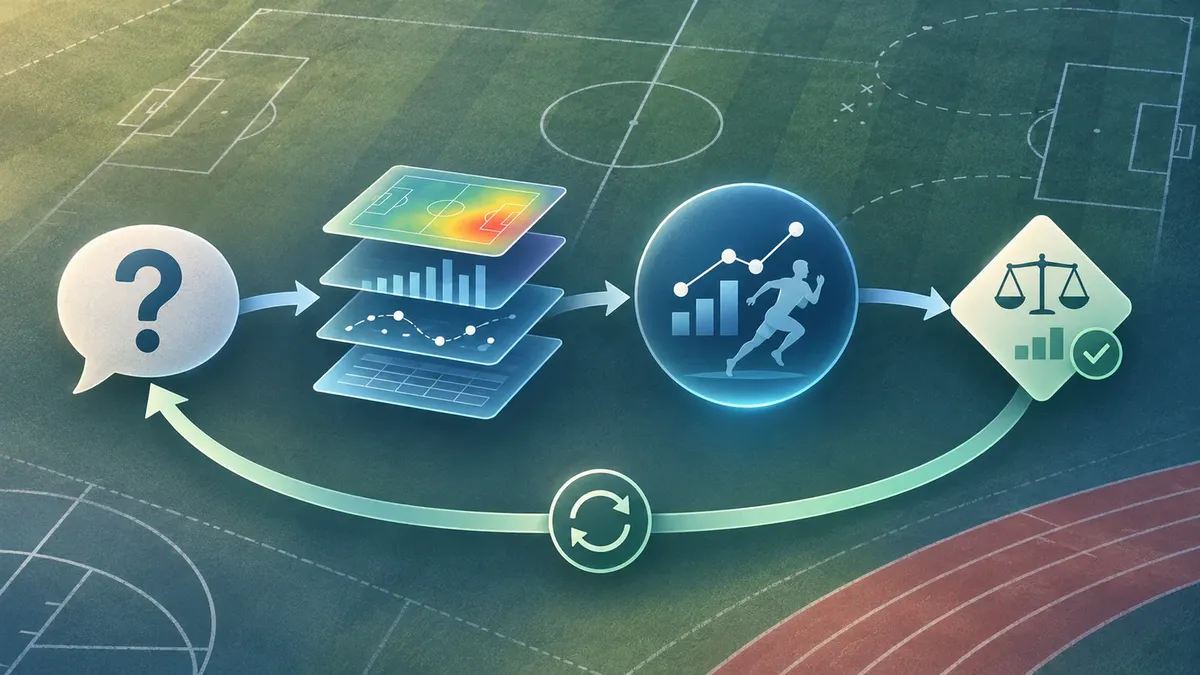
Can an analytics assistant use evidence from its own operation to improve? Sports Agent proposes a feedback loop for changing both its model and its workflow, with checks intended to assess those changes.
The question: can an analytics agent learn from its mistakes?
A conversational sports analytics system must respond to questions about structured data. Over time, shifts in the questions people ask, available data and model behavior may make a fixed configuration less effective. In an arXiv preprint, Chao Chen and colleagues present Sports Agent, a framework intended to use evidence from system operation to guide updates.
The abstract describes three components: an Agentic SQL Model for reasoning over structured data, a “harness” for planning and coordinating tools, and a Feedback Engine that connects online execution with offline evolution. The system assesses both answers and the trajectories—the steps and tool use—leading to them.
How the proposed feedback loop works
The Feedback Engine is described as checking factual claims, diagnosing failures and converting its assessments into signals for improvement. The authors outline two routes for change.
For the model, SQL-to-Question Scaling is intended to expand question coverage, while Graph-Guided Scaling directs synthetic question generation toward diagnosed errors. Generated questions undergo trajectory distillation and quality filtering, then are used for iterative supervised fine-tuning. The abstract also describes a separate post-reinforcement-learning stage.
For the harness, recurring failures can inform bounded updates to prompts and skills. The abstract says proposed changes are assessed through independent audits, execution replay and regression testing. It also describes performance-tolerance checks intended to guard against unacceptable degradation during simplification. The abstract does not specify the precise decision process for adopting or retaining changes.
This is therefore a proposed, evaluated evolution process—not simply an agent rewriting itself without checks. But the abstract alone does not show how effective each safeguard is in practice.
What the authors report
The authors report that a model based on Qwen3.6-35B-A3B outperforms Qwen3.8-Max on sports question answering and analysis, with approximately three times the inference efficiency. Across 30 rounds of harness evolution, they report a 10.8-point increase in aggregate performance score.
For a live sports analytics product, the abstract reports a 10.5-point improvement in factual correctness and a 158.1% increase in average response length, which the authors use as a proxy for answer richness. It also reports a 41.3% reduction in average latency relative to a baseline.
These figures are claims reported in the abstract, not independent confirmation. Longer responses do not necessarily provide more useful information, and the abstract does not give enough detail to assess how correctness or richness was measured. It also does not specify the datasets, sample sizes, statistical uncertainty, hardware conditions or exact baseline configurations. Those details are important for judging the scale and generality of the results.
What remains uncertain
This article is based on the abstract because full-text extraction exceeded the request limit; that does not establish whether the full paper is otherwise available. The abstract summarizes the system and reported outcomes, but does not provide enough information to evaluate the feedback engine’s error detection, the audit process or whether the findings extend beyond the tested sports analytics setting.
The source identifies the work as an arXiv preprint. The supplied evidence does not establish whether it has undergone peer review, so the results should be treated as preliminary claims from the research team. The approach’s practical value will depend on details—including evaluation design and how safely changes are handled—that cannot be assessed from the abstract alone.
- sports analytics
- AI agents
- structured data
- self-evolving systems
- large language models
- arXiv preprint
Reviewed cross-references
These connections were reviewed by a model, not independently fact-checked by a human. Similarity does not imply agreement; consult the original papers and the evidence below.
Teaching AI agents to train other language models
Shared method: Both papers use execution trajectories and quality filtering in model training: Sports Agent describes trajectory distillation and filtering before iterative fine-tuning, while RSI-Dojo filters collected model-training trajectories before fine-tuning agents. The training goals differ—sports-data reasoning versus learning to conduct post-training—and this connection does not imply comparable evaluations or results.
Model review: · openai-codex/gpt-6-luna
Evidence and provenance
Selected excerpts, not complete papers. PDF extraction can omit figures or damage equations, tables and reading order; sources may be preprints.
2611.33700v1 — Original paper
Excerpt reference:
static/papers/2611.33700v1.md:13-95
Basis: Paper text
Source SHA-256:0eb37e4da149adb571e78c9a82b1f7d947c6d2552b0837f209ac4a91182aed4f2611.03698v1 — Original paper
Excerpt reference:
static/papers/2611.03698v1.md:15-63
Basis: Paper text
Source SHA-256:9fa44499a91269878010c4430da018c8f234e05666e21454f98cf836144a8d5f
Related reading
Automatically matched by shared topic keywords. These links do not imply that the sources agree or establish a consensus.
Can AI scripting agents learn from their own EDA mistakes?
Source published
Shared keywords: ai agents, large language models, self evolving systems
When an AI agent must remember before it knows what matters
Source published
Shared keywords: ai agents, self evolving systems
TreeAgent gives AI memory a map of the data it reads
Source published
Shared keywords: ai agents, structured data
Can insurance make AI agents answer for mistakes?
Source published
Shared keywords: ai agents
Can AI agents work with less context? A study tests compact memory and selective reading
Source published
Shared keywords: ai agents