TRANSMISSION // 2611.33699v1
When a Thin Spin Layer Becomes a Slow Bath
Source published
A model of nitrogen spins in diamond places the shift toward two-dimensional behavior near the average spacing between spins. Hyperfine disorder can slow the thin-layer bath, while spin relaxation may limit measured coherence.
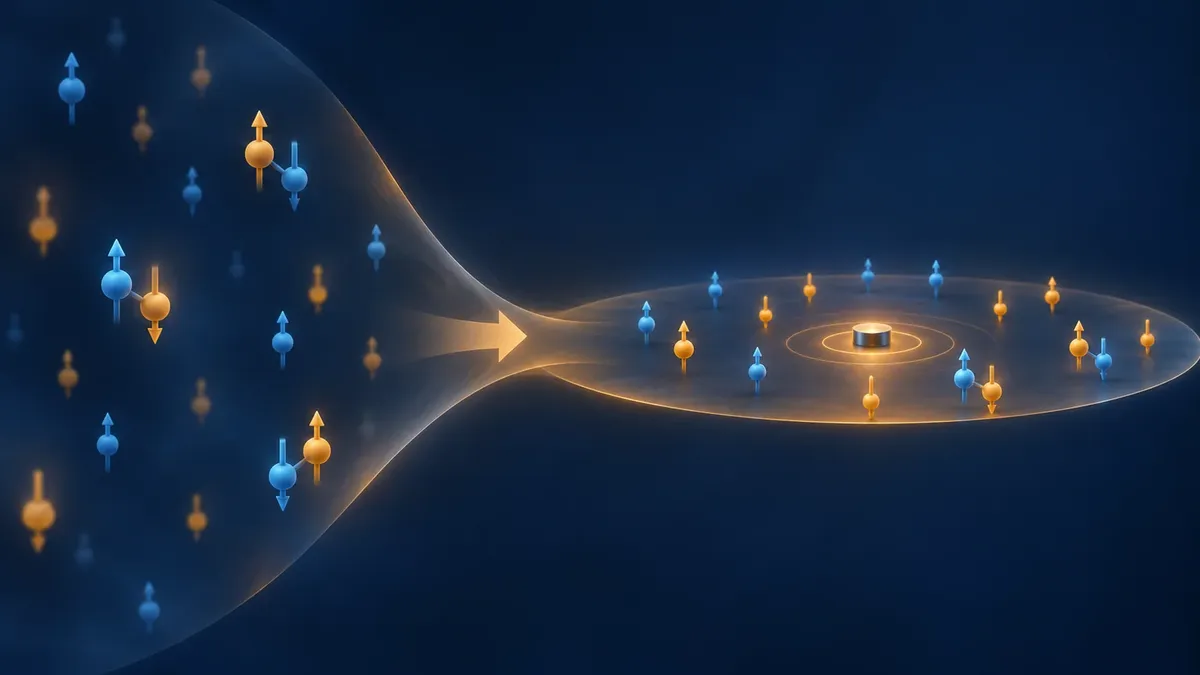
How thin must a layer of spins be before it behaves like a two-dimensional environment? A theoretical study of nitrogen spins in diamond places the crossover near the average spacing between spins—and finds that disorder can make the thin-layer bath unusually slow.
A spin sensor can lose quantum coherence when nearby spins disturb it. In diamond, nitrogen-vacancy (NV⁻) centres can serve as sensors, while surrounding substitutional nitrogen spins, called P1 centres, form a fluctuating bath. When bath spins exchange spin states—a process called a flip-flop—the magnetic field at the sensor changes and its echo signal fades.
A nitrogen-doped layer confines those spins. But when does a layer stop behaving like a three-dimensional solid and start behaving more like a two-dimensional sheet? Chikara Shinei’s calculations investigate that question and whether the change in geometry also alters how quickly the bath fluctuates.
Simulating a layer of spins
The model places one NV⁻ sensor at a uniformly distributed depth within a nitrogen-doped layer. It represents each P1 centre as an electron spin coupled to a nitrogen nucleus, and includes magnetic dipole interactions between centres. The simulated layers vary in thickness and nitrogen concentration.
To estimate the bath’s motion, the study uses a pair-level cluster-correlation expansion. Small groups of spins are treated together, while other spins affect them through a magnetic field. The researchers compare two treatments of those outside spins: one keeps their fields fixed, while the other allows nearby pairs to flip-flop. The second treatment, called pair flip-flops, is the main estimate; the fixed-field case gives an upper bound on the echo time because it leaves out those additional changes.
The frozen-field calculation is checked against exact calculations for small groups of six spins. It agrees closely in that test, supporting the pair expansion and mean-field treatment in the frozen case. But this test does not validate the pair flip-flop rates: in six-spin systems, the calculation’s flip-flop model decays faster than the exact result. The rates instead receive support from comparison with bulk measurements: the pair-flip-flop calculation agrees with the measured echo relation within 1.7 standard deviations.
A crossover near the spin spacing
The key length scale is the average distance between spins in bulk diamond. When the layer is much thicker than this distance, its simulated echo resembles the bulk case. As the layer becomes thinner than roughly one mean spin spacing, the calculated echo time rises sharply. The transition is gradual, not a sharp boundary: its midpoint in the model is around one and a half times the bulk mean spacing.
For sufficiently thin layers, the calculations follow two-dimensional scaling with the layer’s areal spin density. The fitted prefactor is six to seven times the bulk value, allowing for a correction for simulated bath size. This means the model predicts a longer echo time for a thin layer than for bulk material at the corresponding spacing.
Geometry explains only part of this increase. P1 centres’ hyperfine interactions with their nitrogen nuclei divide them into groups with different resonance frequencies. A flip-flop is favored when two spins have compatible energies. In the model’s two-dimensional sheet, the average number of resonant partners counted within a given distance saturates at about 0.25 per spin; this is an average across spins, not a fractional partner for any individual spin. In three dimensions, the count continues to grow with distance. The sparse resonant connections in the sheet are consistent with less frequent spin exchange.
A control calculation removes the hyperfine subgroups. The crossover remains at about the same thickness, but the increase in echo time falls below a factor of three. The authors therefore distinguish two effects: geometry sets where the crossover occurs, while hyperfine-related disorder accounts for much of the additional slowing in this P1 model.
What might limit measured coherence?
For the thickness and spin density of a reported experiment, the model estimates that flip-flops alone would permit echo times of several milliseconds—well above the roughly half-millisecond coherence reported. The study therefore considers another process: spin-lattice relaxation, in which a P1 spin changes state through interactions with its surroundings. Adding a room-temperature relaxation time of about 1.5–2 milliseconds, taken from measurements in synthetic diamond, produces calculated echo times of 0.58–0.67 milliseconds. These are comparable to, though somewhat longer than, the reported single-NV values of 0.489–0.562 milliseconds.
That comparison is suggestive, not proof that relaxation is the cause. The relaxation time was measured in bulk crystals, not the specific thin layer, and the calculation treats relaxation and flip-flops as independent. Under those assumptions, the model predicts that cooling should lengthen the echo if relaxation is limiting it. If flip-flops alone set the limit in this calculation, the echo is much less temperature-sensitive. This is a proposed test, not a general rule for all spin baths.
The results are theoretical predictions, not a new experiment. The exact small-system check supports the frozen-limit pair expansion but not the flip-flop rates. Moreover, the authors report that adding three-spin clusters can produce unphysical coherence values, so higher-order expansion does not provide a straightforward check. The calculation also omits other possible defects, which may matter especially at high nitrogen concentrations. The paper is an arXiv preprint and has not necessarily been peer reviewed. Its conclusions are best understood as applying to the modeled system: the crossover tracks mean spin spacing, while pronounced slowing depends on disorder that suppresses resonant exchanges.
- spin baths
- diamond
- NV centres
- quantum sensing
- dimensional crossover
- hyperfine disorder
Reviewed cross-references
These connections were reviewed by a model, not independently fact-checked by a human. Similarity does not imply agreement; consult the original papers and the evidence below.
How moving nitrogen spins reshape diamond’s quantum echo
Shared method: Both studies use cluster-correlation expansion with a dynamical mean field in which outer P1 spins flip-flop in pairs. The thin-layer study applies it to a dimensional crossover, while this study examines bulk P1 baths across magnetic fields; their different geometries and questions limit direct comparison of outcomes.
Model review: · openai-codex/gpt-6-luna
Evidence and provenance
Selected excerpts, not complete papers. PDF extraction can omit figures or damage equations, tables and reading order; sources may be preprints.
2611.33699v1 — Original paper
Excerpt reference:
static/papers/2611.33699v1.md:95-140
Basis: Paper text
Source SHA-256:048910424dfc8c74a9557c2a3a0551a489b1ff7008eec661a8e8da2b2271023d2611.02528v3 — Original paper
Excerpt reference:
static/papers/2611.02528v3.md:13-64
Basis: Paper text
Source SHA-256:c33376fede80a63368337bec68d6152cbce6eade79bd51215b0a82372b4cebe7
When diamond’s vacancies combine, a qubit may keep its coherence longer
Supporting evidence: Both theoretical studies identify bath-spin frequency mismatch as a way to suppress flip-flops and lengthen NV coherence: the thin-layer study attributes slow dynamics to hyperfine subgroups, while the vacancy study predicts longer coherence for multi-vacancy baths because their distinct transition frequencies block exchanges. This supports that bounded mechanism, not a direct comparison of coherence times; the systems and model assumptions differ, and the vacancy results are predictions.
Model review: · openai-codex/gpt-6-luna
Evidence and provenance
Selected excerpts, not complete papers. PDF extraction can omit figures or damage equations, tables and reading order; sources may be preprints.
2611.33699v1 — Original paper
Excerpt reference:
static/papers/2611.33699v1.md:205-300
Basis: Paper text
Source SHA-256:048910424dfc8c74a9557c2a3a0551a489b1ff7008eec661a8e8da2b2271023d2609.24295v4 — Original paper
Excerpt reference:
static/papers/2609.24295v4.md:185-230
Basis: Paper text
Source SHA-256:f393682ceff7e5ca3935f3218d19b3b4c28c5b01808be705eb7e965c066755c02609.24295v4 — Original paper
Excerpt reference:
static/papers/2609.24295v4.md:145-184
Basis: Paper text
Source SHA-256:f393682ceff7e5ca3935f3218d19b3b4c28c5b01808be705eb7e965c066755c0
Related reading
Automatically matched by shared topic keywords. These links do not imply that the sources agree or establish a consensus.
A quieter diamond spin bath—if the magnetic field is low
Source published
Shared keywords: nv centres, quantum sensing
When diamond’s vacancies combine, a qubit may keep its coherence longer
Source published
Shared keywords: quantum sensing
A hybrid method brings huge spin baths within reach
Source published
Shared keywords: quantum sensing
A diamond camera reads radio frequencies in parallel
Source published
Shared keywords: quantum sensing
A diamond sensor follows a magnetic film’s reversal
Source published
Shared keywords: nv centres