TRANSMISSION // 2611.33692v1
Can Sequential AI Knowledge Edits Stay Stable?
Source published
A preprint proposes a sequential editing approach it describes as batch-equivalent and analyzes how editing-related parameter changes grow as updates accumulate.
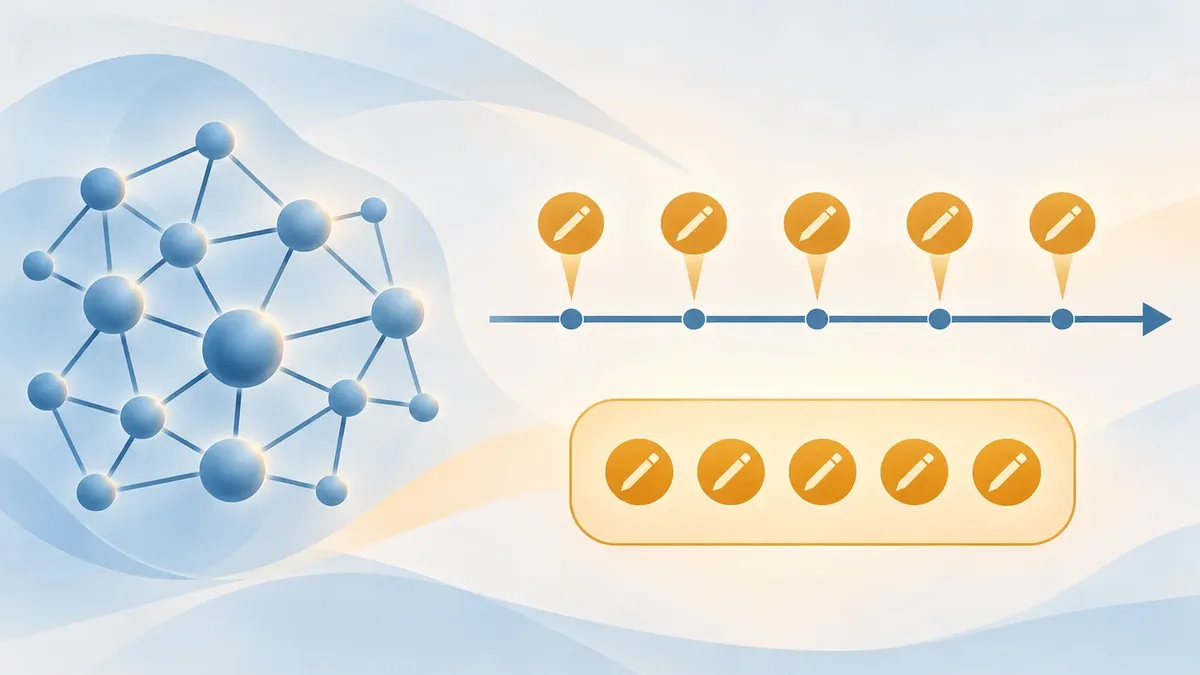
Language models may need updates as facts change or new information arrives. A preprint asks whether sequential editing can match batch editing while avoiding instability, and reports a theoretical analysis of how parameter changes grow over time.
The challenge of updating knowledge
Language models are often updated after their initial training. One approach, called locate-then-edit, aims to make knowledge updates without full retraining. But updates may arrive one at a time, and the authors say existing sequential methods can suffer catastrophic forgetting and model collapse after repeated edits.
The paper, Rethinking Sequential Locate-Then-Edit: Optimality and Stability, examines whether sequential editing can close the gap with batch editing. In batch editing, a group of updates is jointly optimized under a specified objective. The abstract says batch methods can handle many edits while preserving general capabilities, but does not give the conditions or measurements behind that comparison.
An approach described as batch-equivalent
The authors propose a sequential editing approach that they describe as batch-equivalent. They say it can close the gap between sequential and batch editing. The abstract does not explain how the approach works or define the precise scope of “batch-equivalent,” so the term should be read as the authors’ characterization rather than a general guarantee across models and applications.
The paper also analyzes weight perturbations—changes to model parameters associated with editing—and how they grow as edits accumulate. According to the abstract, existing methods typically show linear or logarithmic growth in perturbation, while the proposed method achieves time-invariant growth. The authors say their analysis theoretically guarantees long-term stability and preservation of pretrained knowledge during large-scale sequential editing.
What the abstract can—and cannot—show
These are the authors’ reported findings, not an independent assessment. The available source is the abstract, which does not provide the method’s details, experimental results, model or dataset names, evaluation measures, numerical comparisons, or assumptions behind the theoretical analysis. Without those details, readers cannot assess how the method performs in particular tests or how broadly the guarantee applies.
In particular, the abstract does not establish how editing success, computational cost, or preservation of capabilities compare in specific practical settings. Evaluating those questions would require the full paper’s methods and results. A theoretical guarantee also depends on its assumptions; the abstract alone does not show what they are or demonstrate performance on real-world streams of updates.
The source is an arXiv preprint, and this article is based only on its abstract. The supplied information does not establish whether the work has been peer reviewed. The claims are therefore best treated as the authors’ reported proposal and analysis, pending examination of the full paper and further evaluation.
- large language models
- knowledge editing
- sequential editing
- locate-then-edit
- catastrophic forgetting
- AI stability
Reviewed cross-references
These connections were reviewed by a model, not independently fact-checked by a human. Similarity does not imply agreement; consult the original papers and the evidence below.
GEdit Uses Geometry to Update AI Facts With Less Collateral Damage
Supporting evidence: Both papers report sustained sequential knowledge editing in their tested settings: the origin paper describes a batch-equivalent method and reports effectiveness through 10,000 edits, while GEdit reports experiments with up to 10,000 sequential updates. This supports only the bounded point that sustained editing was demonstrated in these evaluations; it does not establish equivalence or generalization beyond the tested setups. The evidence is from selected excerpts of arXiv versions.
Model review: · openai-codex/gpt-6-luna
Evidence and provenance
Selected excerpts, not complete papers. PDF extraction can omit figures or damage equations, tables and reading order; sources may be preprints.
2611.33692v1 — Original paper
Excerpt reference:
static/papers/2611.33692v1.md:67-140
Basis: Paper text
Source SHA-256:af96e437df792bab0ed6465181946b9295173050f5fc9420e1d8bed38ff83e592611.33692v1 — Original paper
Excerpt reference:
static/papers/2611.33692v1.md:141-215
Basis: Paper text
Source SHA-256:af96e437df792bab0ed6465181946b9295173050f5fc9420e1d8bed38ff83e592611.06185v1 — Original paper
Excerpt reference:
static/papers/2611.06185v1.md:65-113
Basis: Paper text
Source SHA-256:19a05748a97a7ce72fd2b0f7dd765ca840c4ed7017ca3a10ec6ba0fbaa199457
Related reading
Automatically matched by shared topic keywords. These links do not imply that the sources agree or establish a consensus.
GEdit Uses Geometry to Update AI Facts With Less Collateral Damage
Source published
Shared keywords: knowledge editing, large language models, sequential editing
Why AI Agents Can Misuse Retrieved Memories
Source published
Shared keywords: knowledge editing
WoW maps educational training data—and shows where its gains stop
Source published
Shared keywords: catastrophic forgetting, large language models
Why Multimodal AI Can Forget—and How SAME Tries to Help
Source published
Shared keywords: catastrophic forgetting
Why Multimodal AI Can Forget in Two Places
Source published
Shared keywords: catastrophic forgetting