TRANSMISSION // 2611.33665v1
A quantum error decoder that runs without global coordination
Source published
Amatlas maps Union-Find decoding onto a two-dimensional FPGA array, avoiding a central controller. Simulations and an RTL implementation show promising speed and scale, with a modestly lower estimated threshold than a cited comparison.
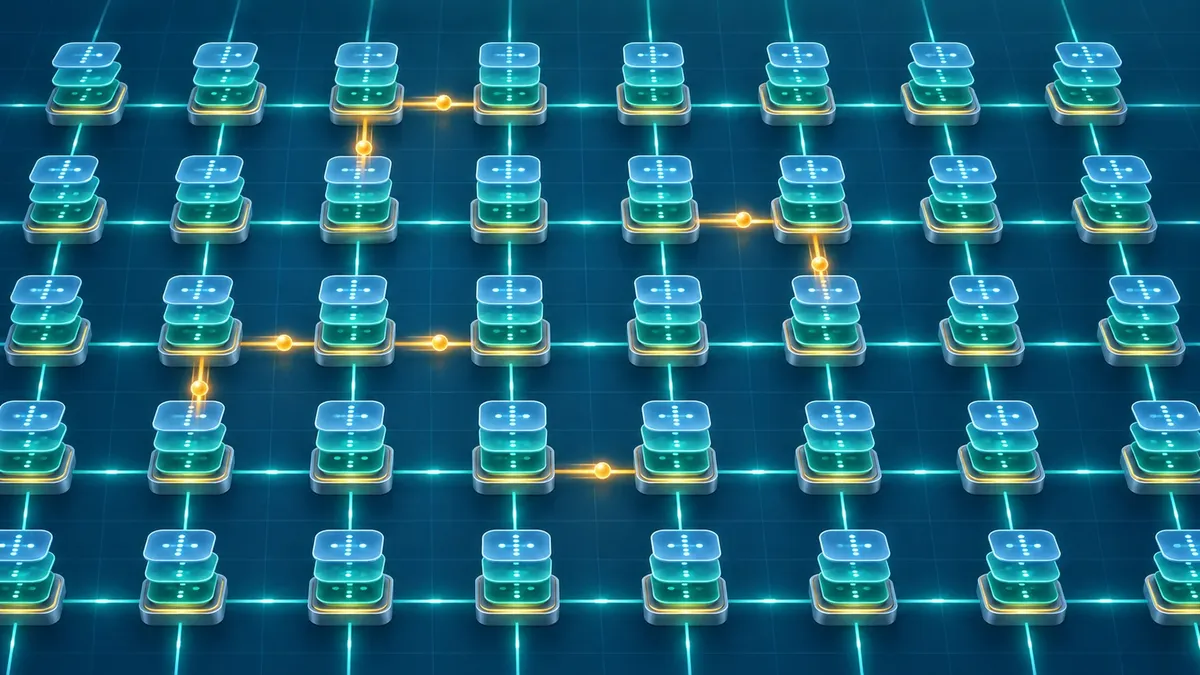
Quantum computers need classical hardware to interpret error signals as they arrive. A new design called Amatlas spreads that decoding work across a two-dimensional array, letting its processing elements follow a fixed schedule rather than wait for a central controller to synchronize them.
Quantum error correction protects information by encoding it across many physical qubits and repeatedly measuring checks called stabilizers. Those measurements produce a stream of outcomes that a classical decoder must interpret: it looks for patterns indicating errors and determines a correction. Because the measurements continue during computation, decoding needs to keep pace with them.
A popular method for this task, Union-Find (UF), groups detected errors into clusters that grow and merge. Its operations are local, which makes it attractive for hardware made of many neighboring processors. But local operations can still require global coordination: conventional designs may need to confirm that all merging is finished before starting the next growth step. That coordination can be awkward on a flat, two-dimensional chip or FPGA.
The paper introduces Amatlas, a UF decoder designed around a two-dimensional array of processing elements (PEs). Each PE corresponds to a stabilizer on the surface-code lattice and stores that stabilizer’s state across multiple measurement rounds. In this way, the time dimension of the decoding problem is kept in local memory rather than represented as a third physical dimension of processors. Links connect neighboring PEs, and each PE advances according to a fixed schedule. The clock is the array’s only global signal during decoding; there is no central controller synchronizing stages.
The key idea is to let cluster growth proceed on schedule even while information about cluster merges is still propagating. Amatlas uses tokens to carry defects toward cluster roots and to record correction paths. The authors give a residual-syndrome invariant: at every cycle, the remaining syndrome is represented by the tokens and parities held in the array. When those are cleared, the correction recorded along token paths is valid. This means the design does not need to wait for merging to converge before growing clusters. The trade-off is that growing too early can reduce decoding accuracy, so the authors tune the interval between growth steps.
The team evaluated the design using simulations and a register-transfer-level (RTL) hardware implementation. The simulations modeled a rotated surface code with circuit-level noise: errors associated with gates, qubits and measurements, rather than a simplified model that considers only selected error sources. The authors tested logical error rates across code distances and physical error rates, and also measured decoding-cycle distributions. They then implemented the RTL design on a Xilinx VCU129 FPGA and used its post-placement-and-routing clock frequency to convert cycle counts into decoding times.
In that setup, the design fit on the FPGA through code distance 25, using 91% of its lookup tables at that largest tested distance. At a physical error rate of 0.1%, its average decoding time per round at distance 25 was 462 nanoseconds. Average time remained below one microsecond per round across the tested distances. The reported 99.99th-percentile time was higher: it exceeded one microsecond from distance 17 onward. At a physical error rate of 0.5%, average decoding time also stayed below one microsecond through distance 25, though it increased compared with the 0.1% case.
The estimated decoding threshold was 0.72%. A threshold is an approximate boundary in the modeled noise rate: below it, increasing code distance is expected to reduce logical errors. The paper compares this estimate with 0.78% reported for UF decoding under the same noise model. These figures suggest a small accuracy cost in the comparison, not identical performance. The authors attribute some loss to how the design represents certain circuit-level error connections and note that UF’s uniform cluster growth is itself less accurate than weighted approaches.
The hardware comparisons need care. Other decoders in the paper’s table do not all decode the same number of stabilizer types, use identical noise models, or run on the same FPGA. Amatlas handles both stabilizer types in one array, while several listed implementations handle one. So the table is informative about design trade-offs, but it is not a clean, like-for-like contest. The authors also discuss potential improvements to FPGA routing and suggest that a regular ASIC layout might help, but those are expectations rather than demonstrated results.
This is a hardware architecture study, not a demonstration on a quantum computer. Its speed and threshold figures come from a specified circuit-level noise model and an FPGA implementation; they do not establish performance under every device’s noise or prove that the approach scales indefinitely. The source is an arXiv preprint, and its claims should be read as research results awaiting the scrutiny that comes with further review and replication.
- quantum error correction
- surface code
- Union-Find decoding
- FPGA
- quantum computing
Reviewed cross-references
These connections were reviewed by a model, not independently fact-checked by a human. Similarity does not imply agreement; consult the original papers and the evidence below.
GARI++ splits quantum error correction into a fast first pass and a smaller cleanup
Shared method: Both papers use Union-Find decoding for surface-code syndromes: Amatlas implements UF in a distributed two-dimensional PE array, while GARI++ uses UF as a second-stage decoder for GARI’s residual syndrome. This is a shared decoding method, not evidence that the architectures or their performance are comparable.
Model review: · openai-codex/gpt-6-luna
Evidence and provenance
Selected excerpts, not complete papers. PDF extraction can omit figures or damage equations, tables and reading order; sources may be preprints.
2611.33665v1 — Original paper
Excerpt reference:
static/papers/2611.33665v1.md:13-62
Basis: Paper text
Source SHA-256:520f3b269db8cf148df18680dc4aacd74cbffb516f1ed2d733907cdf76fa3a382611.12833v1 — Original paper
Excerpt reference:
static/papers/2611.12833v1.md:413-480
Basis: Paper text
Source SHA-256:33fd9cd6459a4c29f7872240837149d7d83b2601bd468f7d00d56eb7a44c6c87
Related reading
Automatically matched by shared topic keywords. These links do not imply that the sources agree or establish a consensus.
GARI++ splits quantum error correction into a fast first pass and a smaller cleanup
Source published
Shared keywords: quantum error correction
Teaching a quantum decoder to work with missing photon signals
Source published
Shared keywords: quantum error correction
A quantum decoder that learns to adapt to changing noise
Source published
Shared keywords: quantum computing, quantum error correction, surface code
A proposed silicon blueprint packs logical qubits into a dense chip
Source published
Shared keywords: quantum computing, quantum error correction
TopoLS explores new layouts for lattice surgery
Source published
Shared keywords: quantum computing, quantum error correction, surface code