TRANSMISSION // 2611.33660v1
Can Gaia’s stars map the dark matter around the Sun?
Source published
A deep-learning study uses stellar motions in Gaia DR3 to reconstruct nearby dark matter. It recovers a broad density gradient, but the absolute density remains uncertain.
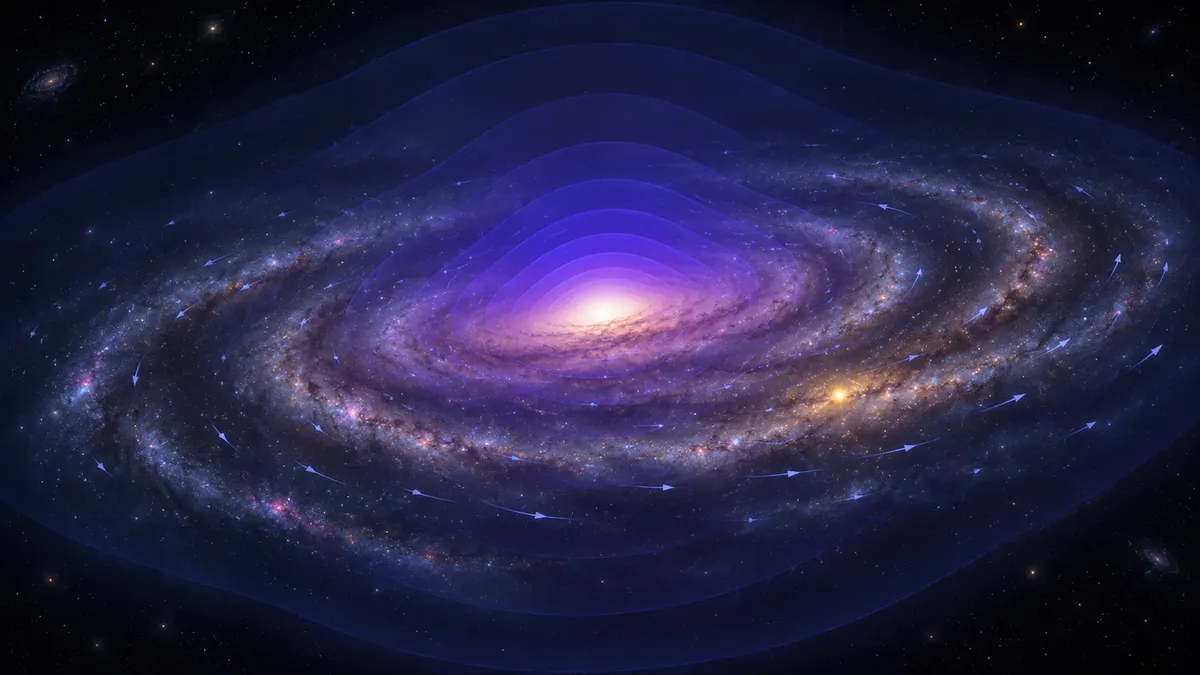
Stars move through the gravitational field created by all matter, including dark matter. Could their motions reveal a three-dimensional map of the invisible matter near the Sun? A new study trains neural networks on simulated Milky Way-like galaxies, then applies them to Gaia data. The method recovers a broad pattern, but its local density estimates differ between models and remain sensitive to how simulations and observations are matched.
Dark matter cannot be seen directly, but its gravity influences the motions of stars. Those motions offer clues to where dark matter is concentrated. The challenge is that a star’s velocity reflects its journey through the Galaxy’s gravitational field, not just the matter immediately around it. Turning stellar motions into a detailed dark matter map requires a way to interpret that complicated relationship.
In a preprint, Yigon Kim and colleagues test whether deep-learning models can learn this relationship from simulated galaxies and use it to estimate dark matter around the Sun. They aim to reconstruct a three-dimensional map across a cube six kiloparsecs (about 19,600 light-years) on each side, centred on the Sun—extending about 9,800 light-years from the centre along each axis.
Learning from simulated galaxies
The team built its training data from seven Milky Way-like galaxies in the FIRE-2 simulation suite. For each, it created many three-dimensional volumes containing simulated stars and dark matter. The stellar inputs were maps of average velocity in each grid cell, using two tangential-motion components across the sky and motion towards or away from the observer. The target was the corresponding simulated dark matter density map.
Two neural-network designs were trained: VNet, a convolutional model, and ViT-VNet, which combines convolutional layers with a transformer. Both were tested on a simulated galaxy held out from training. Each design was trained ten times with different random starting points. This helps characterize variation across runs, but the reported density ranges come from predictions on the held-out simulation—not from a complete accounting of uncertainty in applying the models to Gaia.
For the real-data test, the researchers used Gaia Data Release 3 measurements of nearby stars. They applied quality and brightness cuts, estimated distances, and converted proper motions and radial velocities into three-dimensional velocity inputs. Gaia radial velocities are available for only some stars, so that input channel was built from a smaller subset than the two tangential-velocity channels.
A broad pattern, but not fine detail
On the held-out simulated galaxy, both models reproduced the broad dark matter density gradient but smoothed over smaller fluctuations. Applied to Gaia, both likewise found density increasing towards the Galactic centre and decreasing farther away. That broad trend is qualitatively consistent with expectations for a dark matter halo; it is not, by itself, a detailed confirmation of the local density estimates.
The estimated density in the central region was 0.80 GeV/cm³ for VNet and 1.12 GeV/cm³ for ViT-VNet. The quoted ranges—0.70–0.90 and 0.99–1.27 GeV/cm³—describe prediction scatter estimated from held-out simulation tests. They should not be read as comprehensive uncertainties on the Gaia-based values. The difference between the models is itself important: the paper identifies model choice as a source of systematic uncertainty.
The authors also report that their reconstructed density normalisation is above reference profiles from simulations and halo models they examined. They caution that this offset could reflect differences between the simulated galaxies and the Milky Way, as well as observational selection and how stars are sampled. Tests showed that changing tracer sampling or matching simulated stellar velocities to Gaia could shift the inferred normalisation. These tests reveal sensitivity; they do not establish a uniquely justified correction or the true local density.
What the map can—and cannot—say
Fine structure is difficult to recover for several reasons. The simulation’s dark matter maps were smoothed before training, and stellar motions encode gravitational influences accumulated along orbits. Small-scale density variations may therefore leave weaker signals in the velocity data. The Gaia sample is also not a complete census of stars: brightness limits, dust and the uneven availability of radial velocities affect which stars contribute. Matching some velocity distributions between Gaia and the simulations cannot guarantee that their underlying dynamics and selection effects match in full.
This is an initial method demonstration, not a final calibrated measurement. The supplied manuscript does not establish its publication or acceptance status: it contains a placeholder for journal acceptance information, while also thanking referees for constructive comments. The authors state that model and data procedures will be made public following further work incorporating Gaia DR4; this is a plan, not a release described as already available. They also propose broader simulation sets and stellar acceleration measurements as possible future improvements.
For now, the clearest result is methodological: in this simulation-trained framework, stellar kinematics can help recover a large-scale density gradient. The absolute density and fine-grained map remain uncertain and need stronger tests of how well the simulated training data represent the real Milky Way.
- dark matter
- Gaia DR3
- Milky Way
- stellar kinematics
- deep learning
- FIRE-2 simulations
Reviewed cross-references
These connections were reviewed by a model, not independently fact-checked by a human. Similarity does not imply agreement; consult the original papers and the evidence below.
Could the Sutlej Stream Come from Tucana III?
Supporting evidence: Both studies use stellar motion as information about the Milky Way’s gravitational field: Kim et al. say stellar velocities retain information about the integrated potential along stellar orbits, while Burdett et al. describe streams as tracing the potential along their orbits. This supports that bounded methodological premise, not either study’s density or stream-origin result; the tracers and inference methods differ, and Kim et al.’s mapping relies on a FIRE-2 simulation prior.
Model review: · openai-codex/gpt-6-luna
Evidence and provenance
Selected excerpts, not complete papers. PDF extraction can omit figures or damage equations, tables and reading order; sources may be preprints.
2611.33660v1 — Original paper
Excerpt reference:
static/papers/2611.33660v1.md:553-621
Basis: Paper text
Source SHA-256:165f2d8b98a227a8a8d5ef42d9dcc1ca0cfcb5f0ab5bf6c655b2669f8d8037e12611.29794v1 — Original paper
Excerpt reference:
static/papers/2611.29794v1.md:46-99
Basis: Paper text
Source SHA-256:dad9970718c9d937e512fd66bb605aed4e1ba16f60048b0834825741b7d0fa50
Related reading
Automatically matched by shared topic keywords. These links do not imply that the sources agree or establish a consensus.
Red-clump stars reveal a moving Milky Way warp
Source published
Shared keywords: milky way, stellar kinematics
A Proposed Infrared Instrument Could Trace the Milky Way’s History
Source published
Shared keywords: dark matter, milky way
A close galactic encounter could bend the Large Magellanic Cloud’s bar
Source published
Shared keywords: gaia dr3
Milky Way stars reveal chemistry and motion don’t tell the same story
Source published
Shared keywords: milky way, stellar kinematics
A billion-star search maps the Milky Way’s nested structures
Source published
Shared keywords: gaia dr3, milky way