TRANSMISSION // 2611.33658v1
A Star in GD-1 Preserves a Binary’s Chemical Footprint
Source published
A chemically unusual star in the GD-1 stream carries signs of past mass transfer from a companion. Spectra support the binary explanation, but the precise history remains uncertain.
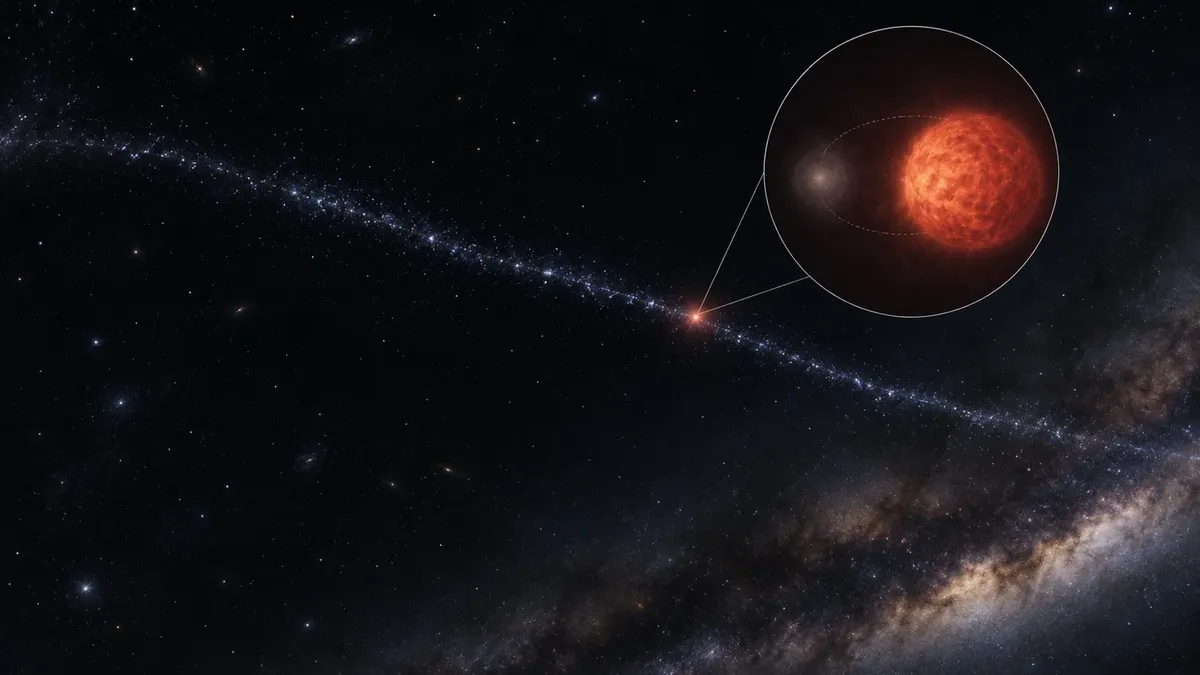
How can astronomers tell whether a star was once paired with another? In the GD-1 stream, one star’s unusual chemistry, a 69.2-kilometre-per-second difference between two velocity measurements, and excess ultraviolet light support the interpretation that it was enriched by a companion.
A star can preserve traces of a companion long after a possible interaction. In the GD-1 stellar stream, researchers report a star whose chemical composition appears to record material received from a former companion. The finding offers a clue to binary evolution in a stellar system later pulled apart by the Milky Way’s gravity.
The star, J0930+2902, is identified in the study as the first carbon-enhanced metal-poor star with strong slow-neutron-capture, or s-process, enrichment found in GD-1. The stream is widely thought to be debris from an old, metal-poor globular cluster. One unusual member can reveal a distinctive history, but does not necessarily represent the cluster’s stars as a whole.
Reading a star’s chemical fingerprints
The team analyzed high-resolution spectra taken with the Subaru Telescope’s High Dispersion Spectrograph. A stellar spectrum contains absorption lines produced by elements in a star’s atmosphere. Comparing those lines with models lets researchers estimate chemical abundances and atmospheric conditions.
The researchers recalculated the star’s atmospheric properties using Gaia photometry and parallax, then iteratively analyzed iron lines while accounting for departures from local thermodynamic equilibrium. This is a more detailed treatment than assuming atoms in the atmosphere are in local equilibrium—a simplifying assumption that can affect predicted line strengths. They report abundances for 22 elements, including upper limits for oxygen and lead.
J0930+2902 is poor in iron compared with the Sun, but rich in carbon, nitrogen, sodium and several neutron-capture elements. Its carbon-to-carbon-13 isotope ratio is 7.4. Together, these features fit a familiar explanation for carbon-enhanced, s-process-rich stars: a former asymptotic giant branch (AGB) companion may have produced carbon and heavier elements, then transferred some of its material to J0930+2902.
Evidence for a companion comes from more than chemistry. A LAMOST measurement and a Subaru measurement, taken about seven years apart, differ in radial velocity by 69.2 kilometres per second. That two-epoch difference supports binarity, though it does not establish a complete orbit. The star also shows more near-ultraviolet light than the team’s model of the star alone predicts. A hot white dwarf is one explanation for the excess and a plausible remnant of a former AGB star. The observations support this interpretation; neither the transfer itself nor the companion’s identity is directly observed.
What the models suggest—and what they cannot settle
To estimate the former companion’s mass, the researchers compared J0930+2902’s neutron-capture element pattern with FRUITY models of AGB nucleosynthesis. They first estimated and subtracted a contribution from rapid neutron-capture processes, using europium to set its level. They then compared the remaining pattern with model predictions while accounting for dilution: transferred material would have mixed with the star’s original outer layers.
Among the models tested, one with an initial companion mass of about three times the Sun’s mass gave the best match. This is a model-based estimate, not a direct measurement. The inferred pattern depends on the assumed rapid-process contribution. The models also do not reproduce the observed carbon, nitrogen and sodium abundances well; those elements were not used to select the best-fitting neutron-capture pattern.
The timing is unresolved. The binary may have left the original cluster before mass transfer began, or it may have remained there until the donor reached its AGB phase. The observations cannot distinguish between these possibilities. The authors argue that the chemical signature survived the tidal evolution that produced the stream, but this single star does not establish when or where the transfer occurred.
This is a study of one unusual star, compared with six other GD-1 members analyzed in earlier work. It cannot establish how common such systems were in the stream’s progenitor. The authors call for a larger, consistently selected sample and further radial-velocity monitoring to determine the orbit and better constrain the companion.
The study is an arXiv preprint, so its findings should be treated as research in progress rather than independently confirmed consensus. Its evidence supports a binary mass-transfer explanation, while the companion’s precise properties and the sequence of events remain open questions. J0930+2902 illustrates how stellar chemistry may preserve clues to interactions even after a larger stellar system has been disrupted.
- GD-1 stellar stream
- binary mass transfer
- CEMP-s star
- AGB stars
- stellar spectroscopy
- stellar archaeology
Reviewed cross-references
These connections were reviewed by a model, not independently fact-checked by a human. Similarity does not imply agreement; consult the original papers and the evidence below.
Lead-Rich Stars Offer Clues to a Hidden Heavy-Element Factory
Shared method: Both studies use stellar spectroscopy to measure elemental abundances and compare neutron-capture patterns with AGB nucleosynthesis models. The GD-1 study examines a metal-poor CEMP-s star and favors a roughly 3-solar-mass donor; Manea et al. study metal-rich barium-star candidates, so their model comparisons concern different populations and do not independently confirm the GD-1 result.
Model review: · openai-codex/gpt-6-luna
Evidence and provenance
Selected excerpts, not complete papers. PDF extraction can omit figures or damage equations, tables and reading order; sources may be preprints.
2611.33658v1 — Original paper
Excerpt reference:
static/papers/2611.33658v1.md:12-58
Basis: Paper text
Source SHA-256:8f26b6a2680d7002f1d7bbc4a5ef2819940b07e58133d28f1148f251c21b1a872611.05470v1 — Original paper
Excerpt reference:
static/papers/2611.05470v1.md:15-66
Basis: Paper text
Source SHA-256:fc0e78fa90076eb67f8ef11e7b5a30cdd847ccef29374441bb25aac3f890808e
Related reading
Automatically matched by shared topic keywords. These links do not imply that the sources agree or establish a consensus.
Lead-Rich Stars Offer Clues to a Hidden Heavy-Element Factory
Source published
Shared keywords: stellar spectroscopy
The first stars alone may not explain the iron in tiny galaxies
Source published
Shared keywords: stellar archaeology
Gaia data reveal a vast map of aging Milky Way stars
Source published
Shared keywords: agb stars
Reading the dust around aging stars
Source published
Shared keywords: agb stars
New model estimates how aging stars replenish a nearby dwarf galaxy
Source published
Shared keywords: agb stars