TRANSMISSION // 2611.33657v1
A Supernova’s Light Hints at Misaligned Cosmic Structures
Source published
Polarization from supernova 2025kzr changed over time, offering clues that its stellar debris and surrounding gas may have different orientations. Models can reproduce the pattern, but the geometry is not uniquely established.
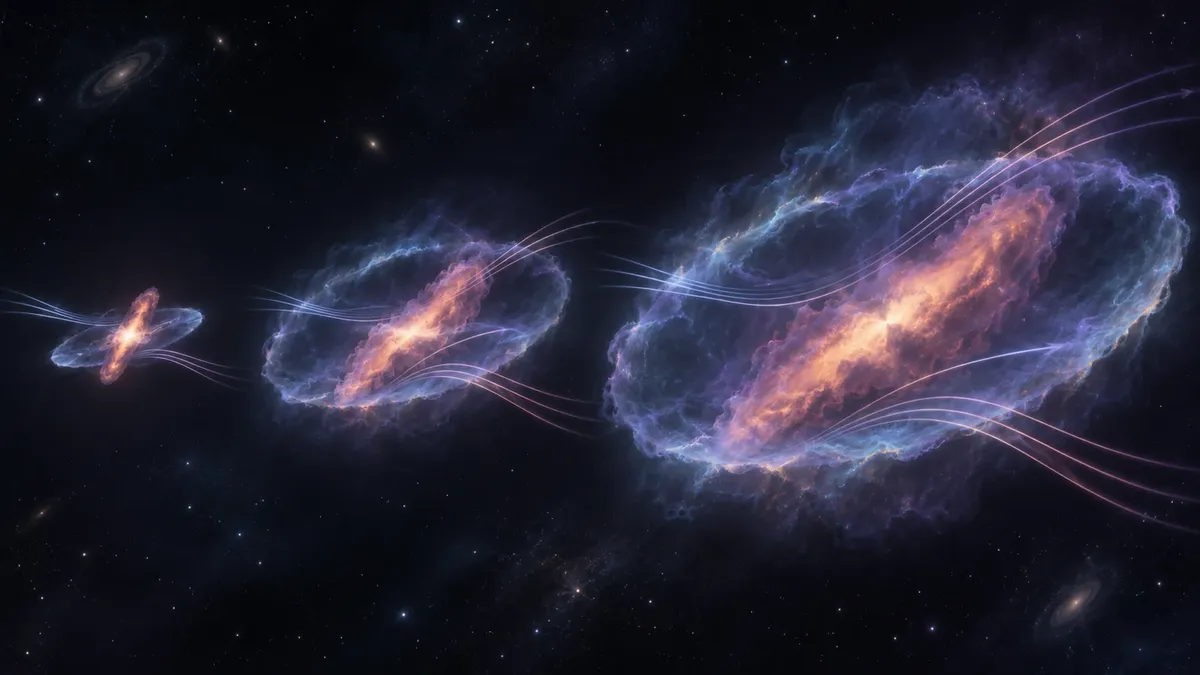
A supernova’s light can carry clues about the shape of material too distant to resolve. In observations of the rare Type Ibn event SN 2025kzr, researchers tracked how that light’s polarization changed as the explosion interacted with helium-rich gas around the star. The evolving signal is consistent with the debris and surrounding gas having differently oriented shapes—but it does not prove a specific progenitor or explosion scenario.
A supernova is far too distant for telescopes to map its expanding debris directly. But the light it emits can still reveal clues about the shape of the emitting and scattering material. In a new study of SN 2025kzr, researchers tracked those clues over time and found a changing polarization signal consistent with a possible mismatch between the orientations of the explosion’s debris and the gas around it.
SN 2025kzr belongs to the rare Type Ibn class of interacting supernovae. These explosions encounter dense, helium-rich circumstellar material (CSM)—gas shed by the star before it exploded. The interaction can make the supernova bright, while the gas’s shape and the debris’s shape may preserve different information about the star’s final mass loss and the explosion itself.
The study asks how those geometries change as the supernova’s light shifts from being dominated by interaction with the surrounding gas to coming increasingly from the ejecta, the material thrown out by the explosion. Polarization is useful here because scattering in a perfectly spherical arrangement tends to cancel out across the unresolved source. An uneven arrangement can leave a net polarization, with its direction—the polarization position angle—providing another clue to the projected geometry.
The team collected three epochs of spectropolarimetry with the Very Large Telescope, at 8, 25 and 34 days after the estimated explosion date. They combined these with two previously published epochs of V-band imaging polarimetry, giving five observations across roughly 5–34 days. Spectropolarimetry measures polarization across wavelengths, letting researchers examine both the continuum light and features associated with particular elements. They corrected for instrumental effects and estimated polarization from intervening dust, known as interstellar polarization.
The polarization changed substantially during the early transition. The combined observations show a low signal at about five days, a rise to roughly 0.6% by about day 11, and a rotation in position angle. Later, the measured continuum polarization was consistent with zero within the uncertainties. The paper interprets this fading as the visible photosphere receding into the ejecta as the expanding material became less effective at producing measurable electron-scattering polarization.
The early low signal does not necessarily mean the surrounding gas was round. The authors argue that, while the gas was optically thick, repeated scattering could have suppressed the net polarization. As the shock moved through the dense material and the optical depth fell, the geometry could become more visible. Later still, a shell of shocked material and then the ejecta increasingly influenced the signal.
To explore that interpretation, the researchers used Monte Carlo polarization calculations and a three-dimensional radiation-hydrodynamic simulation. Their illustrative picture has an oblate CSM—flattened around its equator—and prolate ejecta or a prolate cold dense shell, elongated along an axis. In the model, the axes are tilted relative to one another, allowing the dominant source of polarized light to change as the shock evolves. The calculated polarization track qualitatively resembles the observations.
That is a plausible explanation, not a unique reconstruction. The simulations use simplified, smooth ellipsoids and are intended to show how the observed pattern could arise, rather than provide a definitive fit to the supernova. Different combinations of geometry, viewing angle and optical depth can produce similar signals. The interstellar-polarization estimate also has meaningful uncertainty, and the helium-line polarization measurements are tentative rather than a firm independent geometric constraint. The data indicate changes in the projected polarization; they do not directly reveal the full three-dimensional shapes.
Nor can the polarization identify how the star made its surrounding gas. Binary mass transfer could produce an equatorially enhanced outflow, but the authors say the observations alone cannot establish that channel; other mass-loss processes remain possible. The inferred rotation also does not require the explosion itself to have been intrinsically elongated: an asymmetric interaction region around initially spherical ejecta could contribute.
The authors note similar evolving polarization signals in some other supernovae, but whether misaligned ejecta and CSM are common remains an open question. More densely sampled observations, better measurements of interstellar polarization and improved models that treat polarized radiation and complex structure more fully could test the interpretation. This account is based on an arXiv preprint, a draft that may not yet have undergone peer review; its proposed geometry should be read as a model-supported possibility, not a settled result.
- SN 2025kzr
- Type Ibn supernova
- spectropolarimetry
- circumstellar material
- supernova geometry
- stellar mass loss
Reviewed cross-references
These connections were reviewed by a model, not independently fact-checked by a human. Similarity does not imply agreement; consult the original papers and the evidence below.
Dust around a yellow hypergiant could make it look brighter than it is
Shared method: Both studies use Monte Carlo radiative-transfer modeling that includes polarized scattering: Wen et al. model supernova continuum polarization with MCPol, while Suh models dust-scattered light with RADMC-3D. The applications and scattering environments differ, so this is a methodological connection, not evidence that their geometric findings are directly comparable.
Model review: · openai-codex/gpt-6-luna
Evidence and provenance
Selected excerpts, not complete papers. PDF extraction can omit figures or damage equations, tables and reading order; sources may be preprints.
2611.33657v1 — Original paper
Excerpt reference:
static/papers/2611.33657v1.md:327-371
Basis: Paper text
Source SHA-256:253c7d36e13face928d2434cacd9978ca794d581ccf1170e9eb4b38d110a22e82611.11853v1 — Original paper
Excerpt reference:
static/papers/2611.11853v1.md:290-352
Basis: Paper text
Source SHA-256:330a7a8b8cb12b5dc43f2b98f13c79bae306411ceb0bcf3215185e51a1a12a58
Related reading
Automatically matched by shared topic keywords. These links do not imply that the sources agree or establish a consensus.
Bright supernovae reveal how surrounding gas shapes their light
Source published
Shared keywords: circumstellar material, stellar mass loss
New model estimates how aging stars replenish a nearby dwarf galaxy
Source published
Shared keywords: stellar mass loss
Reading the dust around aging stars
Source published
Shared keywords: stellar mass loss
Dust around a yellow hypergiant could make it look brighter than it is
Source published
Shared keywords: stellar mass loss