TRANSMISSION // 2611.33642v1
Twisted Photons Shift from Infrared to Visible Light
Source published
An experiment prepared single photons in orbital-angular-momentum combs of up to 128 modes and converted smaller combs from infrared to visible light, checking whether their mode populations and phases were preserved.
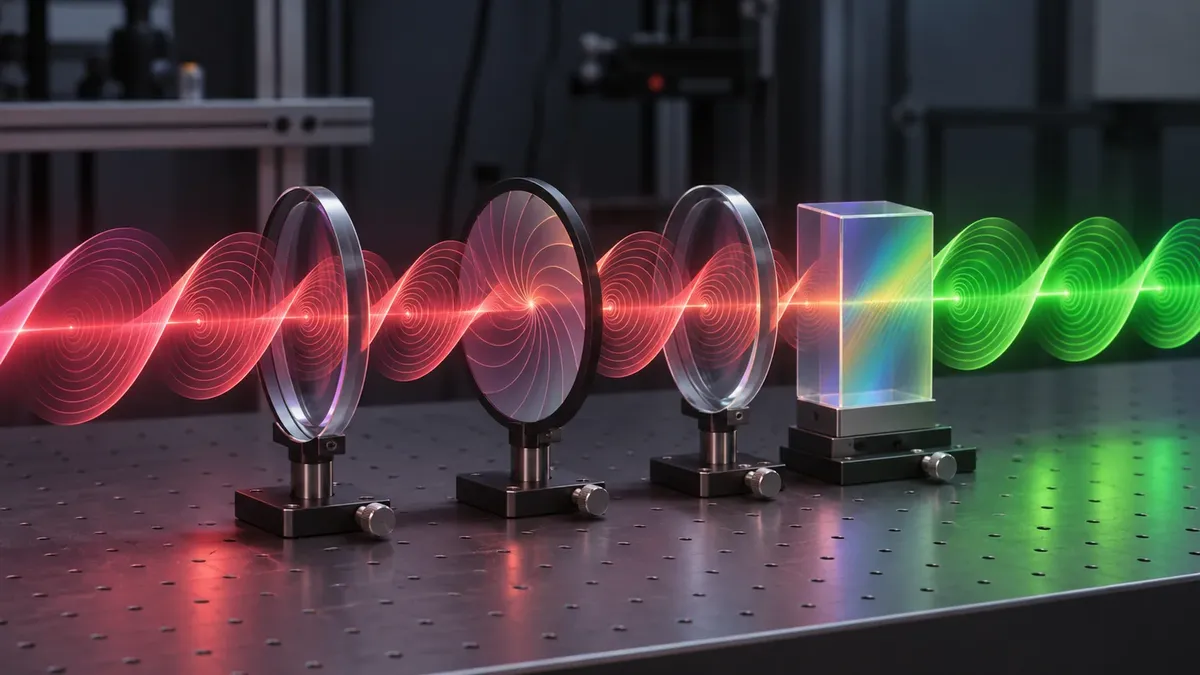
Photons can carry information in the twisting pattern of their wavefronts. Researchers prepared single photons in superpositions of many such patterns, then converted some of these states from infrared to visible light and measured how well their encoded structure survived.
A photon’s orbital angular momentum (OAM) describes a twist in its wavefront. Different OAM modes can serve as distinct states in a high-dimensional information alphabet. But creating a single photon in a controlled superposition of many modes—and changing its wavelength without scrambling that superposition—presents experimental challenges.
In a paper posted to arXiv, Sheng-Qiang Jia and colleagues report a system addressing both steps. They prepared heralded single photons in OAM “comb” states and used a nonlinear optical process to convert some of those states from infrared to visible light. This is a laboratory demonstration, not a quantum communication system or network.
Building a comb of twisted modes
An OAM comb is a superposition of modes with regularly spaced OAM values and, ideally, equal weights. The researchers generated heralded photons at 1560 nanometres. Detecting one photon from a pair signals the presence of its partner, which is used in the experiment.
To create the comb, they shaped the photon’s spatial phase. For smaller combs, patterns were displayed on a spatial light modulator. At higher dimensions, the pattern’s narrow sectors become difficult to resolve with the modulator’s finite pixels, especially near the centre. The high-dimensional arrangement used an annular input beam and a custom liquid-crystal phase plate with smaller pixels. Polarization manipulation then interleaved two shifted sets of OAM modes, doubling the number in the final comb.
The team reconstructed the photon states using projection measurements. Measurements of individual modes reveal their populations; measurements of paired-mode superpositions with different relative phases provide information about phase relationships. Together, these measurements allow the researchers to estimate a density matrix, a mathematical description of the reconstructed state.
They prepared states with dimensions up to 128. For the 128-dimensional comb, the reconstructed state’s fidelity with the target was 0.787. Fidelity measures agreement between the measured state and the intended one; it is not the fraction of photons successfully converted. The authors also report an effective dimension of about 100, defined as target dimension multiplied by fidelity. This is a summary metric, not a claim that the photon occupied exactly 100 perfectly controlled modes.
Changing wavelength and checking the state
For frequency conversion, the team combined the 1560-nanometre photon with a 780-nanometre pump in a second nonlinear crystal. Sum-frequency generation produced photons at 520 nanometres. The researchers used an annular pump intended to improve spatial overlap with the incoming OAM state. In the idealized collinear interaction described in the paper, the output OAM shifts according to the pump’s OAM. The key test was whether the encoded pattern of mode weights and relative phases survived that mapping.
The team reconstructed states before and after conversion for 4-, 8- and 16-dimensional combs—not for the 128-dimensional state. The converted states had reported fidelities with their targets of 0.901, 0.881 and 0.804, respectively. These measurements support preservation of mode distribution and phase information in the tested states. They do not show that a 128-dimensional comb was frequency-converted and characterized to the same extent.
Measurement time was a practical constraint. The paper says that, at the observed converted-photon counts, full tomography for dimensions above 16 could take more than two weeks. It also identifies finite conversion efficiency and the need for accurate mode matching as challenges. The broad claim of high-dimensional frequency conversion should therefore be read alongside the results: the largest prepared comb and the largest converted-and-reconstructed comb were different.
The work demonstrates a method for preparing a large single-photon OAM superposition and a separate, smaller-scale test of converting such states between wavelength bands. Wavelength interfaces could be useful when optical components operate in different spectral ranges, but this experiment does not demonstrate communication, storage or a network application.
This account is based on the text of arXiv version 1, a preprint; the supplied source does not establish whether it has undergone peer review. The authors say the underlying data are not publicly available but may be requested from them. These limits matter when considering how independently the reported measurements can be checked.
- orbital angular momentum
- single photons
- frequency conversion
- quantum optics
- high-dimensional states
- sum-frequency generation
Reviewed cross-references
These connections were reviewed by a model, not independently fact-checked by a human. Similarity does not imply agreement; consult the original papers and the evidence below.
A single hologram shapes twisted light into 128-dimensional states
Shared method: Both studies use spatial phase modulation to prepare high-dimensional OAM states: Jia et al. combine a custom liquid-crystal phase plate with an SLM, while Sheng et al. encode amplitude and phase in a single phase-only SLM hologram. These are related implementations, not the same preparation scheme, and their reported fidelities are not a direct comparison.
Model review: · openai-codex/gpt-6-luna
Evidence and provenance
Selected excerpts, not complete papers. PDF extraction can omit figures or damage equations, tables and reading order; sources may be preprints.
2611.33642v1 — Original paper
Excerpt reference:
static/papers/2611.33642v1.md:74-167
Basis: Paper text
Source SHA-256:75c1adc86267048832007d770a2209a5fb92a470095213314d7632fd77fbc9f22611.33704v1 — Original paper
Excerpt reference:
static/papers/2611.33704v1.md:60-117
Basis: Paper text
Source SHA-256:52f54af359acddea448be1241ffab8f7073c75ae8714c2cac270aa0aefc42891
Related reading
Automatically matched by shared topic keywords. These links do not imply that the sources agree or establish a consensus.
Why single photons can build interference fringes
Source published
Shared keywords: quantum optics
A theoretical route to few-photon diodes
Source published
Shared keywords: quantum optics, single photons
Can one photon make a better quantum sensor?
Source published
Shared keywords: quantum optics, single photons
How researchers reconstruct the states in twisted light
Source published
Shared keywords: quantum optics
A cryogenic circuit reads photon number in real time
Source published
Shared keywords: quantum optics