TRANSMISSION // 2611.33624v1
Two early galaxy neighborhoods reveal different paths of growth
Source published
JWST observations of two galaxies about 12.5 billion years ago find contrasting distributions of stellar mass: one has more mass in its companions, the other in the central galaxy.
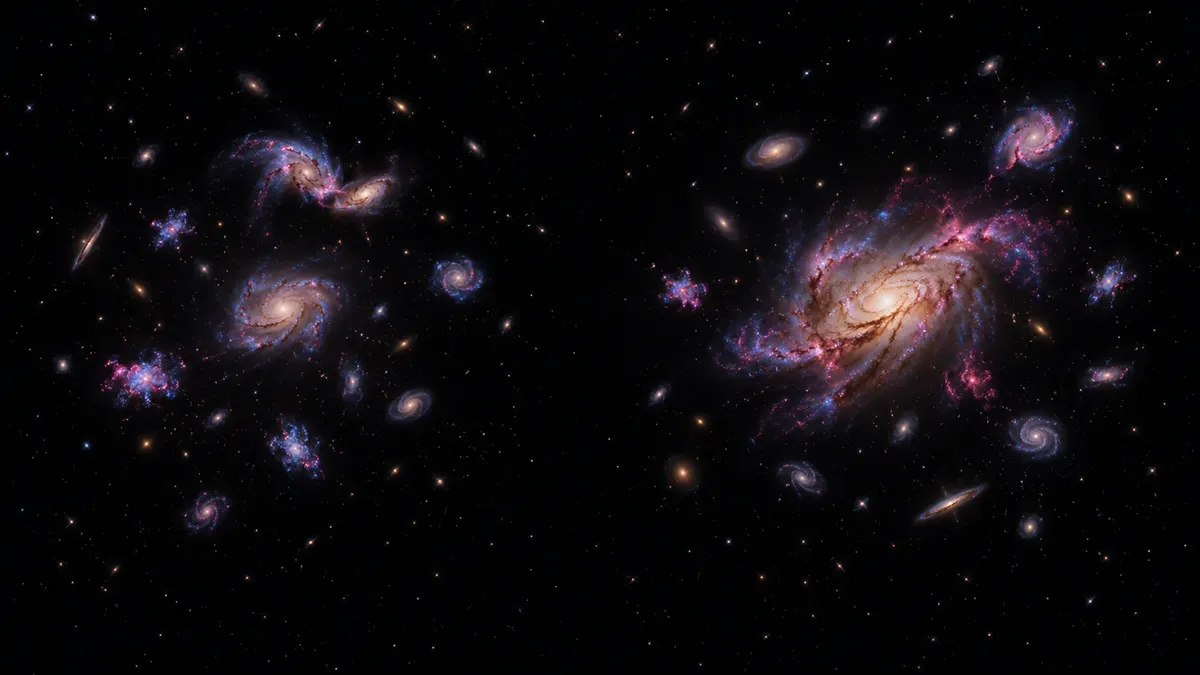
How does a young galaxy grow—and how much of its neighborhood is growing alongside it? A study using JWST spectroscopy and ALMA data compares two galaxies at redshift 5.2. Both lie in overdense regions, but their measured stellar mass is distributed differently between each central galaxy and its companions.
At a time when the universe was only a small fraction of its present age, two young galaxies occupied crowded neighborhoods. Yet the galaxies at the centers of those regions show different patterns of accumulated stellar mass. CRISTAL-19 has less mass than CRISTAL-21 as a central galaxy, but its measured companions are more massive on average. CRISTAL-21 itself accounts for a larger share of the measured mass in its selected population.
The researchers examined the galaxies at redshifts 5.235 and 5.256—so distant that their light has traveled for roughly 12.5 billion years. They used slitless spectroscopy from the James Webb Space Telescope’s NIRCam instrument, which spreads light into spectra across the sky, to identify galaxies showing H-alpha emission. This light comes from hydrogen energized by nearby young stars and helps reveal actively star-forming galaxies. The team combined the spectra with multi-band imaging and existing Atacama Large Millimeter/submillimeter Array measurements.
To map the wider surroundings, the researchers used a “friends-of-friends” method: galaxies close enough in projected position and redshift were linked into groups. The analysis identified two distinct concentrations, or overdense nodes, separated by about 25 comoving megaparsecs. Comoving distance accounts for the expansion of the universe. The authors use “nodes” to describe these observed concentrations, not to formally identify them as nodes in the cosmic web.
For a closer comparison, the team selected H-alpha-emitting companions within one physical megaparsec of each target and within a specified velocity range. The sample included nine systems, resolved into 11 measured components, around CRISTAL-19 and 12 systems around CRISTAL-21. The researchers estimated stellar masses by fitting models to light across several wavelength bands, testing two fitting programs and different assumptions about how star formation changed over time. They also estimated star-formation rates from dust-corrected H-alpha emission.
The companion populations differed. Their median stellar masses were about 10^9.43 and 10^8.82 times the Sun’s mass around CRISTAL-19 and CRISTAL-21, respectively. Median dust-corrected star-formation rates were about 31 and 16 solar masses per year. The authors argue that the higher absolute rates around CRISTAL-19 largely reflect its more massive companions, rather than a strong boost in star formation at a given mass. In a separate comparison using 100-million-year average rates and mass-matched field galaxies, the reported offsets were modest.
The clearest contrast is how the measured stellar mass is apportioned. CRISTAL-19 itself accounts for about 4.5% of the combined measured mass of the target and selected companions; CRISTAL-21 accounts for about 39%. In other words, more of the measured mass remains in separate galaxies around CRISTAL-19, while a greater fraction resides in CRISTAL-21. Resolved companion systems around CRISTAL-19 show possible interactions. CRISTAL-21’s disturbed gas morphology and kinematics are consistent with an interaction or late-stage merger. These clues support a difference in assembly state, but they do not establish a complete history for either galaxy.
There are important limits. The companion samples include selected, detectable H-alpha emitters, not every galaxy in either environment; one CRISTAL-19 companion also lacks a matching mass estimate. Some density comparisons have overlapping uncertainty intervals. Bootstrap estimates do not capture all uncertainties, including systematics from modeling galaxy light and incompleteness. Possible future cluster masses rely on assumptions about which selected members will assemble into a common halo. Those estimates are illustrative, not predictions that either target will become a brightest cluster galaxy.
The main target comparison concerns two environments, so it cannot establish how common either pattern is across early galaxies. The paper also makes comparisons with field and photometric samples, which provide context but do not remove that limitation. This work is a preprint submitted to the American Astronomical Society; the available source does not establish that it has been peer reviewed. Its central result is a measured contrast: in these two regions at similar cosmic epochs, the more massive central galaxy does not have the more massive companions.
- JWST
- early galaxies
- galaxy environments
- galaxy mergers
- star formation
- ALMA CRISTAL
Related reading
Automatically matched by shared topic keywords. These links do not imply that the sources agree or establish a consensus.
Webb probes the chemistry of a galaxy near cosmic dawn
Source published
Shared keywords: early galaxies, star formation
Fading galaxies could reveal why the early universe looks so bright
Source published
Shared keywords: early galaxies
Can Top-Heavy Stars Explain JWST’s Bright Early Galaxies?
Source published
Shared keywords: early galaxies
AMORE6 offers clues to possible primordial stars
Source published
Shared keywords: early galaxies
How unstable disks may build clumps in early galaxies
Source published
Shared keywords: early galaxies