TRANSMISSION // 2611.33617v1
A shared design language for fluid rotors
Source published
VaneCraft uses explicit geometric controls to generate rotor CAD, recover parameters from existing models and support further edits.
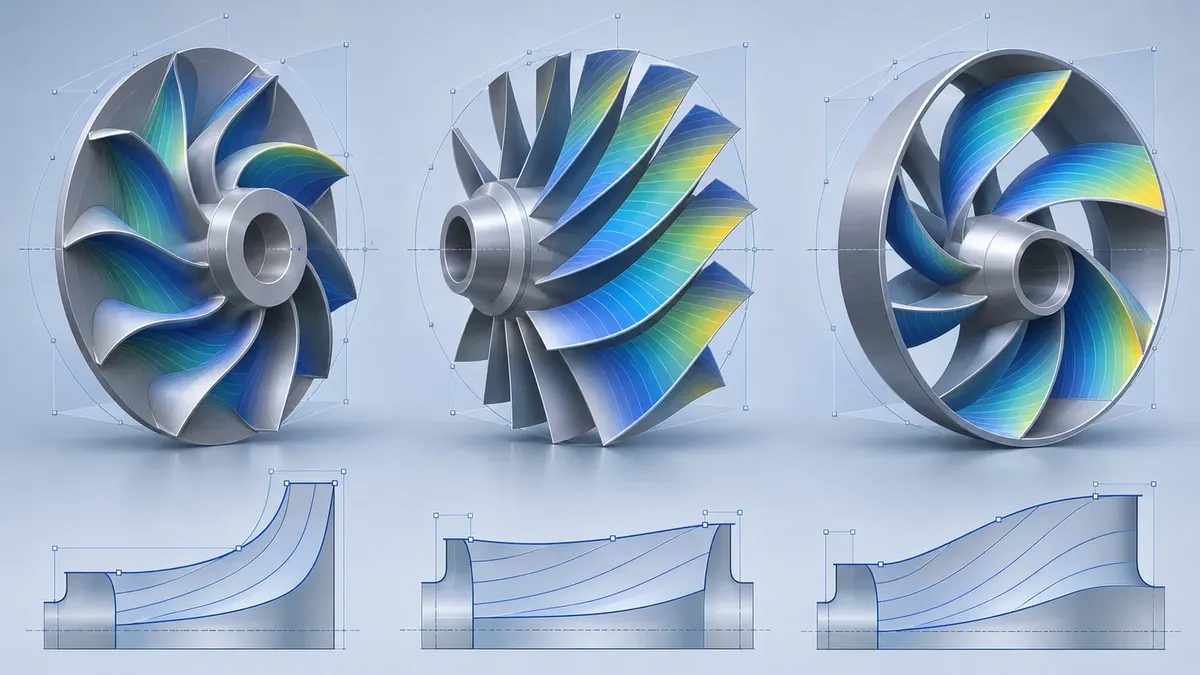
Fluid rotors can be difficult to design consistently because different configurations often call for different modeling procedures. VaneCraft, a framework described in an arXiv preprint, aims to make rotor geometry easier to generate and revise by representing it through shared design parameters.
Why rotor design is a CAD challenge
A rotor’s shape is not just a collection of surfaces. Blade count, thickness, inlet and outlet angles, and curved hub and outer profiles all contribute to its geometry. Yet many computer-aided design (CAD) formats describe a model as surfaces, mesh elements or construction steps, rather than exposing those design choices directly. That can make it difficult to translate an instruction such as “change the inlet angle” into a coordinated edit—or to reuse an existing model for a new design.
The researchers behind VaneCraft set out to connect rotor design intent to editable CAD. Their framework uses one shared set of geometric controls for generating rotors, recovering controls from existing CAD, and making later changes.
A parameter-based route from request to blade
VaneCraft’s agent interprets a design request and calls geometry tools. Its design state includes the rotor category and geometric parameters. A design can start from supplied dimensions or, when operating conditions are given, use sizing procedures and presets to initialize its geometry.
The blade representation separates two kinds of geometry. A meridional profile describes the blade’s axial and radial outline. Angle laws specify how the blade turns around the shaft along the hub and shroud boundaries. At the inlet and outlet, values are interpolated between those boundaries; they are not separate prescribed boundary laws.
A partial differential equation (PDE) propagates the boundary angles across the blade’s interior. Its anisotropy parameter, κ, shifts how that interior is shaped while keeping the prescribed boundary values fixed. As κ increases, the interior approaches spanwise interpolation between hub and shroud angles. As κ approaches zero, it approaches chordwise interpolation between inlet and outlet values. The resulting surfaces are assembled into CAD. The system checks for problems including inadmissible configurations, crossing surfaces, invalid solids and splitter interference.
The team also developed geometric parameter correction (GPC), an optional refinement step. An encoder processes an initial blade mesh and its profiles; a decoder predicts adjustments to geometric controls. The revised controls then pass through the PDE-based construction. GPC can refine an initialized design, but it is not required for every generation.
VaneCraft also attempts to recover the shared controls from existing STEP models or STL meshes. The recovered parameters can be used to rebuild the blade and continue editing. In the reported workflow, saved design states allow a partial change—such as adjusting blade count or an angle—while retaining other parameters. This describes a system capability, not a guarantee that every model or edit will succeed.
What the tests report
The authors evaluate geometric generation, parameter correction, inverse recovery, editing, angle-field control and computational fluid dynamics (CFD). GPC training used SHIFT-Pump data for closed rotors, ParaturboCAD for semi-open rotors and the NASA Rotor37 dataset for fully open rotors.
Under the paper’s geometric-comparison protocol, VaneCraft had the highest intersection-over-union score and the lowest Chamfer and Hausdorff distances among the listed methods in the aggregate comparison. These metrics compare aligned generated shapes with reference geometries; they do not establish that a rotor is the best engineering design.
The GPC ablation results are more nuanced than a simple across-the-board gain. Table 1(b) reports that full GPC had the highest IoU and slightly lower Chamfer and Hausdorff distances than GPC without surface loss. Compared with template initialization without GPC, however, full GPC had higher IoU but slightly higher Chamfer and Hausdorff distances. The paper’s accompanying prose describes improvements across metrics, which does not match that comparison in the table.
The authors also show that changing κ shifts the interior angle field while holding boundary values fixed. For CFD, five simulated cases report absolute head errors from 0.05 to 2.55 metres. These are simulations of selected generated designs, not experimental tests of physical rotors. The reported cases do not establish how performance would hold under other operating conditions.
A separate evaluation used 200 design cases—40 per configuration—across five language-model systems, with matched tasks involving generation, recovery and modification. Adding sizing tools, presets and parameter references improved reported pass rates and geometry compliance for some models. With support, four models scored 1.000 on both measures; qwen3.8-max scored 0.974 for task accuracy and 1.000 for geometry compliance. Some models already scored 1.000 on one or both measures without support. These results reflect the combined system and its tools, not language models in isolation.
What remains uncertain
The preprint presents a technical demonstration of a shared, editable representation for several rotor configurations. It does not establish that every rotor can be recovered or generated reliably, or that CAD validity and similarity to a reference amount to manufacturing readiness or proven performance. The CFD results are simulations, and the paper does not establish how broadly they apply beyond the selected cases.
This account is based on the authors’ arXiv preprint. Its results are the authors’ reported experiments, not independent confirmation or evidence of scientific consensus.
- VaneCraft
- rotor CAD
- fluid machinery
- parametric design
- inverse CAD recovery
- computational fluid dynamics
Reviewed cross-references
These connections were reviewed by a model, not independently fact-checked by a human. Similarity does not imply agreement; consult the original papers and the evidence below.
An AI CAD system plans mechanical operations instead of writing long programs
Shared method: Both describe an agent using language-model decisions to coordinate CAD operations: VaneCraft’s agent selects generation, recovery, or editing operations, while GOPR-CAD’s agent progressively builds a graph of executable operations. Their representations and tasks differ—rotor-specific parameter editing versus general mechanical-part text-to-CAD—so this is a shared agent-and-tool workflow, not evidence of comparable performance.
Model review: · openai-codex/gpt-6-luna
Evidence and provenance
Selected excerpts, not complete papers. PDF extraction can omit figures or damage equations, tables and reading order; sources may be preprints.
2611.33617v1 — Original paper
Excerpt reference:
static/papers/2611.33617v1.md:79-204
Basis: Paper text
Source SHA-256:f5f716ae9c7c00d6dd2b78dcde51c835187ad8c7e88792b0b62e65bf5fc0d09f2611.11470v1 — Original paper
Excerpt reference:
static/papers/2611.11470v1.md:82-143
Basis: Paper text
Source SHA-256:c1528dbcd6b71254a46682a447189be4aa8ec31c17487fbf224014fb0e4caee0
Related reading
Automatically matched by shared topic keywords. These links do not imply that the sources agree or establish a consensus.
How WingBench evaluates AI design search
Source published
Shared keywords: computational fluid dynamics
A quantum solver designed to preserve fluid-flow constraints
Source published
Shared keywords: computational fluid dynamics
FastAgent uses rapid physics screening to target detailed simulations
Source published
Shared keywords: computational fluid dynamics
A neural operator targets fine-scale airflow around cars
Source published
Shared keywords: computational fluid dynamics
Using AI Disagreement to Improve Microdroplet Design
Source published
Shared keywords: computational fluid dynamics